
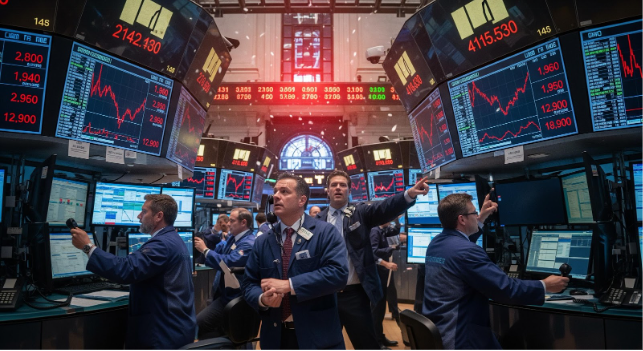

Surprisingly, stock market optimism soared this year despite President Trump’s initial tariff announcements last April. The S&P 500 and Nasdaq both hit record highs in July, fueled by tech gains, stimulus-driven liquidity, and expectations of rate cuts. Investor confidence remained strong through geopolitical tensions, rate policy uncertainty, and inflationary pressures. Broad participation across sectors has led many to declare the start of a new bull market. However, that surge in confidence may be masking deeper structural risks. Three major warning signs indicate that a market correction in stocks could happen soon.
3 Signs Of An Impending Market Correction
Alexandria Wilson-Elizondo, co-CIO of multi-asset solutions at Goldman Sachs, told CNBC this week that the current stocks rally may prove unsustainable in the long run. She said the market is due for “a little bit of a correction,” and added that this could provide a re-entry opportunity for institutional portfolios. But the following three signs suggest more than just a routine dip:
1. Investor Sentiment Is Overheated
The first sign is rising investor risk appetite. A new Bank of America fund manager survey shows global sentiment jumped from 3.3 to 4.3 in July. That’s the highest level since Trump’s second inauguration. Consequently, many fund managers have largely dismissed fears of a recession. The same survey showed that 59% said they believe a global recession is unlikely.
This kind of optimism, while positive in moderation, tends to signal late-cycle dynamics. Historically, extreme bullishness has often preceded sharp reversals. When sentiment climbs too fast, it can detach from economic fundamentals and leave the market vulnerable to shocks.
2. Retail Buying Is Surging
Retail investors have poured into the stock market at rates not seen in years. Wilson-Elizondo noted that retail purchases reached $50 billion in the past month alone. Barclays and JPMorgan data suggest retail investors are on pace to buy $360 billion worth of equities by the end of the year.
The danger here lies in fragility. Retail investors tend to follow momentum and often exit quickly when volatility spikes. If the labor market weakens or interest rates fail to fall as expected, retail money could rush out just as fast as it came in. Goldman warns that a “stall speed” in hiring could trigger a feedback loop that raises unemployment and depresses market demand.
3. Volatility Metrics Are Rising
While risk appetite and retail flows dominate headlines, another less visible signal is flashing red: the Volatility Index (VIX). This tracks expected price swings in the S&P 500 based on options market activity. Often called Wall Street’s “fear gauge,” it tends to rise when investors expect market instability.
Under normal conditions, the VIX moves in the opposite direction of stock prices. When markets rise steadily, volatility usually falls. But recent data from the CBOE and Bloomberg show the VIX rising even as major indexes remain at or near record highs. This rare divergence signals that institutional investors are hedging against potential downside, even as the broader market appears calm.
How Should Investors Respond?
The uptick in volatility, combined with frothy sentiment and aggressive retail buying, reflects increasing nervousness among professional investors. Historically, this pattern has appeared before past market corrections, particularly when the surface-level rally hides growing concern underneath.
Goldman Sachs maintains a long-term bullish view, supported by potential Fed rate cuts and tax stimulus. Still, short-term risk factors are mounting. Overconfidence, reactive buying, and growing hedging activity make the current rally look increasingly fragile.
Other firms including HSBC, Evercore ISI, and Pimco have echoed similar caution. While timing a correction remains difficult, the convergence of these three indicators suggests investors should reassess their risk exposure. Staying liquid, limiting leverage, and holding defensive positions may prove prudent as the second half of 2025 unfolds.
Which indicator do you believe is the most reliable sign a market correction is approaching? Tell us what you think.