
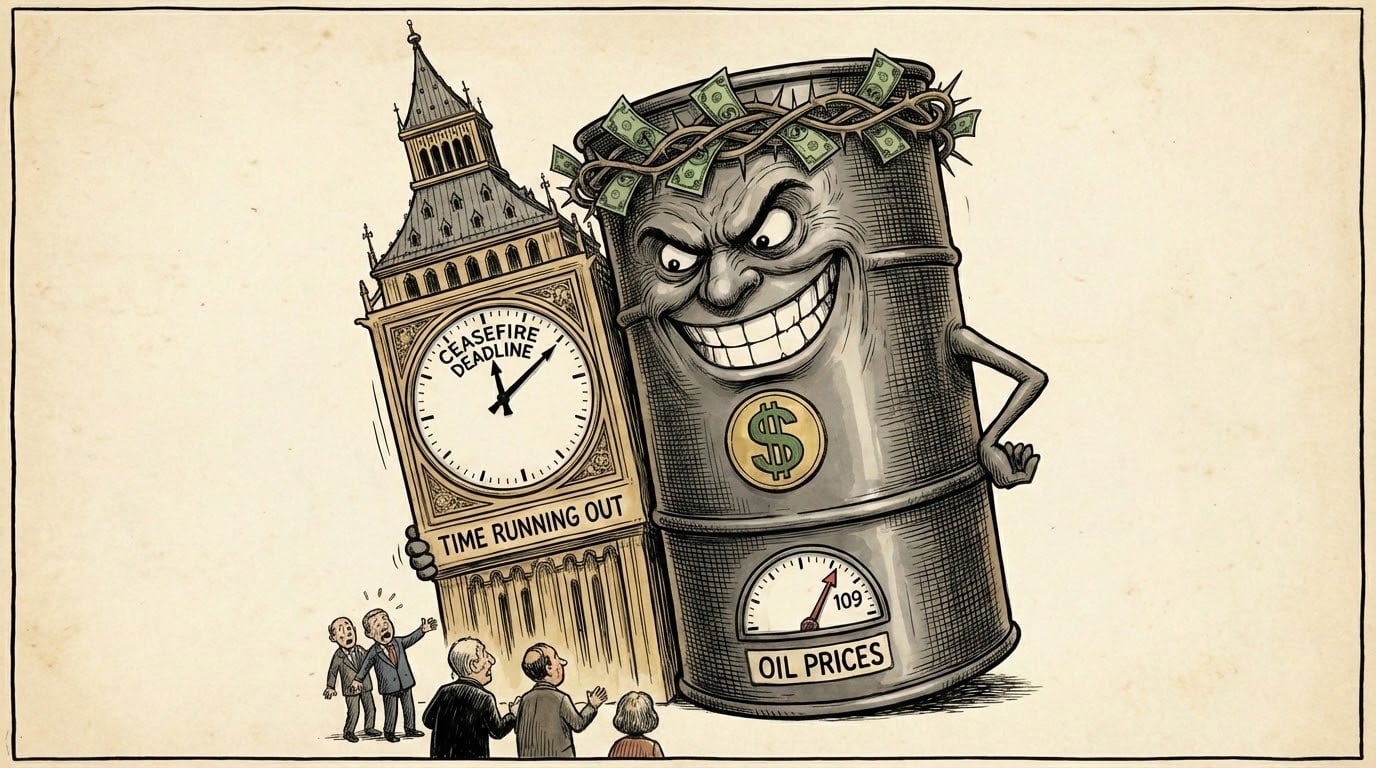

Quick Summary: The $109 oil shock forces a binary market pivot. If the ceasefire holds, energy equities will retreat while consumer discretionary stocks will rally. If talks fail, expect a spike in structural inflation toward 4%, dragging the S&P 500 toward 5,400. Investors must audit energy exposure and shift to inflation-protected assets like TIPS to mitigate geopolitical supply risk.
Tonight at 8 p.m. ET, an oil shock clock runs out.
The U.S., Iran, and regional mediators are discussing terms for a potential 45-day ceasefire that could end six weeks of war and reopen the Strait of Hormuz to global oil traffic. Analysts say that the chances of a deal in the next 48 hours are low. If talks collapse and the administration follows through on its threat to strike Iranian energy infrastructure, you will wake up tomorrow to a different market than the one you went to sleep in.
Here is what that market looks like, and the three moves that matter before it opens.
Oil Shock: How The Markets Arrived at This Situation
The U.S.-Iran war began on February 28. Oil prices surged from $67 to over $111 per barrel, the fastest spike in more than 40 years. The reason is simple: the war has effectively closed the Strait of Hormuz, a waterway that serves as a transit route for about 20 million barrels of oil per day, representing more than 20% of global supply.
Brent crude has rocketed nearly 80% in 2026 to almost $110 a barrel. WTI, the U.S. benchmark, soared nearly 95% to over $112. The average nationwide price of unleaded gas surpassed $4 per gallon this week for the first time since 2022, with gallon prices jumping more than $1 over the last month. The energy sector has been the top-performing sector in 2026, gaining around 40%. Everything else is fighting the headwind.
The stock market has held together better than many expected. The S&P 500 has declined roughly 6% since the start of the conflict. But under the surface, the pressure is building. Goldman Sachs strategists recently warned that persistent disruptions to global oil supplies could drag the S&P 500 down to 5,400 in 2026, a 22% decline from its January peak of 6,979. Bank of America analysts expect soaring energy prices to push headline inflation to nearly 4% year-over-year in the coming months.
This is not noise. This is a structural problem with two possible outcomes tonight.
Two Scenarios, One Portfolio Response
The April 6, 8 p.m ET deadline has two likely outcomes:
Scenario A: The ceasefire holds, Oil Shock subsides.
The oil shock drops hard. Energy stocks give back a portion of their 40% year-to-date run. The rest of the market rallies. Airlines, consumer discretionary, and industrials lead. The S&P 500 claws back toward 6,800. If this happens, the worst move you can make is chasing the energy sector on the way down to cover a position you should have trimmed two weeks ago. The second-worst move is panic-buying everything that rallied.
Scenario B: Talks fail, the deadline passes, Oil Shock intensifies
The market impact is not simply about oil prices. It is about what surging energy costs do to the broader economic environment. Inflation is set to rise sharply as energy price spikes feed through to transport, manufacturing, and household bills. That inflationary pressure may force central banks to keep interest rates higher for longer at precisely the moment when economies need relief.
Stocks, bonds, and gold fell simultaneously when the Strait first closed, with traditional safe havens failing for the second time in four years. If escalation resumes, that pattern likely repeats.
Here is what investors keep getting wrong. They treat these two scenarios as opposites that require opposite portfolio moves. They don’t. The right portfolio survives both, and it isn’t built the night the deadline expires.
What the Experts Are Saying (And Where They Disagree)
The financial establishment is split on how to respond, and you deserve to hear both sides directly.
One camp points to history as the argument for doing nothing. Across 40 major geopolitical events spanning 85 years, the S&P 500 lost an average of 0.9% in the first month but recovered to gain 3.4% over the following six months. Their case: this will pass, it always does, and selling is the mistake.
The other camp makes a harder argument. Brent crude near $109 is not just a geopolitical headline. It is an inflation delivery mechanism. Every dollar oil holds above $85 is a tax on every business that ships, manufactures, or transports anything. That tax goes directly into the inflation number that the Federal Reserve is trying to control. And the Federal Reserve, as of today, has its hands tied.
The stay-the-course argument is historically valid during moderate shocks. But this environment stacks a war-driven supply disruption on top of a CAPE ratio at 39.8, the second-highest reading in 150 years of market history, with a Fed that cannot cut rates without ignoring inflation. That is a different regime than the 40-event average. The historical recovery data assumes you can afford to wait. At peak valuations with no Fed cushion, that assumption deserves harder scrutiny.
What The Oil Shock Means for Your Investments
At this point, you have a couple of options to protect your investments:
Move 1: Audit your energy sector exposure before 9:30 a.m. tomorrow.
In an inflationary environment driven by energy supply shocks, the energy sector has historically helped offset the effect, since higher oil prices tend to support the earnings of energy producers. This is exactly why broad sector diversification across a portfolio can help cushion unexpected macroeconomic developments.
If you have zero energy sector exposure right now, you have been entirely unprotected during the biggest sector run of 2026. That does not mean chase it today. It means evaluating whether your diversification was actually built for this kind of oil shock.
If you are already overweight energy after the 40% run, a ceasefire tonight cuts that position’s value quickly. Know your exit before the market tells you.
Move 2: Understand what you own in the bond portion of your investments.
Goldman Sachs Research notes that after 15 years of innovation driving balanced portfolio returns, the average investment portfolio is now overweight innovation and does not have enough assets that protect against inflation. Their framework: one-third in innovation exposure, one-third in inflation protection covering real assets, infrastructure, and TIPS, and one-third in risk mitigation.


Rising oil prices push headline inflation higher, complicate Federal Reserve policy and delay rate cuts, compress consumer spending power, and increase input costs across energy-intensive industries. At the same time, energy equities, commodities, gold, and certain real assets tend to appreciate during oil shocks, which is precisely why holding them alongside domestic large-caps matters.
If your “safe” allocation is entirely in intermediate-term bonds, run a stress test on what happens if inflation prints above 4% with no rate cuts coming. The answer is not comfortable.
Move 3: Build a written plan for both scenarios tonight, before the market opens.
Write it down now. If the ceasefire holds and oil drops to $85, you will do X. If talks fail and oil spikes to $125, you will do Y. The specific action matters less than deciding the emotional weight of a market open that forces you to react without a plan.
The investors who lose money in moments like this are rarely the ones who made the wrong call. They are the ones who made no call, watched the headlines, froze, then acted at the worst possible moment when the pain became unbearable.
The $109 Oil Shock Bottom Line: Ceasefire Good for Stocks and Bad for Energy Holdings
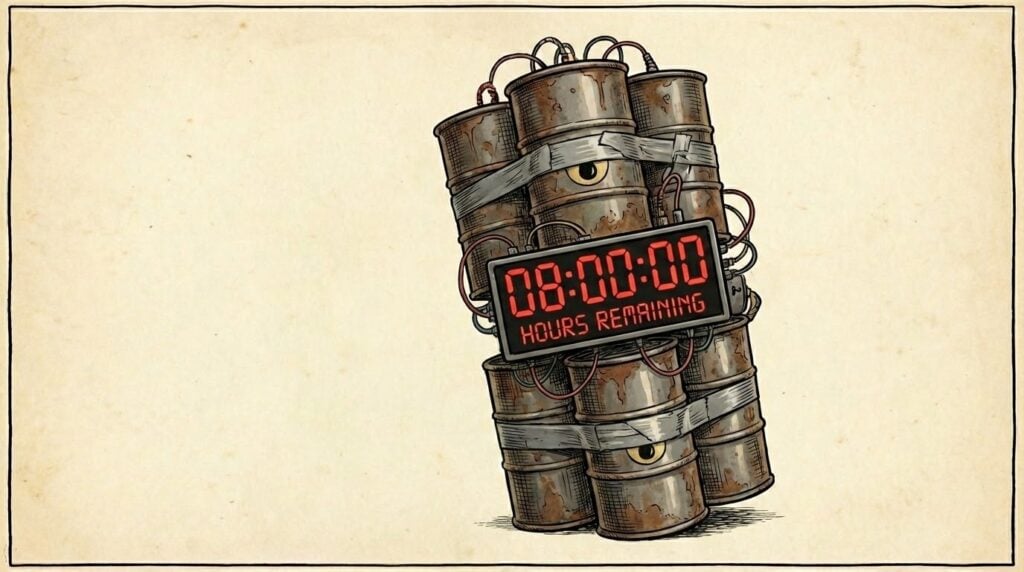
A ceasefire tonight is good for stocks and bad for energy holdings. No deal is the reverse, and likely worse. Neither outcome is catastrophic for a well-structured set of investments. Both outcomes are dangerous for a portfolio that was never built to handle inflation, concentrated tech exposure, and no Fed buffer simultaneously.
The uncertainties about the direction, duration, and effects of this war and the resulting oil shock are still unresolved and perhaps have grown as we start April. The questions you need to answer are about where you fall on the continuum between complacency and full-blown panic.
Know which scenario your investments were built for. If the answer is only the last three years of calm markets, tonight is the right time to find out.
How are your investments positioned going into tonight’s ceasefire deadline? Tell us what you think!
FAQ
Will a ceasefire lower gas prices and remove the oil shock immediately?
A ceasefire would likely cause an immediate drop in Brent crude futures, potentially toward $85. However, retail unleaded gas prices, which recently surpassed $4 per gallon, typically lag behind futures markets. The speed of the decline depends on the stabilization of traffic through the Strait of Hormuz.
What are the best stocks to hold during an oil shock?
Energy producers and commodity-linked equities typically provide the strongest hedge during supply-driven shocks. Conversely, airlines, industrials, and consumer discretionary sectors face the highest headwinds due to rising fuel and logistics costs. Diversification into “Real Assets” is mandatory for mitigating 2026 volatility.
How does the $109 oil price affect Federal Reserve policy?
Sustained oil prices above $100 per barrel increase input costs across all energy-intensive industries, complicating the Federal Reserve’s ability to cut rates. This inflationary pressure often forces a “restrictive” monetary stance even during periods of slowing equity growth, increasing the risk of a “hard landing” for the economy.
THE CAPITALIST DISCLAIMER: For educational purposes only. Not financial advice. All investing involves risk, including the possible loss of principal.