
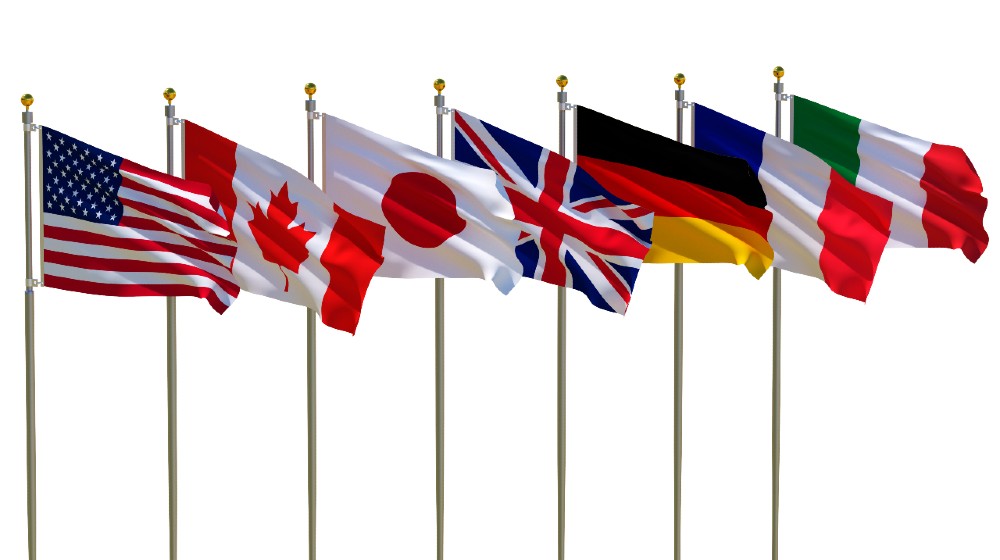

The Group of Seven (G7 Nations) democracies agreed Saturday to support a global minimum corporate tax of at least 15%. This aims to deter multinational companies from avoiding taxes by registering in countries with lower tax rates and declaring profits there.
RELATED: Biden Coming After Tax Loopholes For The Ultra-Rich
G7 Nations Finance Ministers Meeting
During the recent G7 Nations finance ministers meeting in London last week, also endorsed additional tax proposals. This includes making large companies, including US tech giants, pay taxes in countries where they have no offices but make sales.
G-7 finance ministers meeting in London also endorsed proposals to make the world’s biggest companies — including U.S.-based tech giants — pay taxes in countries where they have lots of sales but no physical headquarters.
US Treasury Secretary Janet Yellen
US Treasury Secretary Janet Yellen, the primary US delegate, hailed the agreement. She said that the G7 nations’ agreement “provides tremendous momentum” towards reaching a global deal.
This can help end “the race-to-the-bottom in corporate taxation, and ensure fairness for the middle class and working people in the US and around the world.”
In a press conference on Saturday from London, she said members of the G-7 agreed “the post-pandemic world must be fairer, especially with regard to global taxation. I think we will end up with a tax system that is much fairer,” Yellen added.
In particular, Yellen said that the details remain a work in progress. Afterward, the proposal will go through the larger Group of 20 for approval. In addition, Yellen said she believes they’ll reach a preliminary agreement with the larger group by July.
International Discussions
The tax issue discussions gained movement earlier this year when President Joe Biden backed proposals for a global minimum tax of 15% on corporate profits.
“The G-7 finance ministers have made a significant, unprecedented commitment today that provides tremendous momentum towards achieving a robust global minimum tax at a rate of at least 15%,” Yellen added.
For the next step involving the Group of 20, it won’t be as easy to get consensus. The measure will need support from leading economies outside of G7 nations like China and India.
It will also need the okay of 135 other countries. These nations are part of the Inclusive Framework that joined the negotiating table. Treasury chiefs from the G20 will meet in Venice on July 9-10.
Cooperation Needed
For the measure to succeed, countries that traditionally offer lower taxes below 15% must agree. Ireland is among the prominent of these countries and boasts a 12.5% corporate tax rate.
As a result, the country is home to a number of pharmaceutical and big tech companies. This early, Ireland already declared they prefer to keep their rates intact. “Any agreement will have to meet the needs of small and large countries, developed and developing,” Irish Finance Minister Paschal Donohoe wrote in a tweet Saturday.
Meanwhile, the US Congress can potentially gum up the works. Countries with parliamentary systems can perform better and turn the measure into a law immediately.
For the US, however, a razor-thin Democratic majority is vulnerable to Republican obstruction efforts. As long as the US remains immobile on the tax measures, other countries may delay their implementation as well.
Watch the Reuters news video reporting that G7 nations agree to tax big firms and squeeze havens:
Do you agree that large companies should pay uniform tax regardless of headquarters location? Also, do you think large corporations will accept these proposals hands down?
Let us know what you think about companies’ practice of paying the lowest tax rates. Share your comments below.