


The account balance looks great. That’s part of the problem.
If you set a target allocation and haven’t touched it since the S&P 500 was trading well below current levels, your portfolio has almost certainly moved. US small caps gained over 22% in the first half of 2026, their best first-half performance since 1991, while large caps trailed by 12 percentage points. Meanwhile, gains within the large-cap index were concentrated in semiconductor stocks, raising concerns about index concentration and sector risk. If your equity holdings tracked either of those runs, you’re now more concentrated than your original plan intended.
A portfolio that started at 60% equities and hasn’t been rebalanced since 2023 is likely sitting at 68 to 72% equities today, running more risk than any financial plan assumed.
That’s not a market prediction. It is arithmetic. “The main reason for rebalancing is to control risk, not necessarily to improve returns,” Morningstar portfolio strategist Amy Arnott said in late June 2026. “As you get older, you have a much smaller margin of safety leading up to retirement and then actually in retirement. It’s definitely important to rebalance on a regular schedule.”
That’s the argument for doing this now, before Q3 adds another leg and the gap between where you are and where you planned to be gets wider.
Portfolio Drift Turned a 60/40 Allocation Into 70/30 Without a Single Decision
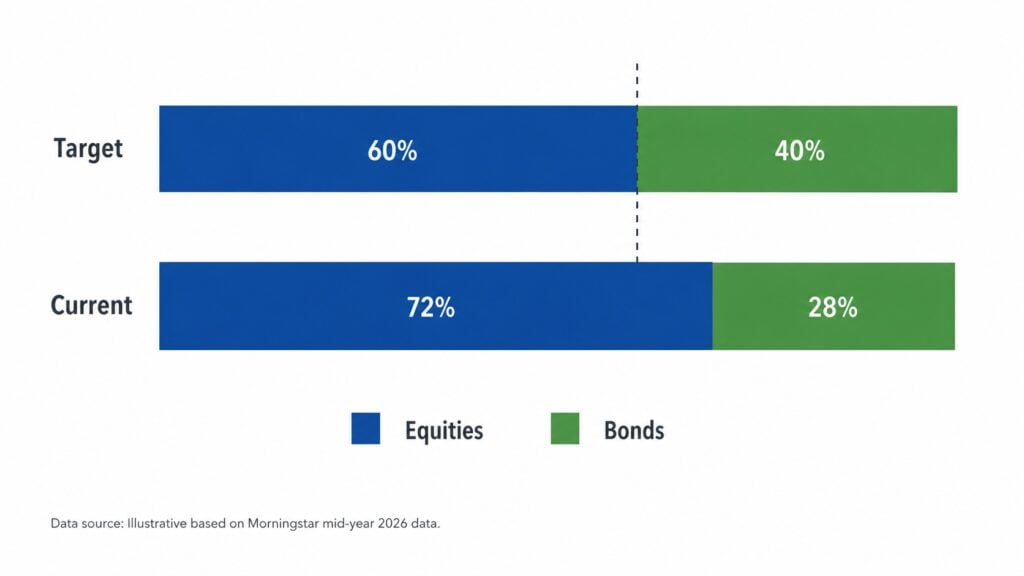
Portfolio drift isn’t dramatic. It doesn’t show up as a red number. It shows up as a percentage.
A portfolio built at 60% equities and 40% bonds in 2023 doesn’t stay at 60/40. The S&P 500’s capitalization-weighted index gained 25% over the past two years, driven almost entirely by a handful of mega-cap growth stocks. The so-called Mag 7 generated 53.7% of total return while making up only about a third of the index’s weight. The math is mechanical: the equity side of a 60/40 portfolio that rode those gains is probably sitting somewhere between 68% and 72% equities today, depending on when it was last touched.
A portfolio that allocates 60% stocks and 40% bonds will not stay this way on its own. During a bull market, stocks outperform, and the allocation drifts upward. This happened to many retirees between 2020 and early 2022, as equities surged while bonds stagnated. Portfolios designed to be more moderate became aggressive without any conscious decision-making.
“You are now taking on more risk than you intended.” That sentence deserves to sit for a moment before moving on.
Two Points of Clarity Before Any Portfolio Change in 2026
Before adjusting anything, two questions have to be answered in this order.
First question: What is your actual current allocation?
Log into each account separately. Pull the dollar amounts by asset class, not by account. Combine them. Calculate what percentage is equities, what percentage is fixed income, what percentage is cash or alternatives. Do this across all accounts, including the 401(k) that gets ignored because it rebalances “automatically” in a target-date fund.
Compare that number to your written target allocation. If there’s no written target allocation, that’s the first problem to solve before the second.
Second question: Where are you in the sequence?
An investor in year 10 of a 40-year accumulation window runs a different calculation than an investor in year 3 of retirement. Investors with long runways to draw down from their investment portfolios, say 25 or more years before they plan to retire, may not have the same pressing need to rebalance as those within 10 to 15 years of retirement.
- If you’re more than 15 years from retirement: check annually and trim when any asset class drifts more than 5 percentage points from target.
- If you’re within 10 years of retirement: the bucket structure comes first. Confirm that 18 to 24 months of living expenses sit in cash or short-term instruments before touching equity percentages. Rebalance from equities into intermediate bonds only in up-market years. This is an up-market year.
- If you’re already in retirement: you’re not rebalancing to improve returns. Withdrawals typically come from whatever is convenient, often from bonds, which accelerates the shift toward stocks. A retiree drawing down 4% annually from the bond side of a 60/40 portfolio while stocks appreciate is effectively rebalancing in reverse, increasing equity exposure at exactly the wrong time.
Tax-Sheltered Accounts, New Contributions, and Loss Harvesting: The Correct Rebalancing Sequence
The most tax-efficient rebalancing sequence is: tax-sheltered accounts first, new contributions second, taxable sales last.
The sequence matters because taxes are real and contribution flow is a tool.
Step 1: Start with tax-sheltered accounts before you rebalance your investment portfolio
If the rebalance involves selling appreciated equity positions, do it inside the 401(k) or IRA first. To the extent that you’re rebalancing, concentrate those efforts in your tax-sheltered accounts where you can sell appreciated securities, swap into something else, and not owe any taxes to do so, as long as all the money stays within that IRA or company retirement plan.
Step 2: Use new contributions before selling anything in taxable accounts.
This is the move most investors skip because it’s slower than just trimming the winner. It’s also cheaper. If a targeted 60/40 equity-debt allocation drifts to 75/25 after a rally, an investor can direct all new investments into debt rather than selling equity. This restores balance gradually without triggering avoidable taxes.
A practical test: can new contributions bring the portfolio back inside a 5-percentage-point band within 12 months? If yes, don’t sell. If no, or if the drift exceeds 10 percentage points, a partial sale inside the tax-sheltered account is the path.
Step 3: Look for losses in taxable accounts before looking for gains.
Much of the market’s recent weakness has been concentrated in the market’s largest technology and AI-related companies, with several of the largest names negative through mid-year. An investor holding individual positions in those names may be able to harvest losses to offset any gains realized in the rebalancing process.
Step 4: Check the bond side specifically.
US bond index funds have lagged significantly in 2026, returning just 1.1% year-to-date through June 26, according to Morningstar data. Morningstar’s mid-year guidance points specifically to bonds as the destination asset for investors rebalancing out of equities. At yields in the 4% range, intermediate bonds are productive holdings, not a parking lot. Rebalancing into them now isn’t a defensive retreat. It is restoring the plan.
For further reading on how this plays out in a specific retirement context, see Don’t Wreck Your Retirement Portfolio By Over-Relying On Stocks and The Best ETFs for Retirement Aren’t the Ones With the Best Returns.
Why “Let the Winners Run” Is the Wrong Framework for Investors Within 10 Years of Retirement
There’s a legitimate counterargument. “I’m the kind of investor who believes in letting the winners ride instead of selling them too early” is a real position, not ignorance. In strongly trending bull markets, rebalancing can occasionally cause a portfolio to lag.
But the counterargument lives entirely inside the accumulation phase and falls apart in two situations: investors within a decade of retirement, and investors already drawing down.
Left to their own instincts, most investors do exactly the opposite of what disciplined rebalancing requires: they let winners run and sell losers to stop the bleeding, which is precisely backwards from what disciplined rebalancing enforces. Rebalancing enforces the discipline of selling high and buying low systematically, without requiring a market forecast.
There’s also a structural point. The portfolio that drifted from 60/40 to 70/30 isn’t a more aggressive version of your plan. It’s a different plan. When the next correction hits, the investor running 70% equities will experience a drawdown that their original financial model didn’t account for. For someone 5 years from retirement, that drawdown lands at the worst possible moment in the sequence.
“The retiree who delays rebalancing isn’t just accepting a red flag, they’re accepting a fundamentally different risk profile than the one they planned for.”
Why Shiller CAPE Above 35 Means Your Target Allocation May Be Delivering Less Return Than You Planned For
One consideration mechanical rebalancing doesn’t address: the equity target itself.
The S&P 500 reached new record highs during the first half of 2026, surpassing 7,600 for the first time. At these levels, some long-cycle analysts argue that restoring a 60% or 65% equity weight isn’t restoring the risk level an investor originally accepted. It’s restoring the percentage exposure to an asset class priced to deliver lower long-run expected returns than when the target was originally set.
This is a minority view in the rebalancing conversation, and it carries its own risk. Investors who adjusted equity targets down during the 2015-2020 run missed returns that mechanical rebalancers captured. But for investors within 5 years of a major capital event, the point is worth raising with whoever helps model the plan.
Rebalancing restores the allocation. It doesn’t guarantee the returns the original allocation was designed to produce.
Frequently Asked Questions
What is portfolio drift and why does it matter in mid-2026?
Portfolio drift is the shift in asset allocation caused by market gains or losses; no decision required. With US equities up roughly 9.6% in the first half of 2026 and gains concentrated in a narrow set of stocks and sectors, investors who have not rebalanced are likely carrying more equity risk than their original financial plan assumed.
How do I know if my portfolio needs rebalancing?
Pull the current dollar value of every account, calculate what percentage is equities versus fixed income, and compare it to your written target. If any asset class has moved more than 5 percentage points off target, rebalancing is warranted. If you have no written target allocation, that is the first thing to establish.
What is the most tax-efficient way to rebalance a portfolio?
Start inside tax-sheltered accounts, a 401(k) or IRA, where you can sell appreciated positions without triggering a capital gains event. Then redirect new contributions to underweight asset classes before selling anything in taxable accounts. If taxable sales are unavoidable, look for positions showing losses to offset any gains realized.
Should investors rebalance their portfolios at market highs?
Rebalancing is not a market timing call. It is a risk management correction for where the market has already gone. If your allocation has drifted above its target, you are carrying more risk than your financial plan required, regardless of where the market sits today.