
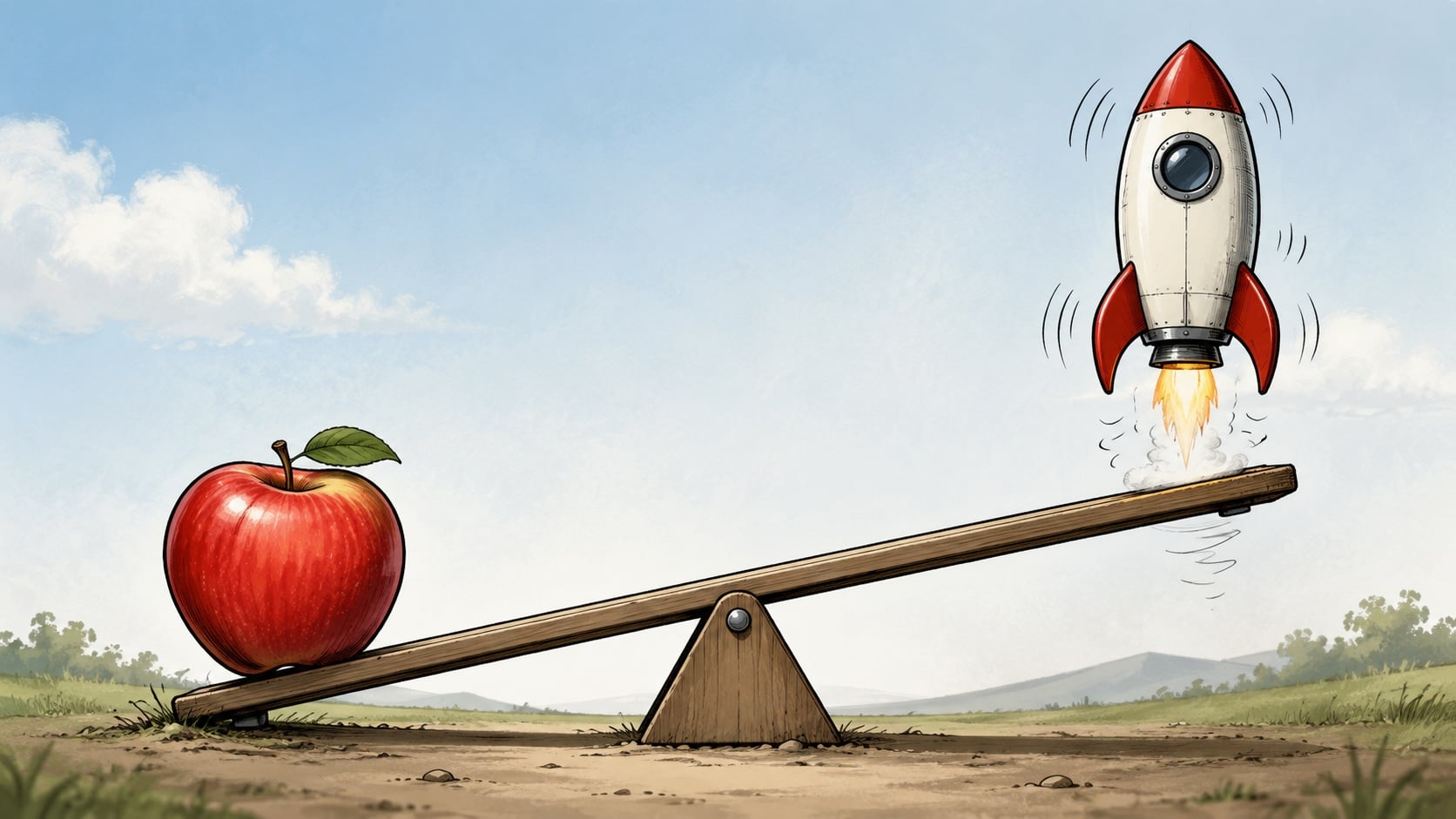

July has been a strange month for anyone holding a basket of the market’s biggest names. Apple’s shares touched $342.89 on Jul. 28, pushing its market cap to roughly $5.04 trillion before it settled back to close near $4.99 trillion, according to CNBC. That makes Apple only the second public company in history, after Nvidia, to reach the $5 trillion level at all. Tesla is down almost 30% year to date. SpaceX, which went public in June at $135 a share, is trading near $116, down about 46% from its post-IPO peak. Add Tesla and SpaceX’s losses together, and you get a mega-cap valuation gap of more than $1.2 trillion, roughly SpaceX’s entire post-IPO decline mirrored in Tesla’s current market cap, wiped out in five weeks.
That split is the story. Two of the market’s most-watched names are getting cheaper. One just touched a valuation only one other company has ever reached. The reason isn’t sentiment, or at least not only sentiment. It’s earnings, and whether the price you’re paying has any relationship to them.
The Apple vs Tesla Valuation Math, Side by Side
Here’s the Apple vs Tesla valuation gap in plain numbers, based on S&P Global Market Intelligence data as of Jul. 28. Apple trades at a trailing price-to-earnings ratio near 41. Tesla trades near 283. Apple’s forward P/E sits near 36, Tesla’s near 159. Apple’s PEG ratio is about 3.2, Tesla’s is above 5.5.
Put another way, investors are paying roughly seven times more for each dollar of Tesla’s trailing earnings than they are for each dollar of Apple’s. Apple reports its own quarterly results on July 30, after the close, so its number could move. Tesla already reported on Jul. 22, and the stock fell 14% in the days after, according to Motley Fool reporting, meaning its current multiple already reflects the market’s post-earnings judgment.
SpaceX doesn’t appear in that comparison at all, and that’s the point. The company posted $18.7 billion in revenue and a $4.9 billion net loss last year. There’s no earnings to divide the price by. You can’t calculate a P/E ratio for a company that doesn’t have a P.
Why Tesla’s PE Multiple Keeps Climbing Despite Falling Margins
Tesla’s operating income fell 57% year over year last quarter to $398 million, and its operating margin has thinned to a sliver of what it was two years ago, per Motley Fool’s earnings coverage. Yet the stock still trades at multiples most companies never see. The answer is that Tesla’s price isn’t really about the car business anymore. It’s a bet on robotaxis, Optimus, and whatever comes next, discounted back to today’s price.
That’s not automatically irrational. Every growth stock is a bet on a future that hasn’t happened yet. The question worth asking, the one behind why Tesla stock is so expensive relative to its current earnings, is how much of that future is already priced in, and how much room is left for anything to go wrong.
As Yale School of Management’s Jeff Sonnenfeld put it during an earlier round of scrutiny over Musk’s pay package, when Tesla’s multiple was already north of 200: “The PE on this, well above 200, is just crazy.” That was months ago, when the number was in the low 200s. It’s climbed since. A managing partner at an investment firm covering both Musk companies made a similar point more recently, noting that the investors most surprised by this month’s declines were, in his words, those who don’t do valuation math.
SpaceX’s Harder Problem: No Earnings to Divide By
The Tesla stock selloff and SpaceX’s post-IPO slide are related but not identical. Tesla at least has a P/E ratio to argue about. SpaceX’s case rests entirely on a story: space-based data centers, a Mars program, and a satellite business that still needs the rest of the world to be able to afford it. One community skeptic put the affordability question directly: most of the planet doesn’t have reliable internet, let alone the budget for a premium satellite service.
Not everyone agrees the selloff is rational. One retail investor argued flatly that “no one cares about valuation when there are always people looking to speculate,” framing the recent price action as rotation between hype cycles rather than a verdict on fundamentals. A separate voice on an investing forum was harsher about both Musk companies at once: “Tesla doesn’t trade on fundamentals and SpaceX won’t either.”
Where the Debate Splits

This is where reasonable investors genuinely disagree, and it’s worth naming both sides instead of pretending one is obviously right.
One side of the argument says that trying to time an exit based on valuation has historically cost investors more in missed gains than it’s saved in avoided losses, and that “expensive” and “wrong” are not the same word. That’s a defensible, data-backed position over long horizons and moderate valuations.
The other side says a margin of safety exists precisely for moments like this one: a stock priced for a flawless future has no room left for anything to go wrong, and paying nearly 300 times trailing earnings requires near-perfect execution just to be considered fairly valued, not cheap.
Both are right under different conditions. The dividing line is the size of the multiple. Buying consistently regardless of price works when a stock trades within a normal range of its peers. It gets shakier when the multiple stops being explainable by anything except belief in the person running the company, which is roughly where Tesla and SpaceX sit today.
The One Number That Separates Cheap From Cautionary
If you only take one tool from this comparison, take the PEG ratio: price-to-earnings divided by earnings growth. It answers a more useful question than P/E alone, which is whether you’re paying a fair price for the growth you’re actually getting, not just the growth someone is promising.
Apple’s PEG sits near 3.2. Tesla’s sits above 5.5. Neither is “cheap” by classic value-investing standards, but the gap between them tells you which stock has less room for a growth miss before the price stops making sense.
For readers who want a deeper, more permanent framework for thinking through exactly this kind of question, price versus value, risk versus reward, Howard Marks’s The Most Important Thing remains one of the clearest breakdowns available for how professional investors actually separate a good company from a good investment. As an educational partner, we think it’s a useful companion the next time a stock’s story runs ahead of its numbers.

This site participates in the Amazon Associates program and may earn a commission from qualifying purchases, at no extra cost to you.
Frequently Asked Questions
What is Apple’s current price-to-earnings ratio?
Apple’s trailing P/E ratio is near 41, and its forward P/E is near 36, based on S&P Global Market Intelligence data as of late July.
Why is Tesla stock so expensive compared to Apple?
Tesla’s price reflects expectations for future businesses like robotaxis and humanoid robots, not just its current car sales. That pushes its trailing P/E to roughly 283, about seven times Apple’s multiple.
Does SpaceX even have a price-to-earnings ratio?
No. SpaceX posted a net loss in 2025, so there’s no positive earnings figure to divide the stock price by. Investors are valuing it entirely on future potential.
Is a high P/E ratio always a warning sign?
Not automatically. A high P/E can reflect real, justified growth expectations. It becomes a warning sign when the multiple requires near-flawless execution just to be considered fair, leaving no margin for error.