

Source: YouTube
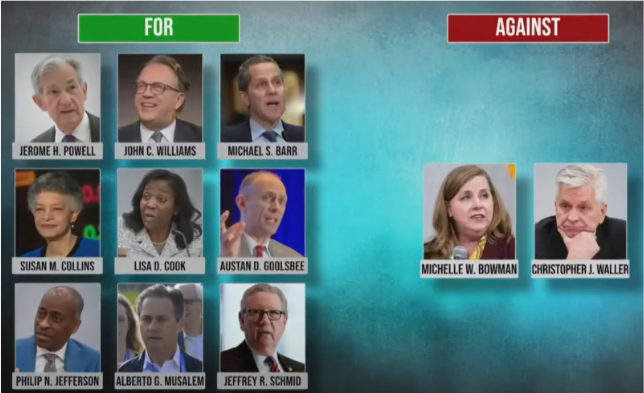
The Federal Reserve held the federal funds interest rate steady this week, maintaining the range at 4.25% to 4.5% for the fifth consecutive meeting. For the first time since 1993, two members of the Board of Governors voted against the decision. This rare dissent has increased uncertainty for investors, especially with President Donald Trump continuing to pressure the central bank to ease borrowing costs.
Trump appointees Michelle W. Bowman and Christopher J. Waller favored a 0.25 percentage point cut. Their vote contrasted with the broader consensus of the Federal Open Market Committee. Fed Chair Jerome Powell defended the hold by citing the need to keep monetary policy moderately restrictive while inflation remains above target. He also clarified that no decisions were made about future changes, including at the September meeting.
Trump Pushes for Immediate Interest Rate Cuts
President Trump has called for a full three-point reduction in interest rates. He argues that the current level is making it harder for Americans to buy homes and increasing the government’s cost of servicing its debt. In a public appearance, Trump said the Fed should lower rates now and only reverse course if inflation resurfaces.
His pressure campaign has extended beyond rate policy. Last week, Trump confronted Powell in person during a visit to the Fed’s ongoing headquarters renovation, challenging the reported cost of the project. Powell later dismissed the president’s claims, saying the figures included unrelated expenditures from earlier phases. While Powell described the visit as respectful, the disagreement underscored the growing tension between the Fed’s leadership and the White House.
Conflicting Data Splits the Fed
The economy presents a mixed picture. Second-quarter GDP rose 3%, but the underlying trend shows weakness. Core growth, which excludes trade and inventory effects, averaged just 1.2% in the first half of the year. Labor market data remains strong, but some Fed members are concerned that private-sector hiring has slowed.
Inflation has hovered between 2.3% and 3.0% over the past year. The Fed’s preferred measure rose 2.1% last quarter, slightly above target. However, tariff-related cost increases are complicating the outlook. Sectors such as electronics and apparel have seen prices rise, but consumer resistance may be limiting the full pass-through of those costs.
Some officials, including Bowman and Waller, believe the Fed should act now to stay ahead of labor market weakness. Others argue that inflation is still elevated and want to wait for more evidence before easing.
Division Doesn’t Mean Discord
The divided vote signals that internal debate at the Fed is intensifying. Although markets still expect a rate cut by September, Powell avoided making any firm commitment. He said future decisions will depend entirely on incoming data.
Investors should monitor labor indicators and inflation closely over the coming weeks. Any signs of wage deceleration or a shift in consumer spending may push the Fed toward action. At the same time, additional inflationary pressure from tariffs could delay cuts beyond the current quarter.
For those managing rate-sensitive assets, flexibility is critical. Sectors tied to housing, credit, or long-duration bonds may face short-term volatility until the Fed’s next move becomes clearer.
Do you think the Fed will cut the interest rate before the end of the year? Tell us what you think.