

Something is happening in healthcare stocks right now, and the investors paying attention to it are asking a question that most financial coverage is not equipped to answer.
The sector rotation is real. Capital has been moving out of overextended technology names and into defensive sectors with resilient earnings for most of 2026. The Health Care Select Sector SPDR Fund (XLV) has been among the primary beneficiaries, climbing from a 52-week low near $127 to the $149 range as institutional investors look for earnings stability in a higher-for-longer rate environment. Health care added more jobs than any other sector in the January 2026 employment report. The demographic tailwind is not a theory. It is showing up in the numbers.
The dominant managed care holding inside that rotation, accounting for roughly 10% of XLV by weight, is a stock that a meaningful portion of retail investors has spent the past year actively not thinking about. And now that it has recovered 29% from its lows, some of those same investors are watching from the sidelines with a feeling they cannot quite name.
That feeling has a portfolio cost. This article is about how to calculate it honestly.
How Did UnitedHealth Stock Fall 35% and Why Is It Recovering Now?
UnitedHealth Group spent 2025 accumulating problems at a pace that would have destroyed a less structurally entrenched business. The stock lost approximately 35% of its value over the course of the year, against an S&P 500 that gained 16%. The causes were compounding and, to be fair to any investor who stepped away, genuinely serious.
The medical loss ratio, which is the percentage of premium revenue paid out in claims, climbed to 88.9% in 2025, up from 85.5% the prior year. For a business model built on the spread between premiums collected and care delivered, that is an earnings-destroying shift. The company pulled its full-year guidance. Its CEO departed. A Senate committee investigation found that UnitedHealth had used what it called aggressive tactics to collect diagnosis data that boosted Medicare Advantage reimbursements, concluding that the insurer had turned risk adjustment into a profit mechanism beyond its original regulatory intent.
A Department of Justice antitrust probe into the integration between its Optum services arm and its insurance business remained active. Berkshire Hathaway fully exited its position in the first quarter of 2026. Massachusetts filed a lawsuit alleging $100 million in Medicaid fraud and patient misclassification.
None of that is ancient history. All of it is still in play to varying degrees.
The stock also absorbed something no financial model had ever priced: an event in December 2024 that became a cultural flashpoint unlike anything that had happened to a publicly traded company in recent memory. Reddit sentiment on UNH swung from a score of 18 on r/WallStreetBets, deep bearish territory, to bullish peaks of 82 within weeks, then cooled to a reading of 42, described by analysts as neutral, bearish-leaning. The phrase that kept appearing across investor forums, analyst notes, and financial commentary in the months that followed was not “strong buy” or “compelling value.” It was “reluctant buy.”
That phrase is doing a lot of work. It is worth examining what it actually means.
Is UnitedHealth Stock Actually a Good Buy at Current Prices?

UnitedHealth Group reported first-quarter 2026 revenue of $111.7 billion, up 2% year over year, and raised its full-year adjusted earnings guidance to above $18.25 per share. That raised guidance, applied to the stock’s historical earnings multiple of 22 to 25 times, implies a fair value range of roughly $400 to $456. At the current trading price near $384, the stock sits at the low end of that range. UNH raised full-year 2026 EPS guidance above $18.25 per share and has recovered 29% from its 2025 lows, but at $384, the stock sits at the low end of its fair value range with three binary risks still unresolved.
It is not cheap. It is not expensive. It is close to fairly valued, with a set of active headwinds still attached.
The analyst community has moved decisively to the constructive side. Bank of America raised its price target to $420. Truist raised to $440. Bernstein reiterated an Outperform rating with a $444 target. RBC Capital reiterated Outperform at $408. Twenty-six analysts covering the stock carry a consensus rating of Strong Buy. Barclays flagged UNH specifically as positioned to benefit as investor attention rotates away from artificial intelligence names toward stocks that have been left behind.
The structural case has not changed: an aging population, inelastic demand for medical services, and an Optum division that generates revenue from health data, pharmacy benefit management, and care delivery. Those businesses do not depend on the insurance underwriting cycle in the same way the core UnitedHealthcare segment does.
If you are a long-term investor and you want exposure to the healthcare sector rotation without having to resolve every question about a single name, there is a cleaner path. The data-driven case for consistent accumulation over individual stock timing decisions is made systematically in the resource below. For most investors at the accumulation stage, the framework it lays out is a better starting point than a discrete entry decision on any single name.
Affiliate disclosure: TheCapitalist.com participates in the Amazon Associates program. If you purchase through our link, we may earn a commission at no additional cost to you.


Before making any individual stock decision here, the most important question is whether you have a process or just a feeling. That book is a useful place to start.
What’s the Real Reason So Many Investors Are Still on the Sidelines?
Every financial analysis of UnitedHealth Group published in the past six months has run some version of the same exercise: medical loss ratio trajectory, Medicare Advantage rate environment, DOJ probe timeline, earnings multiple versus historical average. The work is competent. Most of it reaches similar conclusions. The stock is range-bound between “fairly valued with risks” and “modestly discounted if the bull case materializes.”
What almost none of it addresses is the investor sitting on the other side of that analysis who read the same numbers and still cannot bring themselves to act. Not because the numbers do not work. Because something else is in the way.
The investor who buys UNH without having resolved the behavioral question will sell it at the first negative headline. That is not a position. It is a liability waiting for a catalyst.
There is a concept in behavioral finance that describes what happens when investors evaluate a decision based on how it turned out rather than whether the process that produced it was sound. The technical term is outcome bias. The practical version looks like this: the retail investor who avoided UNH in 2025 at $400 and watched it fall to $234 may have been right for the wrong reasons.
If the decision was based on a pre-mortem that identified specific failure paths, such as elevated medical loss ratio, Medicare Advantage repricing, and guidance withdrawal risk, that investor ran a good process and got a good outcome. If the decision was based on something harder to articulate, they got the same result but learned something different about their own reasoning.
The investor now watching the stock at $384 from the sidelines is in a third position entirely. They did not buy at $234. They are not sure whether to buy now. And underneath the uncertainty about the financials is a question they have probably not written down: would I be comfortable explaining to someone that I own this stock?
That is a real question. It deserves a real answer, not a dismissal. The investor who buys UNH without having answered it will sell it at the first negative headline. A position you cannot hold through volatility is not a position. It is a liability waiting for a catalyst.
The behavior audit, applied directly: write down the actual reason you have not bought or sold this position. Then ask whether that reason would survive if the stock were up 60% from current levels instead of 29%. If the answer changes, the reason is not a principle. It is a rationalization.
That exercise does not tell you whether to buy the stock. It tells you whether you are ready to run the financial analysis honestly.
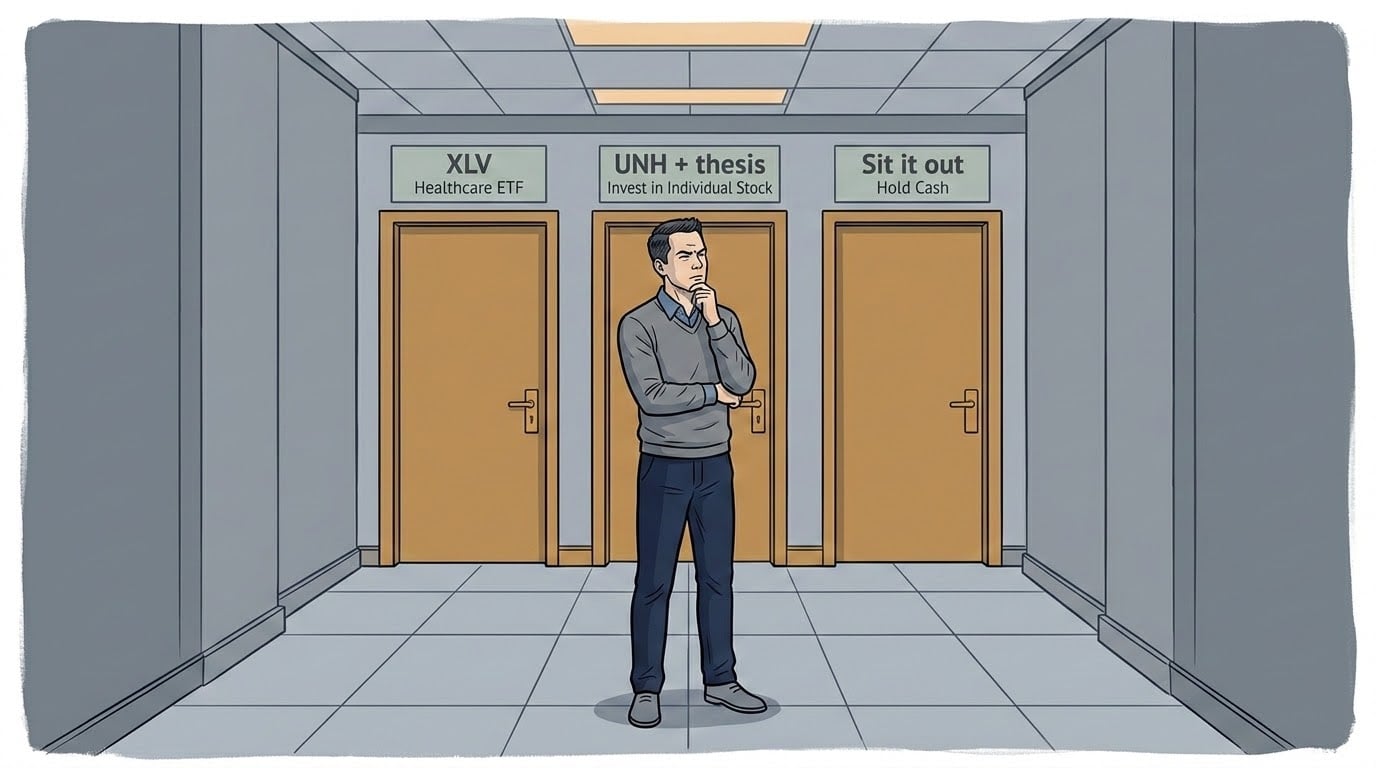
Should You Start Investing in UnitedHealth Stock, Buy XLV, or Sit This One Out?
The investment case for UNH does not have a single right answer. It has three, depending on where you are. Which answer applies to you depends entirely on where you are as an investor, not on what the consensus price target says.
If you are in the accumulation phase with a time horizon of 10 years or more and no specific view on managed care: the XLV approach is defensible and probably better. You get the healthcare rotation exposure at a 0.08% expense ratio without needing to resolve the individual stock questions. One important note: XLV holds UNH at approximately 10% of its current composition. You are not avoiding the company by buying the ETF. You are right-sizing your exposure to it and letting the index weight handle the rest. The margin of safety principle applies here in an unexpected way.
Owning the sector rather than the single name is itself a form of downside protection when one holding carries binary regulatory risk.
If you already hold XLV and you are considering adding UNH as a discrete position on top of it: the valuation framework matters here. The bull case requires three things to go right simultaneously. The medical loss ratio needs to show meaningful improvement in the second and third quarters of 2026. The DOJ antitrust investigation needs to be resolved without structural remedies, as forced divestitures or mandated separation of Optum from the insurance business would reprice the earnings model significantly.
The Massachusetts Medicaid fraud lawsuit needs to settle without billing practice mandates that constrain how the company codes diagnoses going forward. At $384, you are paying close to fair value for a scenario where all three go right. That is not a margin of safety entry. It is a bet on execution. There is a difference.
If you have been watching this recovery from the sidelines and you feel the pull of what you missed: run the pre-mortem before you look at another price target. Assume UNH is trading at $290 twelve months from now. Write down the most likely reason in one paragraph. Assign a probability to that scenario. If you cannot complete that exercise without it becoming emotional, you are not ready to own the stock regardless of what the numbers say. The position will not survive the next headline cycle, and you will have made a market timing decision disguised as a value investment.
The investor who resolves the behavioral question first and then runs the financial analysis is operating in a completely different risk environment than the one who reverses that order. The portfolio does not know the difference. Your returns will.
What Are the Biggest Risks to UNH Stock in 2026?
The DOJ antitrust probe, the Massachusetts Medicaid lawsuit, and an 88.9% medical loss ratio are the three inputs that require explicit probability assignments before any honest position sizing.
None of the following are reasons to avoid UnitedHealth Group stock. They are inputs that require an explicit probability assignment before any honest position sizing.
The DOJ antitrust probe into the Optum and UnitedHealthcare integration is active. The specific concern is that the combination of a health services platform with an insurance underwriting business creates anti-competitive dynamics in care delivery. A structural remedy, if upheld, would not be resolved by a fine. It would require changes to how the business operates.
The Massachusetts lawsuit alleges $100 million in Medicare Advantage fraud through patient misclassification. This follows the Senate committee’s findings about Medicare Advantage diagnosis coding. The pattern of allegations is consistent enough across government investigations that dismissing it as headline noise requires a specific counter-argument, not just optimism about management.
The Medicare Advantage rate environment remains constrained. The Centers for Medicare and Medicaid Services proposed a 0.09% rate increase for 2026, against actual utilization trends running materially higher. For a business where tens of millions of members are enrolled in Medicare Advantage plans, that gap between reimbursement rates and care costs does not close quickly.
The medical loss ratio was 88.9% in 2025. Management’s bull case requires it to normalize toward 85% or below. That has not been confirmed in the reported data yet. Q2 2026 results will be the first meaningful evidence of whether the recovery narrative is accurate or whether investors are pricing in improvement that has not materialized.
These risks do not make UNH uninvestable. They make it a stock that requires a specific thesis, not a general rotation trade.
For context on how the broader rate environment shapes the backdrop for all of this, the Federal Reserve’s current policy posture and a divided FOMC have material implications for how healthcare valuations are supported going into the second half of 2026.
For educational purposes only. Not financial advice. TheCapitalist.com participates in the Amazon Associates program. If you purchase a book through our link we may earn a commission at no additional cost to you. This does not influence our editorial coverage.
Frequently Asked Questions
Is investing in UnitedHealth stock a good idea right now?
At current prices near $384, UNH sits at the low end of its fair value range based on raised 2026 earnings guidance of above $18.25 per share and a normalized multiple of 22 to 25 times earnings, implying fair value of roughly $400 to $456. That is not a deep value entry. It is close to fairly valued with active regulatory and operational risks still attached. Whether it is a good buy depends on your time horizon, your existing healthcare exposure, and whether you have run a specific thesis on the three key risks: the DOJ probe, the Massachusetts lawsuit, and the medical loss ratio trajectory.
What is the biggest risk to UNH stocks in 2026?
The DOJ antitrust investigation into the integration of Optum and UnitedHealthcare is the highest-consequence risk because a structural remedy, rather than a financial settlement, would require changes to how the business operates and how it is valued. The elevated medical loss ratio is the most immediately measurable risk, with Q2 2026 results serving as the first real data point on whether margins are genuinely normalizing.
Should I buy UNH stock directly or just buy XLV for healthcare exposure?
For most accumulation-phase investors with a 10-year or longer horizon, XLV is the cleaner answer. It gives you the sector rotation exposure at a 0.08% expense ratio without requiring you to resolve the individual stock questions. Note that UNH accounts for approximately 10% of XLV’s current composition, so you are not avoiding the company. You are right-sizing your exposure to it. Adding UNH as a discrete position on top of XLV only makes sense if you have a specific thesis that UNH will outperform the broader sector, which requires resolving the three key risks listed above.
How does the DOJ investigation affect UnitedHealth’s stock price outlook?
The investigation creates persistent headline risk, meaning each new development resets the negative news cycle regardless of the underlying earnings trajectory. More materially, if the investigation results in structural remedies rather than a financial settlement, the Optum re-rating thesis underlying the most optimistic price targets becomes significantly harder to defend. Investors should distinguish between a fine, which the market can absorb and move past, and a mandate to restructure the business, which would reprice the long-term earnings model.
What is the “reluctant buy” sentiment around UNH stock and what does it mean for investors?
“Reluctant buy” is the phrase that appeared most consistently across investor forums, analyst commentary, and retail discussion threads following UNH’s 2025 decline and subsequent recovery. It signals that investors accept the financial case but have not resolved the reputational or emotional dimension of owning the stock. Positions held with unresolved reluctance tend to be sold on the first negative headline, meaning the behavioral question has direct portfolio consequences independent of the valuation math.