
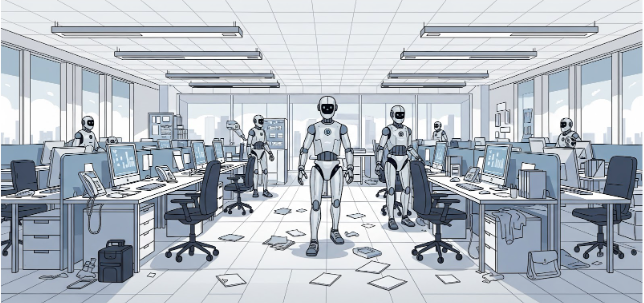

Mounting tech layoffs in 2025 are reshaping the U.S. workforce and raising new questions about the role of artificial intelligence. Major companies across the sector, including Amazon, Meta, Google, Microsoft, and Oracle, announced thousands of job cuts this year. While executives frame the reductions as cost-cutting and restructuring, investors and employees alike are asking whether AI is becoming a permanent replacement for human labor.
Reports from the Economic Times and CNBC highlight how the layoffs coincide with slower growth, higher costs, and rising competition. Oracle, Salesforce, Intel, and Block also joined in announcing significant job cuts. Collectively, these moves represent tens of thousands of lost jobs, with many concentrated in roles most vulnerable to automation. Analysts note that while economic pressures play a role, AI adoption is accelerating the pace of displacement in ways not seen in previous downturns.
The AI Factor Behind Layoffs
Executives at firms like Anthropic argue that AI is changing entry-level jobs across multiple industries, not just technology. Tasks in finance, consulting, and law that were once assigned to junior employees are increasingly being automated. For tech giants, this shift offers a clear way to reduce costs and reallocate capital toward AI development. Companies tout efficiency gains, but workers see shrinking opportunities for traditional career paths.
At the same time, broader economic forces are pressuring margins. Inflation, high borrowing costs, and weaker consumer demand have all weighed on earnings. Still, the overlap between AI adoption and workforce reduction makes it difficult to ignore the technological factor. Unlike cyclical layoffs that ebb as conditions improve, AI-driven cuts appear designed to reshape organizations permanently.
Investor Lens on Tech Layoffs
For investors, the trend produces a mixed picture. On one side, headcount reductions improve balance sheets in the short term. Leaner operations can support margins and free up resources for high-return projects in AI and cloud computing. On the other side, layoffs also signal management doubts about near-term growth. If consumer demand continues to weaken, cost savings may not be enough to restore confidence in these stocks.
Reputation is another consideration. Aggressive job cuts risk damaging employee morale and weakening cultures that fueled innovation. For companies like Google and Meta, that could hinder long-term growth prospects. Investors must weigh whether cost efficiency today outweighs potential stagnation tomorrow. The divergence in opinion explains why some analysts see the layoffs as bullish for margins, while others warn of long-term erosion in competitive strength.
The Bigger Workforce Shift
The wave of tech layoffs carries implications that reach far beyond Silicon Valley. AI adoption is moving rapidly into sectors such as law, finance, and healthcare, threatening to upend professional career ladders that depend on entry-level training. If automation removes the first rung, industries may struggle to replenish skilled talent over time. Policymakers face growing pressure to prepare workers for this transition while encouraging innovation.
For investors, the key question is whether companies adopting AI aggressively can sustain profitability without triggering political and social backlash. The layoffs in 2025 suggest this balance has not yet been achieved. Until firms find a way to integrate AI without eroding confidence in their long-term value, markets will continue to wrestle with the consequences of rapid technological disruption.
Do tech layoffs show that AI is strengthening long-term profitability or weakening the case for future growth? Tell us what you think.