
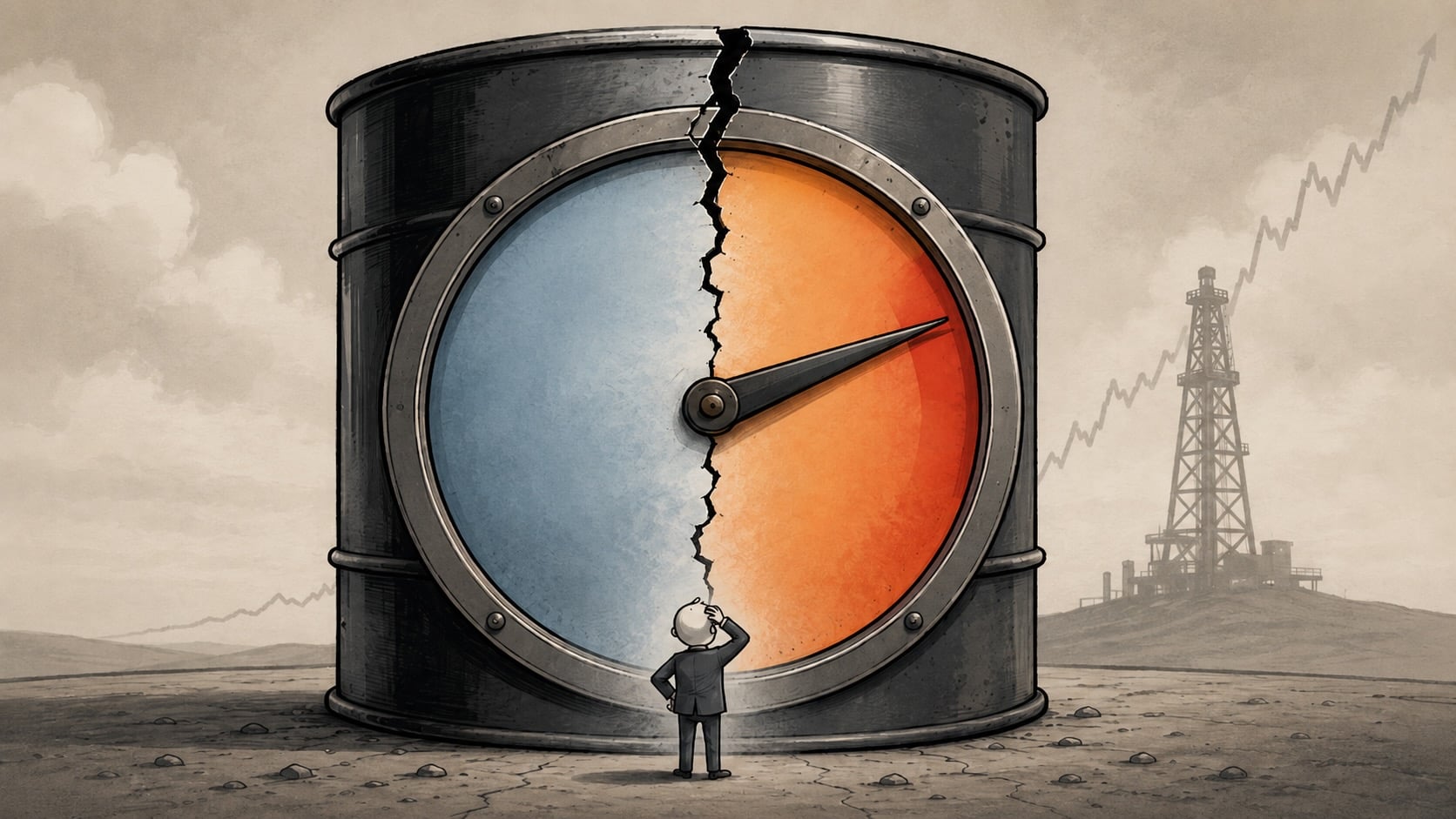

The number that matters this week isn’t a stock price. It’s 43. That’s how many days of crude oil supply the US currently has on hand, the lowest level in 45 years. This is a genuine oil supply squeeze, not a headline exaggeration.
It’s happening while the US completes a ninth consecutive day of strikes on Iran, oil climbing more than 2.5% on the news, and gold sitting near $4,000 an ounce. This is the same conflict that has already whipsawed Fed rate-hike odds twice this year: once in mid-July when a soft CPI and PPI print collapsed July hike odds from the mid-40s down into the high teens, and again days later when renewed Hormuz hostilities pushed the September hike probability back up toward 73%. As of today, the Fed’s July 28-29 meeting is priced at roughly 87% for a hold, while September sits closer to 55%, essentially a coin flip.
The 43-day oil supply squeeze figure is real. Whether it changes your portfolio depends entirely on your time horizon.
Retail investors are feeling this whiplash directly. On Bogleheads, one investor put it plainly: “Telling people it’s not inflationary is a hard sell when they see prices at the pump.” Another, watching diesel climb alongside gasoline, said flatly: “I can’t remember the last time I saw $5/gallon gas.”
The 43-Day Number Splits Investors Into Two Camps
The honest answer is that there isn’t one answer. There are two, and which one applies to you depends entirely on where you are in your investing timeline.
One camp says this is a genuine regime signal. A sustained supply shock, combined with rate-hike odds that can swing 30-plus points in a week, is not the kind of noise you tune out. It’s the kind of environment where bond duration, inflation hedges, and hard-asset exposure deserve a second look, sized to how much your income depends on today’s portfolio holding steady.
The other camp says this is market timing wearing a macro-analysis costume. The data on retail investors reacting to headline-driven shocks is not flattering. As one investor working through the same instinct put it on a Seeking Alpha comment thread: “These types of selloffs are rare opportunities to buy great stocks at great prices.” Another, watching the same headlines, took the opposite read: “I honestly believe we are going to see oil prices remain higher and for longer. There is no easy way out of the Iran situation.”
Both investors are looking at the same 43-day number. They’re reaching opposite conclusions, and that split is the actual story here, not which one of them is right.
This Approach Works Until It Doesn’t
If you’re in the accumulation phase with a decade or more ahead of you, the case for doing nothing is strong. Reacting to a geopolitical headline with a portfolio change is precisely the pattern that causes retail investors to underperform the very funds they’re invested in. The oil shock earlier this year followed the same arc: prices spiked, inflation fears spiked with it, and then the conflict cooled and the spike round-tripped. Twice.
But that “wait it out” position has a breakpoint. If you’re within three to five years of retirement or another major capital event, sequence-of-returns risk means a sustained oil-driven inflation regime is not noise you can afford to ignore. The math changes. A portfolio that’s fine to hold through volatility during accumulation can be genuinely dangerous to hold through volatility during withdrawal.
The market strategist read on this cuts the same way. As market strategist Chris Zaccarelli put it on the broader rally risk: “Higher interest rates could be a real Achilles’ heel for the market. If that were to happen, you have to question valuations, and that could impact the durability of this rally.”
What the Oil Supply Squeeze Actually Changes

If you fall into the “review it” camp, the actionable version looks like this: check your bond duration against a rising-rate scenario, not a falling one. Look at whether your portfolio has any inflation-hedge exposure at all, even a small allocation to commodities or hard assets, and whether that allocation is sized to the current environment or a leftover from a different one. None of this means abandoning your equity allocation. It means making sure the parts of your portfolio that are supposed to protect you during inflation are actually built for the inflation you’re in now, not the one from eighteen months ago.
If you fall into the “stay the course” camp, the actionable version is just as concrete: confirm your allocation was already built to survive a real drawdown, and if it was, there is nothing new here that changes that math. The temptation to “do something” in response to a scary number is itself the risk. A geopolitical headline with no easy resolution in sight isn’t a reason to trade. It’s a reason to already own a portfolio built to hold through headlines like this one.
Time horizon, not the headline, is what should decide your response to this oil supply squeeze.
That’s the real dividing line. Not whether the oil supply squeeze is scary. It is. The dividing line is whether your time horizon means you should act on it.
As an educational resource for thinking through moments like this one, Burton Malkiel’s A Random Walk Down Wall Street remains one of the clearest cases for why a diversified, low-cost index approach survives exactly this kind of headline, without requiring you to correctly predict how a geopolitical conflict resolves.

For educational purposes only. Not financial advice. Researched and fact-checked by TheCapitalist.com editorial team using a multi-source framework. Institutional citations verified. Contradictory expert positions represented. See our editorial standards.
Frequently Asked Questions
Does a 43-day oil supply level mean gas prices are about to spike again?
It raises the odds of an oil supply squeeze. Inventory this tight leaves less buffer against further disruption, but price moves depend on how the conflict develops from here, not the inventory number alone.
Should I sell stocks because of rising Fed rate-hike odds due to the oil supply squeeze?
Not automatically. September hike odds near 55% reflect real uncertainty, not a forecast. Selling in response to a probability shifting is the pattern most associated with retail underperformance.
How do I know if I’m in the “review it” camp or the “stay the course” camp?
Time horizon is the deciding factor. If a major capital need, retirement, a home purchase, or a business sale falls within the next three to five years, review your bond duration and inflation-hedge exposure. If it doesn’t, the case for staying put is stronger.
Is gold a good hedge against this specific oil shock?
Gold has historically moved with inflation-hedging demand during supply-driven oil shocks, though it round-tripped along with oil the last two times this conflict flared and cooled. Sizing matters more than the decision to hold it at all.