
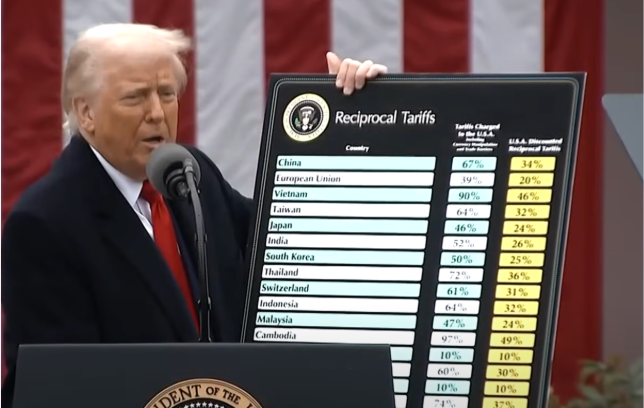

Source: YouTube
President Trump’s blanket 10 percent tariff on imports from over 180 countries is shaking the foundations of his support within the business world. What once looked like a unified economic front is now visibly cracking. Prominent business leaders are warning that the latest move threatens global stability, investor confidence, and America’s credibility as a trade partner.
Markets responded immediately. The S&P 500 dropped 9.08 percent last week, and J.P. Morgan raised the odds of a U.S. and global recession to 60 percent before year-end. The market correction isn’t just about short-term volatility. It reflects the growing unease among executives, capital allocators, and institutional investors who believe the administration is introducing avoidable risk.
Bill Ackman, founder of Pershing Square and a former Trump supporter, described the policy as an “economic nuclear winter.” He warned that the strategy invites retaliation from allies and adversaries alike and sends the wrong message about America’s role in global commerce. Ackman argued that business leaders thrive on predictability and warned that Trump is losing their trust. He also pointed out that low-income Americans, many of whom supported Trump, would be the most exposed to rising prices caused by these tariffs.
Musk Separates Himself from Trump’s Economic Inner Circle
Tesla and SpaceX CEO Elon Musk has also begun to distance himself from Trump’s trade agenda. Though still serving in a formal advisory role within the administration, Musk rejected the fundamental logic behind the tariffs and criticized its architect, Trump’s top trade strategist Peter Navarro.
Musk said he supports a zero-tariff zone between the U.S. and Europe and has encouraged more labor mobility across borders. This stance puts him in direct conflict with Trump’s goal of protecting U.S. manufacturing by discouraging imports. In contrast, Navarro defended the administration’s position by saying that Musk is motivated by self-interest. Despite the attack, Musk used a measured and policy-oriented response that emphasized broader market stability and long-term global competitiveness.
When two of the most visible business leaders in the country express concern about the White House’s economic direction, investors take notice. Tesla shares and other multinational equities with global supply chains saw increased selling pressure following the tariff announcement. Musk’s public divergence signals a deeper concern among CEOs that political alignment no longer guarantees sound policy execution.
Confidence, Not Just Trade, Is on the Line
Business leaders are not merely reacting to higher import costs. They are evaluating the broader implications of executive decision-making that lacks clarity or coordination. Ackman’s additional criticism of Commerce Secretary Howard Lutnick further reflects this sentiment. Ackman suggested Lutnick’s bond-heavy portfolio puts him in a position to benefit if the economy slows. Lutnick denied any conflict, but the public challenge from a respected investor adds weight to growing doubts.
The issue extends beyond tariffs themselves. It touches on credibility, predictability, and alignment between Washington and the private sector. Business leaders use those factors to guide capital expenditures, hiring, and supply chain decisions. When confidence erodes at the executive level, the entire investment climate changes.
The administration may still revise the tariff structure or open new negotiations. But for now, the signal to markets is that the relationship between policymakers and business leaders is fraying. That shift may introduce more uncertainty than the tariffs themselves.
Are business leaders right to worry about Trump’s tariff policy and its effect on markets? Tell us what you think!