
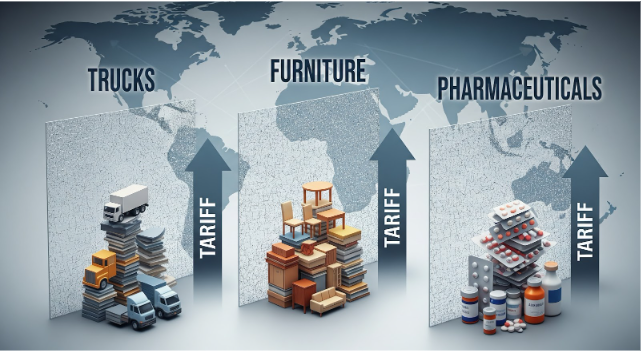

President Donald Trump announced new tariffs on heavy trucks, furniture, and pharmaceutical products late Thursday, setting an October 1 effective date. The sudden move targeted a wide array of goods, raising investor concerns about supply chains and costs across multiple industries.
The new tariffs include a 25 percent levy on heavy trucks, a 50 percent tax on kitchen cabinets, bathroom vanities, and related products, and a 30 percent tariff on upholstered furniture. Trump also said pharmaceutical imports could face a 100 percent duty, though he suggested companies investing in U.S. plants might receive lower rates.
Markets Respond To New Tariffs
Markets opened to the announcement with quick moves across affected sectors. Shares of major truck manufacturers such as PACCAR, the parent of Peterbilt and Kenworth, along with Daimler Truck, Freightliner, and Volvo Trucks, saw a brief uptick in premarket trading. Analysts noted that protection from foreign competition could provide a boost to domestic players, though higher input costs could erode those gains.
Furniture stocks presented a more complex picture. Companies with global supply chains may struggle with increased costs, particularly in segments heavily reliant on imported materials. Tariffs on cabinets and vanities may also drive up prices in the housing and remodeling sectors, affecting both consumers and contractors. Retailers with significant exposure to imported goods could face margin pressures as they navigate higher costs.
Pharmaceutical companies drew the sharpest focus. The threat of a 100 percent tariff on imported medicines raised alarm about potential shortages and price spikes. While Trump signaled that U.S.-based plants could soften the blow, most drugmakers still rely on complex international supply chains for both finished products and raw ingredients. Analysts warned that the policy could disrupt distribution and complicate global partnerships.
Policy Context And Investor Outlook
The announcement of new tariffs continues Trump’s pattern of using trade measures as leverage. Supporters argue that the policy strengthens domestic manufacturing and encourages companies to build capacity in the United States. Critics counter that the broad reach of these levies risks raising consumer prices and provoking retaliation from trading partners.
Investors now face the challenge of assessing which sectors stand to benefit and which may bear new burdens. Truck manufacturers could gain short-term advantages if foreign competition recedes, but their own costs may rise from tariffs on imported parts. Furniture producers that depend on overseas suppliers will struggle to pass higher prices to consumers already facing inflationary pressures. Drugmakers face uncertainty over whether production shifts to the United States can offset steep import taxes.
The broader economic implications also matter for markets. Tariffs add to inflationary risks at a time when the Federal Reserve continues to balance interest rate policy against signs of slowing growth. Higher prices in the construction and health care sectors could ripple through consumer spending, creating fresh headwinds for the economy.
Strategic Considerations For Investors
For investors, the announcement underscores the importance of monitoring tariff-sensitive industries. Portfolio exposure to companies with global supply chains should be evaluated carefully, with attention to whether those firms can adapt by shifting production or sourcing. Firms positioned to benefit from reshoring or domestic expansion may find opportunities to capture market share.
Sector rotation strategies may also gain traction. Investors could weigh adding exposure to companies that stand to gain from protective tariffs, while reducing holdings in firms with heavy import reliance. Yet the policy environment remains volatile, and sudden changes to tariff levels or exemptions could alter outcomes rapidly.
As October 1 approaches, markets will track company guidance and earnings updates for insight into how management teams plan to adapt. The next several weeks may determine whether new tariffs translate into sustained gains for domestic producers or broader economic drag across industries.
Do you believe the new tariffs will create lasting investment opportunities in domestic manufacturing, or will they instead increase costs and inflation risks that undermine long-term growth? Tell us what you think.