
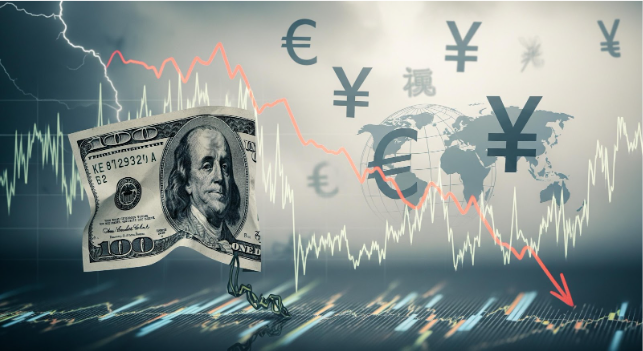

The US dollar has lost 10.7% of its value against major global currencies through June, marking its worst first‑half drop in over five decades. That milestone has raised real concerns among investors, traders, and policymakers about whether the greenback can continue to serve as a global safe haven. While market conditions could reverse, a mix of fiscal instability and policy shocks has weakened confidence in the dollar’s role at the center of world finance.
What’s Driving the Decline of the US Dollar?
Several converging factors contributed to the dollar’s sharp slide in the first half of 2025. The biggest is policy volatility. President Trump’s return to aggressive tariffs and his attacks on the Federal Reserve have created a perception of instability. Investors are increasingly pricing in uncertainty, especially as Trump demands lower interest rates while spending continues to rise.
The U.S. is also running a projected $2 trillion deficit this year. Combined with a ballooning public debt approaching $30 trillion, these figures paint a troubling fiscal picture. That has investors seeking safer alternatives, such as gold, which is being stockpiled by global central banks at a pace not seen since the 1970s.
Market strategist Art Hogan of B. Riley Wealth Management sums it up: “You’re running massive deficits. You’re alienating trade partners. And once momentum starts against the dollar, it’s hard to stop.”
US Dollar: Safe Haven No More?
Traditionally, the US dollar strengthens during global turmoil, as investors flock to its stability. That pattern broke in 2025. The dollar fell alongside equities and bonds in the second quarter, a rare triple‑dip. Treasury Secretary Scott Bessent has downplayed the trend, but analysts see it as a warning.
In April, temporary optimism followed signs that Trump’s tariff hikes might be softer than expected. But the damage was already done. Since January, global funds have reduced holdings of American assets, preferring European and Asian markets. A Bank of America survey found only 23% of global managers now prefer U.S. stocks.
One effect of the dollar’s drop is cheaper U.S. exports, which benefits multinational firms. Companies with large overseas revenue—especially in the S&P 500—gain from favorable currency conversion. But a longer‑term erosion of dollar dominance could raise the cost of capital and damage confidence in U.S. financial markets.
Is There a Path to Recovery?
Some on Wall Street see opportunity. Wells Fargo analysts argue the dollar retains deep institutional advantages: liquidity, legal stability, and unmatched global reach. “There is no real alternative to the US dollar,” said strategist Jennifer Timmerman, citing the euro’s fragmentation and China’s capital controls. Still, major firms like TS Lombard remain short on the dollar, believing political desire for a weaker currency—especially from a trade‑focused Trump administration—will outweigh short‑term economic arguments.
The Federal Reserve could also play a pivotal role. If rate cuts accelerate, that would typically pressure the dollar lower. However, past easing cycles haven’t always translated to predictable currency moves.
Harvard’s Kenneth Rogoff believes we’re entering a multi‑currency world. He predicts a shift to a tri‑polar reserve system over the next 10–20 years, with the euro, yuan, and even crypto assets joining the dollar in global dominance. “The franchise isn’t gone,” he said, “but it’s weakening materially.”
How the Dollar’s Decline Could Reshape U.S. Business Strategy
A weaker US dollar can create both opportunities and risks for business leaders. Exporters may find global buyers more receptive to American products as their relative price advantage improves. However, rising input costs for importers can squeeze margins, especially in sectors reliant on foreign components or raw materials. Companies with international revenue streams could benefit from favorable currency conversions, boosting earnings. Yet the broader shift away from the US dollar as the world’s primary reserve currency raises longer‑term concerns about capital flows, liquidity, and financing costs.
Investors and corporate strategists alike will need to monitor how shifting sentiment toward the dollar intersects with evolving trade policies, Fed actions, and fiscal decisions coming out of Washington. In this environment, agility in capital allocation and supply chain planning could determine who adapts and who falls behind.
How should America restore confidence in the US dollar? Tell us what you think.
Survey