
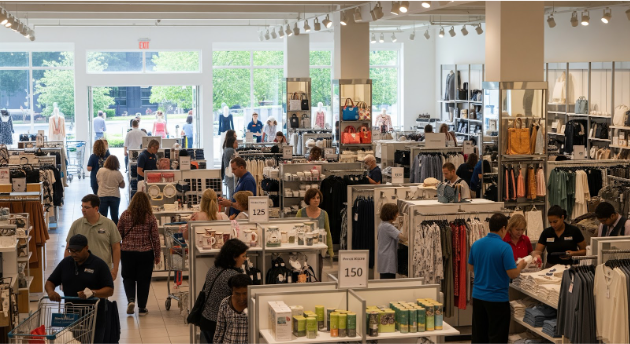

Surprisingly, US retail spending rose more than expected in August, signaling consumers remain active despite a softer labor market and inflation pressures. The Commerce Department reported a 0.6% increase in overall retail sales, while core retail sales, excluding autos, gasoline, and food services, advanced 0.7%. July’s growth remained unrevised at 0.5%. For investors, these numbers show continued resilience, though higher prices are influencing parts of the data.
Economists note that while inflation contributes to stronger retail spend, consumers are not pulling back entirely. Categories like electronics, home improvement, and apparel posted gains. Import prices also rose 0.3% in August, driven by capital and consumer goods, suggesting higher costs are filtering through supply chains. The combination of firm consumer demand and rising input prices creates both opportunities and risks for companies tied to US retail.
US Retail Spending and Consumer Behavior
The August report highlights both resilience and caution. Households are spending more, but much of the growth is concentrated in discretionary categories. Retail purchases of durable goods rose strongly, while gasoline and grocery sales were mixed. Analysts suggest consumers are becoming more selective, trading down in some areas while continuing to prioritize experiences and lifestyle spending. For investors, this selective pattern creates divergence across sectors, with winners emerging in value retail and higher-end discretionary goods.
Market strategists caution that the balance between real and nominal growth matters. Higher prices explain part of the rise in sales, but consumer volume remains steady. This indicates that households are absorbing higher costs rather than retreating from spending altogether. If this trend holds, companies with pricing power may outperform peers more vulnerable to discounting.
Investor Implications for Retail and Beyond
For retailers, the stronger August numbers reinforce expectations of a resilient holiday season. However, margin pressure remains a concern as discounting accelerates in categories sensitive to price competition. Investors will be watching whether core retail gains translate into earnings growth or are offset by higher input costs. Import price gains highlight ongoing inflation risks in supply chains, which could weigh on corporate profitability if not managed effectively.
Bond markets reacted with limited movement, as investors await signals from the Federal Reserve. Persistent consumer spending complicates the Fed’s calculus, as it suggests demand is holding up despite tightening conditions. Equity investors may see opportunities in consumer discretionary and logistics sectors, while remaining cautious on companies facing high input costs. The next few months will determine whether August’s data signals a durable trend or a temporary spike.
Can Resilient Spending Hold Through Year-End?
The bigger question for investors is sustainability. Rising import prices and a softening labor market present headwinds. At the same time, household balance sheets remain relatively strong, with wage growth and credit availability supporting spending. Analysts warn that if inflation flares or unemployment rises further, retail momentum could slow. Still, August’s numbers show that American consumers are not retreating yet.
For investors, this creates a nuanced landscape: opportunities exist in sectors with pricing power, resilient demand, and efficient cost control, while risks persist for companies reliant on aggressive discounting. August’s results underscore the importance of analyzing not just aggregate retail spend, but also where consumers are allocating dollars.
Does increased US retail spending provide a reliable signal of economic resilience? Tell us what you think.