

I have watched this movie before. So have you, probably.
A struggling legacy brand. Heavy short interest. A beloved name that retail investors feel personally connected to. A single Reddit post. Then a chart that goes vertical in under 24 hours, and a wave of new buyers who weren’t there for the original move asking whether they should chase it.
GameStop. AMC. Bed Bath and Beyond. And now Wendy’s.
The pattern is real. The question is what you do with it.
The Pattern: A Short History of What Reddit Does to Heavily Shorted Stocks
The short squeeze playbook was written in January 2021. GameStop had been a struggling brick-and-mortar video game retailer for years, bleeding market share to digital downloads while hedge funds piled into short positions. By January 22 of that year, approximately 140% of GameStop’s public float had been sold short, meaning some shares had been borrowed, shorted, and borrowed and shorted again. The stock was trading at $17.25 on January 4. By January 28 it hit an intraday high of $483.
The mechanism works like this. When a heavily shorted stock starts rising, short sellers face mounting losses on their borrowed positions. To cut those losses they buy shares to cover, which pushes the price higher, which forces more short sellers to cover, which pushes the price higher still. The fuel is short interest. The match is retail buying pressure concentrated enough to start the move.
AMC followed weeks later, peaking near $72 from under $3. Hedge fund Melvin Capital lost 53% fighting the GameStop squeeze and required a $2.75 billion emergency infusion from Citadel. Congressional hearings followed. A movie was made.
The playbook went quiet for a while. Then in May 2024, Keith Gill, known online as Roaring Kitty, posted a single cryptic image on X after nearly three years of silence. GameStop surged 74% the following day. No explanation given. None needed. The crowd recognized the signal.
By summer 2025, the pattern had found new targets. As we covered at the time, Krispy Kreme, Opendoor, Rocket Mortgage, and Kohl’s ran in a coordinated retail wave that Goldman Sachs flagged in a client memo, with a basket of the most-shorted stocks up 60% during that period.
Now it is Wendy’s turn.
What the Wendy’s Stock Short Squeeze Numbers Actually Say
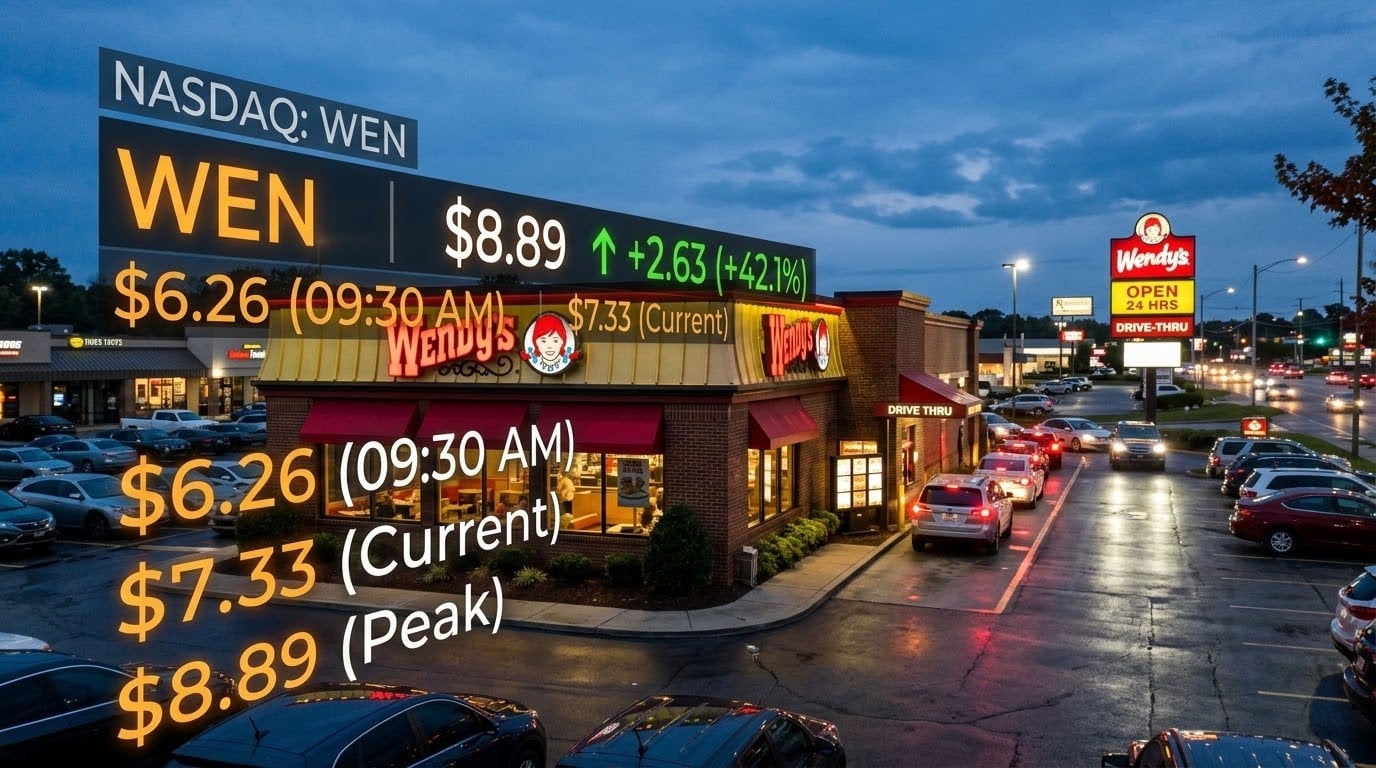
Wendy’s closed June 23 at $6.26, its lowest price in nearly two decades, after falling roughly 47% over the prior year and more than 78% from its all-time high of $24.04 set during the original meme era in June 2021. The company had been grinding lower through weak consumer traffic, rising beef and labor costs, and pressure from activist investor Nelson Peltz’s Trian Fund Management.
Then two things happened on the same day. Wendy’s announced the appointment of Steve Cirulis as its new CFO and chief strategy officer. And a since-deleted WallStreetBets post titled “We need to save Wendy’s before it’s too late” lit the fuse.
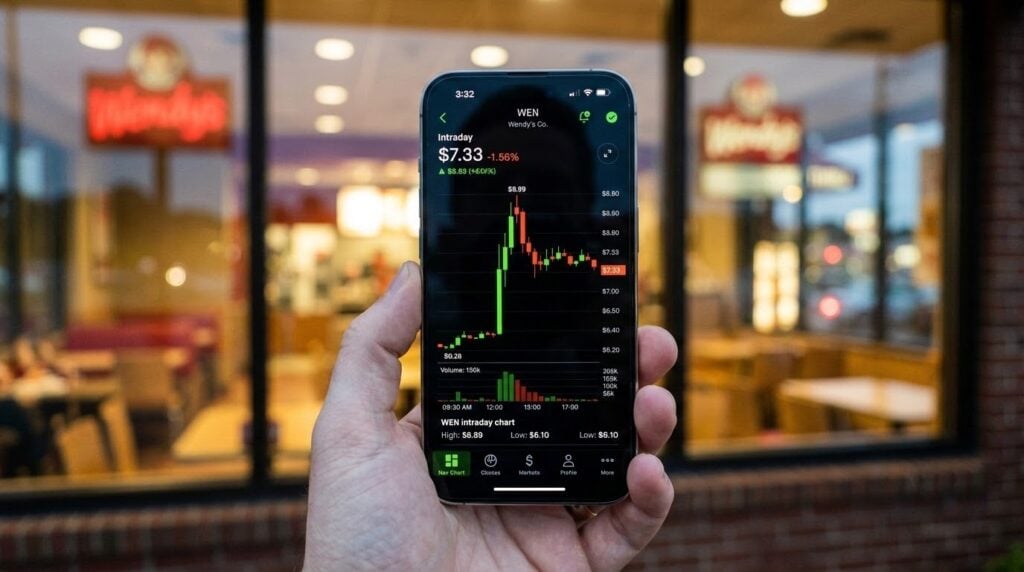
By 10:30 a.m. Eastern on June 24, nearly $790 million worth of Wendy’s shares had changed hands more than 11 times the stock’s average daily volume. Retail investors posted their second-highest day of net buying on record going back to 2012, with flows behind only Nvidia and SpaceX, according to Vanda Research. The stock hit an intraday high of $8.89 before closing up roughly 25% at $7.86. The New York Stock Exchange halted trading multiple times due to extreme volatility.
The short interest was the accelerant. Between 23% and 34% of Wendy’s available float was sold short coming into the move, depending on the data source. Anything above 20% is generally considered elevated enough to create squeeze conditions. GameStop’s 140% in January 2021 was an extreme outlier. WEN’s setup was legitimate but measured, not historic.
Peter Hillerberg, co-founder of ORTEX, noted the mechanics directly: most short sellers had entered at prices low enough that they had not yet been forced to cover. “That situation changes only if the rally continues,” he said. The squeeze was loading, not fully triggered.
Day two confirmed it. On June 25, WEN spiked above $9 in premarket, then faded throughout the session and closed down roughly 7% at $7.33. Don Bilson, head of event-driven research at Gordon Haskett, wrote a three-word client note: “Reddit crowd hijacks stock.”
He was right. He was also only telling half the story.
The Business Underneath the Meme
Strip the squeeze narrative out entirely and ask what Wendy’s actually is as a business.
It is a 6,700-unit global quick-service restaurant franchise generating roughly $540 million in quarterly revenue with an EBIT margin above 15%. Last quarter it produced $59.4 million in operating cash flow and $47.5 million in free cash flow after paying a $26.6 million cash dividend. The dividend yield at recent prices sits near 9%. The forward price-to-earnings ratio is around 14. Price-to-free-cash-flow is approximately 4.7 times. Relative to McDonald’s, Restaurant Brands International, or Darden, those are compressed multiples. The value crowd has legitimate reasons to look at this name regardless of what Reddit is doing.
The catch is the balance sheet. Long-term debt is approximately $4 billion against roughly $115 million in equity. Total liabilities of $4.8 billion sit against total assets of $5 billion. The interest coverage ratio is 2.7 times. A sustained decline in same-store sales does not just hurt earnings at WEN. It threatens the debt coverage math.
The operational picture is genuinely difficult. Q1 2026 same-store sales fell 7.8% in the U.S., a sharp acceleration from a 3% decline the prior year. Company-operated restaurant margin compressed 340 basis points to 11.4% on beef and labor cost pressure. Net income dropped 42% year over year. Wendy’s reaffirmed full-year adjusted EBITDA guidance of $460 million to $480 million, but that guidance assumes a traffic recovery that has not shown up yet.
International is the real bright spot. Systemwide sales grew 6% in Q1 2026, and a new China franchise agreement for up to 1,000 restaurants over 10 years is a credible long-term growth story. It is just not a 2026 story.
The turnaround thesis rests on the Wright and Cirulis pairing. CEO Bob Wright holds 1.77 million stock options, meaning his compensation is directly tied to the stock recovering. Cirulis worked with Wright at Potbelly, where the stock rose approximately 500% during their joint tenure. That track record is not a guarantee. At current prices, the market is not paying much for it, which is either an opportunity or a warning depending on which side of the trade you are on.
WallStreetBets threads have picked up on both angles. One viral post, “Fixing Her: A Wendy’s (WEN) DD,” drew 722 upvotes and 231 comments with detailed analysis of the turnaround thesis. Another framed the contrarian pitch more bluntly: “Wall Street sees risk. We see employee discounts.” As 247 Wall St. reported in its breakdown of the rally’s mechanics, JPMorgan has also flagged three other stocks with similar setups as potential next squeeze targets, suggesting the retail rotation has more targets in mind beyond Wendy’s.
How to Read a Meme Squeeze Without Getting Destroyed By One
The most dangerous moment in any squeeze is not the first day. It is the second and third, when the original buyers are sitting on gains and looking for exits, and the late arrivals are providing the liquidity for those exits.
The question serious traders ask before entry is not “how high can this go?” It is: what is the failure scenario, and at what price does the squeeze fuel run out?
For WEN specifically, short sellers who entered positions below $6.26 are still profitable at $7.33. They are not being squeezed. They are waiting. The mechanical pressure only triggers when the stock pushes above their entry cost and forces their hand. The Reddit crowd needs sustained buying to breach that wall, and Reddit attention spans are measurable in days, not weeks.
As one veteran market strategist noted in a broader warning about the return of speculative behavior to markets, when momentum takes over and rational valuation takes a backseat, the investors who arrived late are carrying the most risk. That observation applies here with unusual precision.
The pre-mortem question is: if you buy WEN today at $7.33, what does it look like in three weeks if the Reddit crowd moves on? The honest answer is probably somewhere between $6.50 and $7.00, where the business valuation math bottoms out given the FCF floor and the dividend yield. That is a 5% to 10% downside to a fundamental floor. Not catastrophic. Not the squeeze upside the WallStreetBets posts were implying either.
For traders who want a framework to separate process from outcome in situations exactly like this one, Thinking in Bets by Annie Duke is the most direct treatment available. Duke’s core argument is that a good decision can produce a bad outcome, and a bad decision can produce a good outcome, and the only thing you control is the quality of your process before you make the call. That principle applies with particular force when the crowd is loud and the chart is moving fast.


FTC Disclosure: TheCapitalist.com participates in the Amazon Associates program. We may earn a commission on qualifying purchases at no additional cost to you.
The Verdict: Trade, Investment, or Neither?
The honest answer depends entirely on which question you are asking.
- If the question is whether the Wendy’s stock short squeeze presented a tradeable setup: yes, it did. On June 23 the ingredients were textbook. A beloved brand at a 20-year price low, meaningful short interest, a management catalyst, and a social media ignition event. Traders who entered Tuesday or in premarket Wednesday, sized the position correctly, and defined their exit before the open had a real trade. That trade is now largely over.
- If the question is whether WEN is a sound long-term investment at current prices: the answer is more nuanced. The free cash flow is real. The dividend is real. The management turnaround team has a credible track record. The international growth story is real. The valuation at 14 times forward earnings and 4.7 times free cash flow is genuinely cheap relative to the sector.
The counterargument is also real. Four billion dollars in debt at 2.7 times interest coverage leaves no margin for error. Same-store sales are declining at an accelerating rate. The competitive environment in quick-service restaurants in 2026 is brutal, with McDonald’s value platform, Chick-fil-A expansion, and fast casual pressure all competing for the same consumer dollars.
WEN does not need Reddit’s help to be worth owning at $7.33 if the fundamental thesis is right. The stock gets there on its own when Q2 numbers give Wright and Cirulis a chance to show deceleration in the traffic decline.
The one number worth watching: Q2 2026 same-store sales. Q1 was -7.8%. If Q2 shows that narrowing to -4% or better, the turnaround thesis has its first real data point and the fundamental floor firms up. If Q2 comes in at -8% or worse, the dividend math gets harder to defend and the short sellers get their narrative back.
Until then, the Wendy’s stock short squeeze is over. The business case is still open. Those are two different things, and confusing them is the most expensive mistake retail investors make in situations exactly like this one.
For educational purposes only. Not financial advice. Consult a licensed financial professional before making investment decisions.
Frequently Asked Questions
What caused the Wendy’s stock short squeeze in June 2026?
A viral WallStreetBets post titled “We need to save Wendy’s before it’s too late” triggered a coordinated retail buying surge on June 24, 2026. Wendy’s had been trading near 20-year lows at $6.26, with 23% to 34% of its float sold short, making it a textbook squeeze target. The simultaneous announcement of a new CFO provided enough of a fundamental catalyst to justify the entry narrative. Retail net buying hit its second-highest level on record going back to 2012, according to Vanda Research.
Is the Wendy’s short squeeze still active?
The initial squeeze largely exhausted itself within 48 hours. Shares surged 42% intraday on June 24 and faded 7% on June 25. Short sellers who entered positions below $6.26 remain profitable at current prices and have not been forced to cover, which means the mechanical squeeze pressure has not fully triggered. A sustained second wave would require the stock to push meaningfully above $8 and hold, forcing those lower-entry shorts to act.
Does Wendy’s have real investment value underneath the meme trading?
The business generates real free cash flow: $47.5 million last quarter, with a dividend yield near 9% at recent prices. The forward price-to-earnings ratio of approximately 14 and price-to-free-cash-flow of 4.7 times are cheap relative to quick-service restaurant peers. The risk is the balance sheet. Long-term debt of approximately $4 billion against $115 million in equity leaves limited room for error if same-store sales continue deteriorating.
What should investors watch as the next catalyst for WEN stock?
The Q2 2026 earnings report is the critical data point. Q1 same-store sales fell 7.8% in the U.S. A Q2 reading that shows deceleration in that decline toward -4% or better would validate the turnaround thesis under CEO Bob Wright and CFO Steve Cirulis. A Q2 reading at -8% or worse puts the dividend under pressure and hands the narrative back to short sellers.
Researched and fact-checked by the TheCapitalist.com editorial team using a multi-source framework. Institutional citations verified. Contradictory expert positions are represented. See our editorial standards.