

Source: YouTube
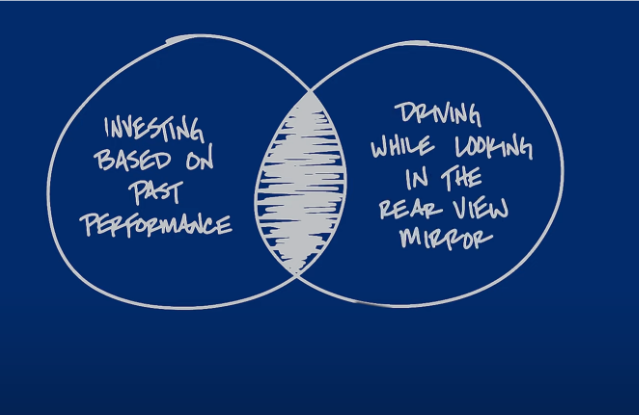
Rearview mirror investing refers to a common but flawed strategy where investors rely too heavily on past performance to guide future decisions. Instead of assessing changing market conditions, risk signals, and valuation indicators, many individuals expect recent trends to continue. This tendency causes them to overexpose themselves at market peaks or chase assets that no longer offer value.
Professionals refer to this behavior as “performance chasing,” and it is one of the leading causes of investor underperformance relative to market benchmarks. Buying stocks that recently surged or sectors that just posted record returns is an emotional impulse and not a strategic one.
Why Rearview Mirror Investing Often Fails
Markets do not reward what already happened. While past results can offer context, they are not predictive. Earnings cycles, monetary policy, interest rates, and geopolitical risks all shift forward-looking expectations. But rearview mirror investing ignores this. It treats price appreciation as a reliable signal for continued success.
This creates two problems. First, it delays entry into high-potential investments until most gains are gone. Second, it increases exposure to assets at or near their peak valuations. The result is a distorted risk-reward balance that leaves portfolios fragile in downturns.
A recent example: tech stocks in 2021. Investors who chased after explosive growth missed warning signs in valuations and macro trends. When conditions shifted in 2022, losses mounted quickly, especially among those who ignored broader signals like rising rates and tightening liquidity.
How Forward-Looking Investors Navigate
The opposite of rearview mirror investing is forward-looking investing. This approach uses predictive indicators such as expected earnings, sector rotation trends, macroeconomic forecasts, and valuation models to guide decisions. It demands discipline and often requires resisting the temptation to follow the crowd.
Forward-looking investors anticipate shifts rather than react to them. They understand that market conditions change, and asset performance is cyclical. They value downside protection and prefer to miss short-term gains rather than take on long-term risk without a clear thesis.
This doesn’t mean ignoring the past entirely. Instead, it means interpreting things in context. A forward-looking investor might recognize that a sector has had a strong run and decide to rotate into undervalued areas before momentum fades. They may also build cash positions during euphoric rallies and wait for more favorable entry points.
Avoiding Emotional Traps
Rearview mirror investing is closely tied to behavioral biases. Recency bias, herd mentality, and overconfidence all reinforce the idea that what worked before will work again. But market conditions rarely repeat themselves so cleanly.
To protect against these traps, investors should focus on their long-term objectives and risk tolerance. Diversification, periodic rebalancing, and data-driven analysis reduce emotional decision-making. Smart allocation means acknowledging uncertainty, not pretending that the past decade of returns will repeat indefinitely.
Market strategists recommend evaluating portfolio exposures based on risk-adjusted return expectations. This approach aligns with forward-looking principles and often produces steadier outcomes over time.
Valuation Matters More Than Momentum
Historical returns rarely explain future performance. In contrast, valuations provide insight into potential outcomes. High price-to-earnings ratios and narrow market leadership often precede lower returns. Meanwhile, unloved sectors with stable fundamentals and low multiples can offer better risk-adjusted opportunities.
Investors who value fundamentals over headlines are more likely to avoid sharp losses. Forward-looking tools like discounted cash flow models, inflation forecasts, and interest rate projections offer a clearer picture than yesterday’s price chart.
Do you agree that rearview mirror investing hurts portfolios? Tell us what you think.