

The Nasdaq just reached an all-time high after a 12-session winning streak, its longest consecutive run since July 2009, completing a V-shaped recovery from the Iran war shock that left most investors frozen in place less than a month ago. This article explains what the Nasdaq all-time high means for long-term investors and pre-retirees, why waiting for a pullback has historically cost investors more than any correction ever saved them, and what specific portfolio actions this moment should trigger depending on where you are in your financial life.
The short answer: history shows buying at all-time highs outperforms waiting for a dip roughly 70% of the time, according to data from Of Dollars and Data. Long-term investors should automate contributions and ignore the streak. Pre-retirees should use this up-market to replenish their short-term cash bucket to a two-year expense target before the next drawdown arrives.
Did the Nasdaq All-Time High Come Out of Nowhere?
Three weeks ago, the CNN Fear and Greed Index sat at 15, deep in extreme fear territory. Elsewhere, the Bank of America Global Fund Manager Survey released in early April showed institutional sentiment had collapsed to 3.7, the most bearish reading since June 2025. Global equity allocations had fallen from a net 37% overweight to just 13% overweight, the lightest positioning in nearly a year. Fund managers had pulled back. Retail investors had gone quiet.
Then the ceasefire came.
PepsiCo beat earnings. Netflix beat earnings. TSMC reported a record profit. AMD jumped 7.5% on AI chip demand. The S&P 500 closed at 7,041, a new all-time high. The Nasdaq logged its 12th straight positive session. The Fear and Greed Index climbed from 15 to 56 in under three weeks.
Macro expectations and prices diverged sharply at the height of the war shock. Historically, those disconnects get resolved higher. This one did.
The investors who held through the fear watched their portfolios recover. The investors who moved to cash are now doing the math on how much they lost.
Should You Buy Stocks at a Nasdaq All-Time High?
Twelve consecutive up sessions sound significant. It is not a signal.
The S&P 500 has hit an all-time high roughly every 18 trading days since 1950, meaning the index spends most of its existence at or near record territory. Framing a streak as a warning or a green light applies the same analytical error in two different directions.
The data on buying at all-time highs is consistent and uncomfortable for investors who prefer to wait. Buying consistently, including at market peaks, outperforms waiting for a dip in approximately 70% of historical periods, according to data from Of Dollars and Data. The cost of sitting out is not hypothetical. It compounds forward in missed returns and backward in lost time.
One investor captured it plainly in a forum thread earlier this year: “I know someone who has been waiting to invest since 2017 because he thought the market was too high. It’s now 2026, and he’s still waiting.”
Nine years. The crashes he was waiting for came and went. By the time each one arrived, the recovery had already lapped him.
For long-term investors still in the accumulation phase, the playbook does not change at a market high. Automate contributions. Minimize expenses. Remove yourself from the execution decision entirely. The streak is a news story. Your contribution schedule is a wealth-building system.
If you want a rigorous data-driven framework for staying invested through exactly this kind of moment, Just Keep Buying by Nick Maggiulli makes the case more thoroughly than any market commentary can. The book addresses the record high that feels wrong to buy into, and why the feeling is the problem, not the price.


Why Surviving the Pullback Doesn’t Mean the Hard Part Is Over
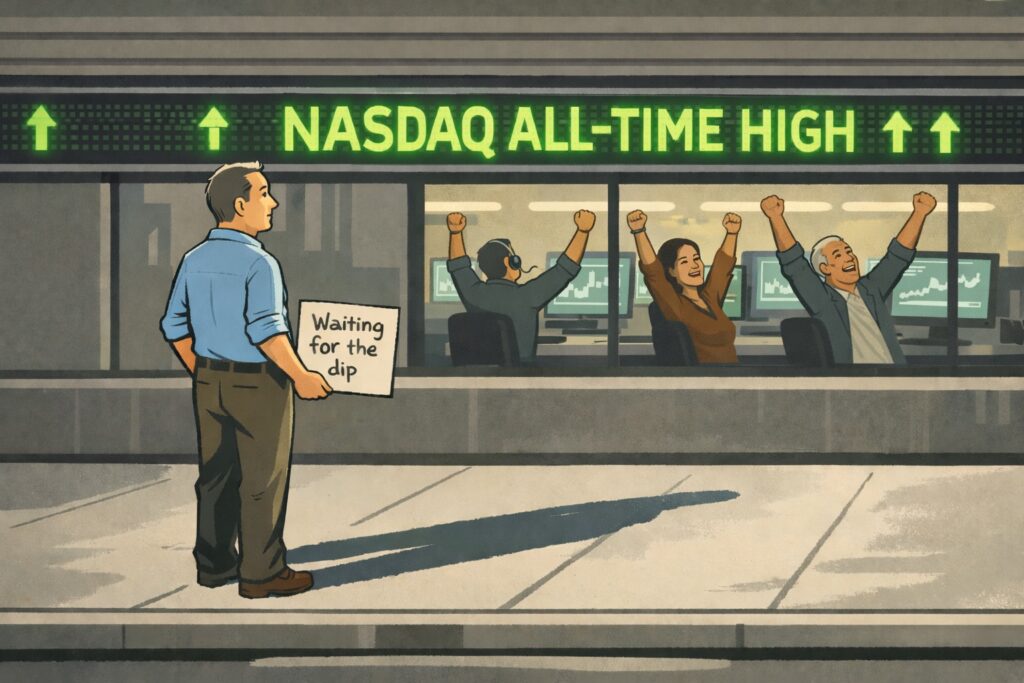
Here is the trap the recovery sets.
The investor who held through a 15% drawdown and watched it fully recover now has evidence that staying the course works. That evidence is correct. It is also dangerous.
A successful recovery makes the next drawdown feel less probable, not more.
Behavioral confidence after a winning streak is its own category of risk. Recent investor sentiment surveys put the share of American investors affected by FOMO at nearly one in eight. At market highs, that same psychology runs in reverse. The investor who held well will now start to feel invincible. The investor who missed the recovery starts to chase.
Both reactions are driven by the same emotional engine, just pointed in opposite directions.
The question to ask right now is not whether the Nasdaq all-time high is sustainable. The question is whether your current allocation is one you could hold through a 40% drawdown without changing the strategy.
If the answer is no, the allocation is wrong. The market did not become safer because it recovered.
What Should Pre-Retirees Do When the Market Hits a Record?
The answer depends entirely on where you are in your financial life.
For the long-term accumulation investor, the action is almost nothing. Confirm your contributions are automated. Check your expense ratio. If you have been holding cash waiting for a better entry point, the data says there is no better entry point coming that will offset the compounding cost of waiting. Deploy it systematically, not all at once on streak euphoria, and move on.
The S&P 500’s current Shiller CAPE ratio warrants a note. Elevated CAPE readings historically compress 10-year expected returns. That is not an exit signal. It is a recalibration signal. Lower your return expectations for the next decade and size your savings rate accordingly. The answer to a high CAPE is to save more, not to invest less.
For pre-retirees within five years of their retirement date, the Nasdaq all-time high is not a celebration. It is a window. The specific action it should trigger is replenishing the short-term cash bucket from equity gains while the market is up.
How the Three-Bucket Retirement Strategy Works
The bucket strategy divides a retirement portfolio into three distinct time horizons:
- Bucket one: one to two years of living expenses in cash or short-term CDs
- Bucket two: bonds and stable assets covering years three through ten
- Bucket three: equities for the long horizon beyond ten years
The cardinal rule is that you never sell equities in a down market to fund expenses. You live off bucket one. You replenish bucket one from bucket two and bucket three only during up markets.
Right now is an upmarket. If your bucket one is below its two-year expense target, the Nasdaq all-time high is your replenishment signal. Miss this window and you may find yourself selling equities at the bottom of the next correction to cover monthly expenses.
That sequence of events is what turns a manageable drawdown into a permanent retirement shortfall.
For readers building toward retirement who want a plain-language framework for how index-based investing holds up across full market cycles, A Random Walk Down Wall Street by Burton Malkiel remains the most rigorously tested guide to long-term portfolio construction for fifty years. The 2024 edition covers the specific challenge of structuring retirement portfolios for durability, not just growth.

Is the Shiller CAPE Ratio a Sell Signal Right Now?
Not every investor should read a Nasdaq all-time high the same way. There is a legitimate case for caution, and it lives in one data point.
The Shiller CAPE ratio measures stock valuations against 10 years of inflation-adjusted earnings. When sustained above 30, it has historically predicted lower returns over the following decade. The current reading warrants attention for any investor within five years of a major capital event, whether that is retirement, a business sale, or a large planned expenditure.
This is not a market timing argument. The historical record does not support selling at high valuations and waiting for a crash. What it does support is stress-testing your equity exposure when CAPE is elevated and your time horizon is compressed.
The question is not whether to invest. The question is whether your current equity weight is appropriate for a portfolio that may need to fund withdrawals within five years, in a market that has already run 10% in 10 trading sessions.
If you have not reviewed your equity allocation since before the Iran war shock, now is the time. Not because the Nasdaq all-time high means a crash is coming. Because a record high combined with a compressed time horizon is the specific combination that valuation indicators have historically flagged as worth examining before the next correction arrives.
You can also review where this bull market started and how far it went to get a fuller picture of the current cycle.
What to Do Before the Market Opens Monday
The action depends on where you are in your financial life, and it is specific.
If you are a long-term accumulation investor:
- Confirm contributions are automated and scheduled regardless of index level
- Check that your expense ratio is as close to zero as possible
- Do nothing else. The streak is not an instruction
If you are a pre-retiree:
- Check bucket one against your two-year expense target
- If it is short, rebalance from equities now while the market is up
- Review your Social Security claiming timeline against your sequence-of-returns window. Delaying Social Security while drawing from bonds in the early retirement years reduces the risk of liquidating equities at the wrong moment
For both: ask whether you would hold your current allocation through a 40% drawdown without making a single change. If the honest answer is no, resize before the next shock arrives.
The Nasdaq all-time high is the best possible time to do it, because right now, you are not afraid.
The next time you have this conversation with yourself, you probably will be.
For educational purposes only. Not financial advice.
Frequently Asked Questions
Is it a mistake to invest when the Nasdaq is at an all-time high? No
The S&P 500 has hit an all-time high roughly every 18 trading days since 1950, and data consistently shows that buying at highs outperforms waiting for dips in approximately 70% of historical periods. The cost of waiting compounds forward in missed returns.
What does a 12-day Nasdaq winning streak historically mean for future returns?
Very little. Streak data describes what has already happened, not what comes next. No reliable predictive relationship exists between the length of a winning streak and subsequent returns. Contribution discipline matters more than entry timing.
What should pre-retirees do when the market hits a record high?
Pre-retirees should use a market high to replenish their short-term cash bucket to a two-year expense target. This locks in gains and reduces the risk of selling equities during a downturn to cover living expenses, which is the core sequence-of-returns threat in early retirement.
How do I know if my portfolio is positioned correctly at market highs?
Ask whether you would hold your current allocation through a 40% drawdown without making a change. If no, the allocation does not match your actual risk tolerance. A record high is the right time to resize, because you are making the decision from calm rather than fear.
Add Image
Add New FAQ