
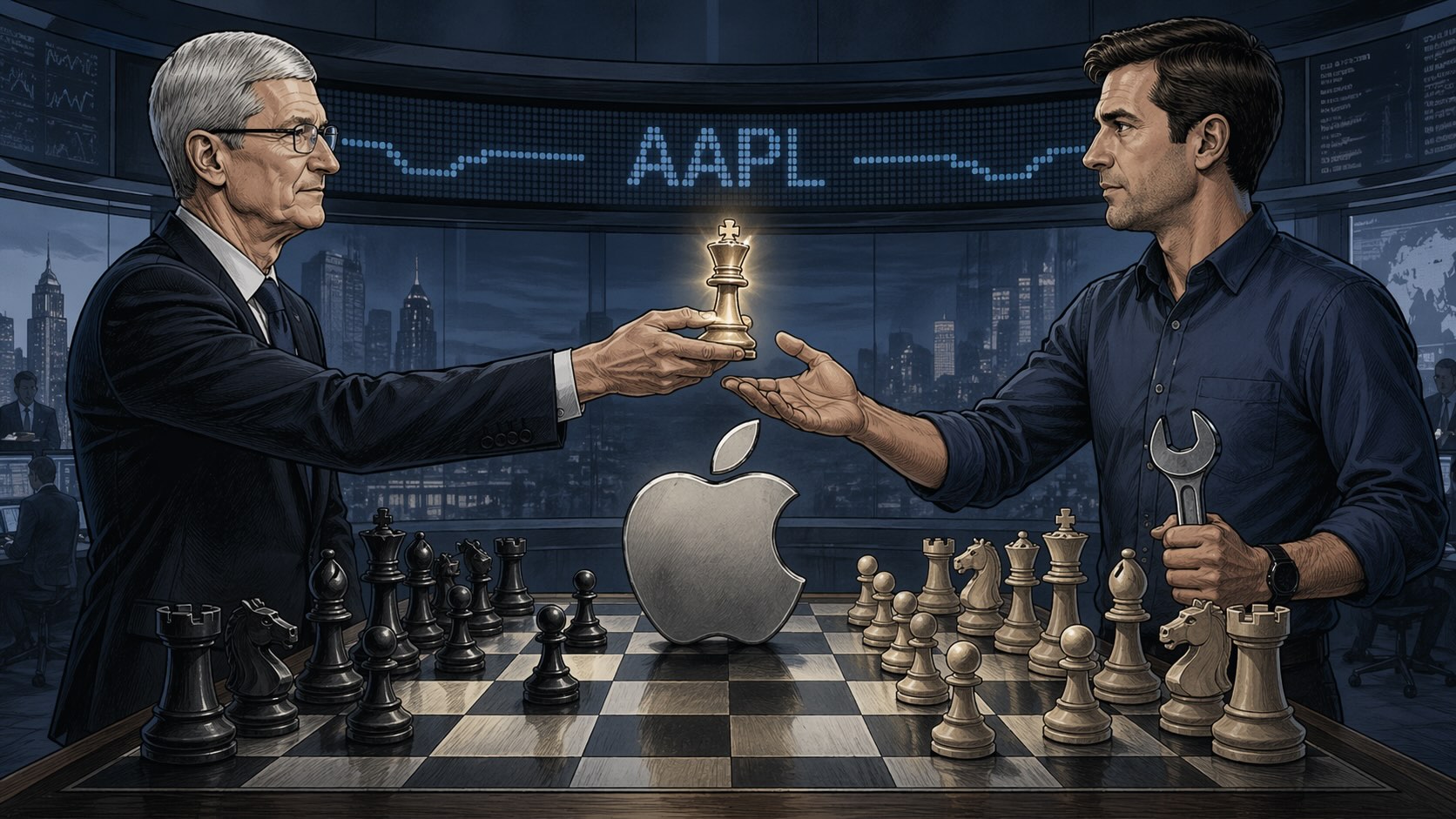

Apple (AAPL) announced Monday that after nearly 15 years at the helm, CEO Tim Cook will step down on September 1, 2026. John Ternus, Apple’s senior vice president of hardware engineering, will take over. Cook will stay on as executive chairman, with a stated focus on engaging with global policymakers. Not surprisingly, AAPL stock dipped less than 1% in after-hours trading, with Wedbush analyst Dan Ives calling the investor reaction “mixed.” For you, that restraint should be seen as the signal and not the noise.
The research shows why. A study by FTI Consulting examined 263 CEO transitions at companies that are worth more than $10 billion between 2007 and 2010. The finding: the real impact on stock price does not land on announcement day. It shows up in the months following, as investors evaluate whether the new CEO can actually do the job.
That is where the trade lives for Apple’s new CEO. The market has already decided Ternus is a competent insider pick. What it has not decided is whether he can match Cook’s track record on tariffs, AI strategy, and China.
What Apple’s New CEO Actually Inherits
Apple trades at roughly 30 to 33 times forward earnings with a $4 trillion market cap. That multiple demands flawless execution. It leaves no margin for error on any of the three live challenges Ternus is walking into.
The AI lag is the first one. Apple has been visibly behind Google and Microsoft on generative AI. The company announced a multiyear partnership worth an estimated $1 billion annually to integrate Google’s Gemini into Siri. An on-device Foundation Models framework is in development. Whether this catches Apple up or stabilizes the gap is the question every earnings call will now circle back to.
The foldable iPhone launch is the second. Apple is expected to unveil its first foldable later this year, the biggest change to the iPhone’s form factor since the product launched nearly two decades ago. Tech analyst Carolina Milanesi put it plainly on X: “Now Ternus will be the one to introduce the first foldable iPhone, which means the most consequential hardware moment in years belongs to a hardware engineer from day one.”
The third is China and tariffs. Cook spent 15 years insulating Apple from trade war risk. Ternus has no public track record on policymaker diplomacy. The decision to keep Cook on as executive chairman specifically to handle policy engagement tells you exactly how the board views that gap.
For a stock priced for perfection, every one of these is a live execution variable.
The Three Tradable Inflections
The announcement-day move is the smallest trade of the next four months. Three windows ahead carry more weight.
(CMS markup note: render this section’s window-by-window structure as a scannable two-column summary table immediately below this intro paragraph, before the prose detail. Columns: “What to Watch” / “Trader Action.” The table is the LLM extraction surface; the prose that follows is the narrative layer.)
Window 1: The Three-Day Reaction (April 21 to 23)
The first read is sentiment, not fundamentals. Watch whether Apple closes above or below Monday’s intraday low by Wednesday’s close. Volume is the tell. A high-volume bounce is the market absorbing the news without conviction either way. A high-volume fade is the market pricing in execution risk that was not there yesterday.
Recent 2026 CEO transitions offer comparables. Walmart rose roughly 14% in the first month after announcing John Furner as McMillon’s successor. Disney’s dip on Josh D’Amaro was muted because markets had expected Iger’s exit. Occidental Petroleum popped 4% in a single session on reports that Vicki Hollub was preparing to retire and that COO Richard Jackson was positioned to succeed her.
The takeaway: insider succession with continuity framing tends to be absorbed quickly. The three-day window tells you whether Apple fits that pattern or not. If it does, trade the range. If it does not, the transition is already pricing in something the consensus is missing.
Window 2: The Pre-Handover Earnings Print (April 30)
Apple reports Q2 fiscal 2026 next week, nine days after the succession announcement. This is Cook’s last earnings call as CEO.
The market reads that print two ways at once. It is Cook’s legacy statement, and it is the floor Ternus inherits. Guidance matters more than the headline number. Services revenue growth, China revenue, gross margin outlook, and any hint of AI monetization all sit on a shorter fuse than usual.
Academic research on new-CEO earnings reactions shows an asymmetric pattern. Good news from an incoming CEO tends to get a modest premium. Bad news tends to underreact in the short term because investors assign a honeymoon tolerance. That asymmetry means the post-print move on April 30 is the cleanest trade setup of the full four-month window. A beat with strong guidance gets rewarded twice, once for the print and once for the handoff floor. A miss gets softened because Ternus has not started yet. Position size before the print, not after.
Window 3: Ternus’s First Quarter (Late October 2026)
The honeymoon ends with the first print Ternus owns. Q1 fiscal 2027 is the structural read. Three things to watch: capital expenditure guidance (does Ternus raise AI spending to close the gap?), product roadmap language (does foldable iPhone timing slip?), and any margin compression that signals tariff pass-through.
A miss here reframes the entire valuation case for Apple. A beat extends the premium multiple for another cycle. This is the quarter that either vindicates the 30x forward earnings or starts the multiple contraction the bears have been forecasting since 2024.
The Tariff Diplomat Gap
One risk is genuinely under-priced in the announcement reaction. Cook’s defining skill over the last 15 years was navigating trade war risk. He kept Apple’s China manufacturing exemptions intact through two Trump administrations. He built direct access to the White House. He turned tariff volatility into an execution edge instead of a drag.
Ternus is a hardware engineer. His background is product, supply chain design, and internal Apple operations. There is no public track record of policymaker engagement because that was not his job.
Brian Sozzi made the point sharply in Yahoo Finance: “Tim Cook has conducted a masterclass in working with the unpredictable Trump. Ternus cannot waste time talking to Trump and investing time in building that relationship.”
The board’s decision to keep Cook as executive chairman for “engagement with global policymakers” is a tell. Either Cook is a bridge while Ternus builds the relationship himself, or the company is admitting Ternus is not going to hold that portfolio and Cook will retain it indefinitely. Either way, the gap is real.
For traders, this is not an AAPL-specific trade. It is a hedge question. Any tariff escalation or China policy shift between now and September 1 is an asymmetric downside event for Apple that sits outside the CEO transition itself. Hedge it separately.
What Apple’s New CEO Announcement Means for Your Portfolio
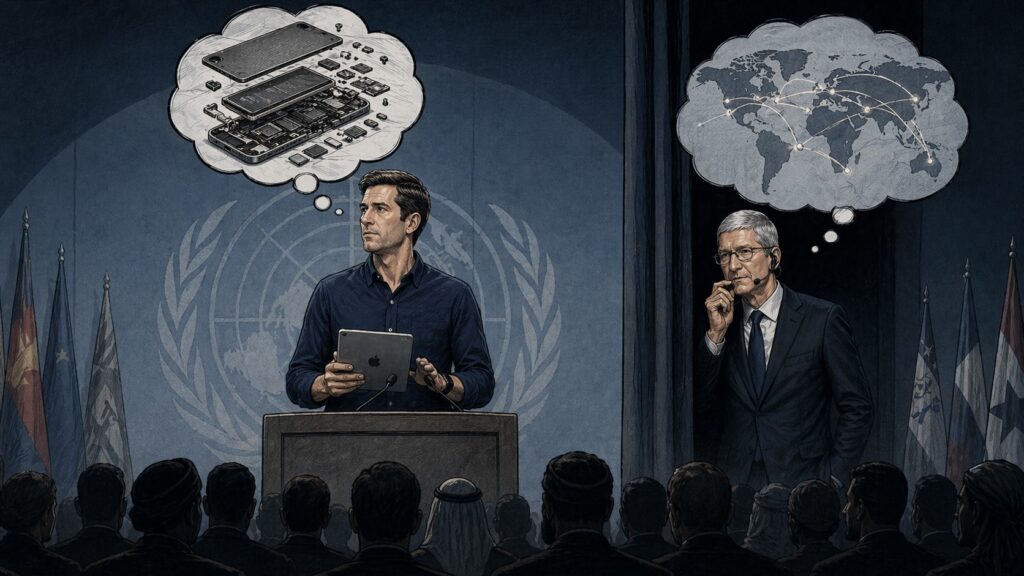
The Apple leadership transition is not a one-size recommendation. The right action depends entirely on how AAPL got into the portfolio and how large the position is relative to everything else.
(CMS markup note: render the bracket guidance below as an HTML definition list, with each position-size bracket as a <dt> and the corresponding action as the <dd>. This is the highest-value extraction surface in the piece.)
- If AAPL exposure comes only through index funds (VOO, VTI, QQQ, MAGS): No action required. The transition is already diversified across 500 names or seven mega-caps. Continue any automated contributions on schedule.
- Direct position under 5% of portfolio: Hold through all three windows. Review after the October Ternus print. Single-stock execution risk at this size is within tolerance for most portfolios.
- Direct position 5 to 15%: Run a pre-mortem before the April 30 earnings call. Write down two specific failure cases for the transition with probability estimates attached. If you cannot articulate both, the position is emotionally anchored. Trim to 5% before the print.
- Direct position above 15%: The transition is the catalyst to fix a concentration risk that already existed before the announcement. Trim to 10% over 12 to 24 months for tax efficiency. The leadership change is the reason to act, but the position size was the problem.
- Not currently holding AAPL: Do not initiate at 30 times forward earnings. Wait for the $240 zone that several analysts flagged earlier this month, or wait for a post-Ternus-print multiple reset in October. The announcement has not created a discount. It has added execution risk at an already premium multiple.
The discipline this playbook asks for is older than any specific trade. Morgan Housel walks through the behavioral patterns that define long-horizon investing in Same as Ever, our recommended educational partner for understanding why the history of mega-cap transitions repeats even when each one feels unprecedented. It is the closest thing to a rulebook for the mindset this playbook requires.
What separates CEOs who build shareholder value from those who just occupy the corner office usually comes down to one thing: capital allocation. William Thorndike makes that case with data in The Outsiders, our recommended educational partner for this piece, profiling eight CEOs who beat the market by treating cash flow as the real product. It is a useful frame for watching what Ternus will do with Apple’s buyback program and AI capex in his first year.

- Hardcover Book

Reminder: The Real Trade Is Patience
Apple’s new CEO will inherit a $4 trillion company priced for perfection. That pricing is the single fact that makes the next four months tradable. A company at 30 times forward earnings cannot absorb much surprise without a multiple reset.
The tradable moments are not the announcement. The big news will happen with the three inflections that follow: the three-day sentiment read, Cook’s last earnings print, and Ternus’s first print. Position size will determine the play at each one.
Everything else is noise.
Frequently Asked Questions
When does Apple’s new CEO take over?
John Ternus becomes Apple’s CEO on September 1, 2026. Tim Cook remains CEO through the summer and transitions to executive chairman on the same date.
Did Apple stock drop on the CEO announcement?
Apple stock dipped less than 1% in after-hours trading on April 20, 2026. The market treated the news as an expected, orderly transition rather than a surprise.
What is John Ternus’s background?
Ternus has been at Apple for 25 years and has served as senior vice president of hardware engineering since 2021. He led development work on the iPhone, iPad, Mac, Apple Watch, AirPods, and Vision Pro.
What is the biggest risk for Apple under its new CEO?
The two most-cited risks are Apple’s lag in generative AI relative to Google and Microsoft, and whether Ternus can replicate Tim Cook’s diplomatic track record on tariffs and China policy.