
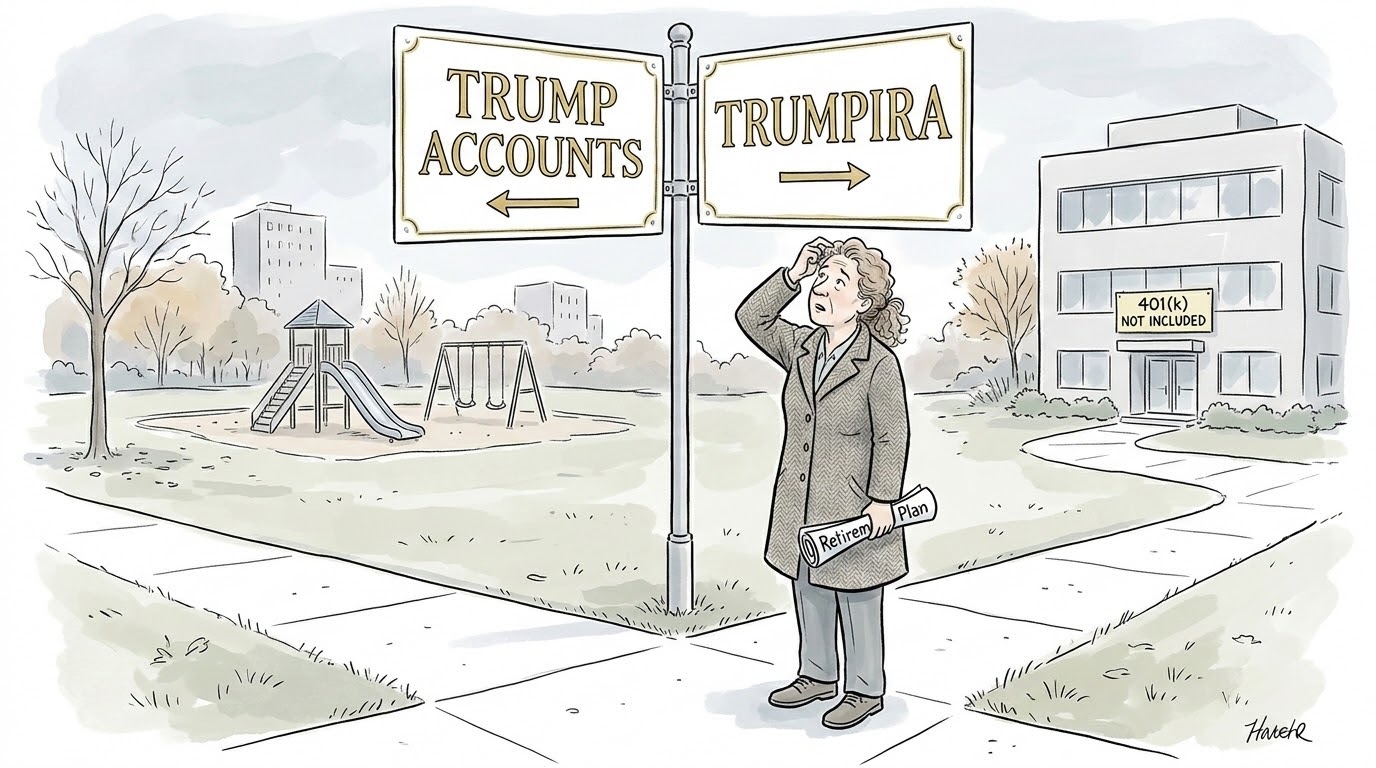

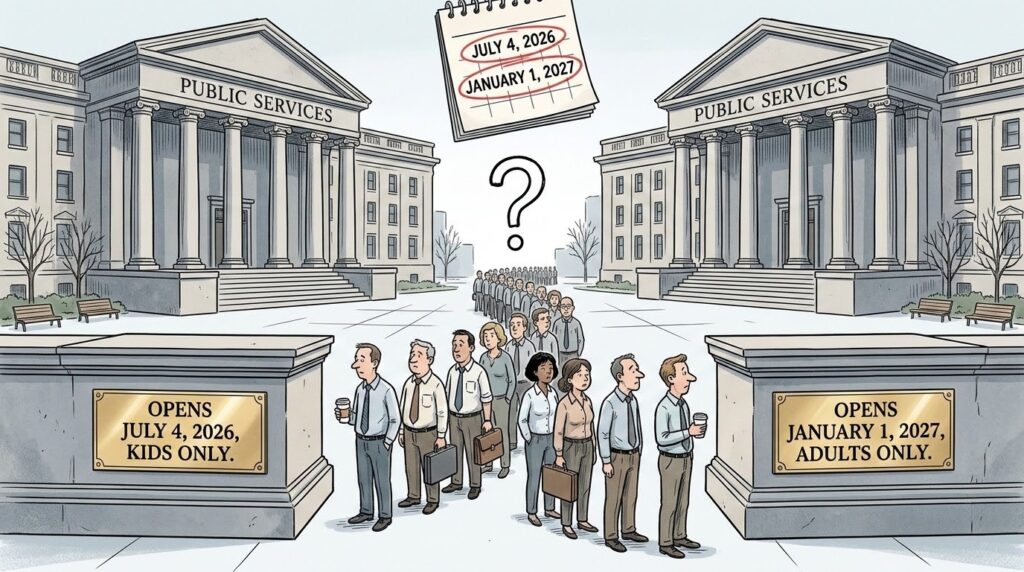
QUICK SUMMARY: The Trump retirement program is two separate programs. Trump Accounts are custodial IRAs for kids under 18, opening July 4, 2026, with a $1,000 federal seed. TrumpIRA is an IRA marketplace for adults without a 401(k), opening January 1, 2027, with a Saver’s Match up to $1,000 a year. Learn the difference between the two programs so you know where you qualify and where to put your money.
Picture a 58-year-old woman who runs a small bookkeeping practice from her kitchen table. She files a Schedule C every spring. She has two grandchildren born in 2025. She watched the news on April 30, 2026 and heard the President sign an order creating a new retirement program called TrumpIRA. She also heard about something called Trump Accounts, with a $1,000 government deposit for kids. She is not sure if these are the same thing. She is not sure which applies to her, which applies to the grandkids, or whether to wait, enroll, or do nothing.
She is not the only one. Conversations on retirement planning forums right now sound like this: people trying to figure out which retirement vehicle applies to their situation, and finding the answer harder to track down than it should be.
The Trump retirement program is not one program. It is two. They share a name. They do not share rules.
Who Qualifies for a Trump Account vs. a TrumpIRA?
Here is what you need to keep straight:
| Feature | Trump Accounts | TrumpIRA |
| Who it is for | Children under 18 | Adults without an employer 401(k) |
| Launch date | July 4, 2026 | January 1, 2027 |
| Federal contribution | $1,000 seed for kids born 2025 to 2028 | Saver’s Match up to $1,000 per year |
| Annual contribution cap | $5,000 | Standard IRA limits |
| Investment options | Equity index funds at 0.10% expense or less | Equity index funds at 0.15% expense or less |
| Created by | 2025 reconciliation law | April 30, 2026 executive order |
| Website | trumpaccounts.gov | TrumpIRA.gov |
While the same person’s name is on both doors, there are two different houses inside.
Trump Accounts: Built for Children, Not for You
Trump Accounts came first, as part of the One Big Beautiful Bill Act passed in July 2025. They are custodial-style traditional IRAs opened in a child’s name and managed by a parent or guardian. Any U.S. child under 18 with a Social Security number is eligible.
The headline benefit is the pilot contribution. For children born between January 1, 2025 and December 31, 2028, the federal government will deposit a one-time $1,000 seed contribution if the family files IRS Form 4547 to elect it. Parents, grandparents, employers, and certain charities can add up to $5,000 per year per child during what the law calls the growth period, which runs from birth through December 31 of the year before the child turns 18.
There are real restrictions. Investments are limited to mutual funds or ETFs that track broad U.S. equity indexes, with an expense ratio cap of 0.10%. No fixed income. No international diversification. No alternatives. Distributions are heavily restricted before the child turns 18.There is also a quiet tax problem most coverage has missed. The federal $1,000 seed money does not create basis. Neither do employer contributions or charitable contributions.
Only out-of-pocket contributions from parents and family members count as basis at withdrawal. So a $4,000 parent contribution inside a $40,000 retirement balance has only $4,000 of tax-free basis at age 59½. The other $36,000, including the federal seed and all earnings on it, is taxed as ordinary income. For families with a child who has earned income, a custodial Roth IRA may produce a better tax outcome over a working life.
TrumpIRA: Built for Adults Without a 401(k)
The TrumpIRA is the program signed into existence on April 30, 2026. It is not a new account type. It is a federally curated marketplace where workers without an employer plan can compare and open private-sector IRAs that meet Treasury standards.
The target audience is specific: independent contractors, gig workers, self-employed individuals, part-time employees, and small business workers without employer-sponsored coverage.AARP estimates 56 million Americans fall into this category. The Pew Charitable Trusts puts the number at roughly 50 million.
The site itself launches January 1, 2027. To make the listings, IRA providers must hold their all-in expense ratio at or below 0.15% and must drop minimum contribution and balance requirements. That is a tight ceiling that excludes most actively managed funds, target-date funds at smaller providers, and any product with advisor or platform fees stacked on top of the underlying expense ratio. The providers who can hit that number at scale are a small group: Fidelity, Vanguard, Schwab, BlackRock, and a handful of indexers. The TrumpIRA marketplace will, by design, route retirement assets toward index providers.
The financial hook is the Saver’s Match, a provision passed under SECURE 2.0 in 2022 and now scheduled to take effect in tax year 2027. Workers earning under $35,500 single, or $71,000 joint, can claim a 50% federal match on the first $2,000 they contribute to a qualifying retirement account. The maximum match is $1,000 per filer, $2,000 per couple. The executive order is the awareness and access layer for this match. The match itself is not new.
Why Doesn’t Everyone Just Claim the Saver’s Match?
Here is the part the announcement does not address. To claim the maximum $1,000 federal match, a worker has to contribute $2,000 first.
Federal Reserve survey data on liquid savings says single workers in the income brackets that qualify for the full match typically have less than $400 they could pull from a checking or savings account without going into debt. The match is real. The contribution required to claim it is, for most of the target population, more cash than they have on hand.
This is not a new problem. The predecessor to the Saver’s Match, the Saver’s Credit, was a non-refundable tax credit available since 2002. The Center for Retirement Research has documented that less than 6% of taxpayers claimed it in 2021. The reason is largely that low-income filers had no tax liability to apply it against and could not afford the contribution to begin with.
The Saver’s Match fixes the refundability problem. The deposit goes directly into the IRA. But it does not fix the contribution problem. Shai Akabas of the Bipartisan Policy Center, speaking to CNBC after the order was signed, noted that the significant majority of people are unlikely to take these proactive steps on their own. Without auto-enrollment, the match relies on workers having both the cash and the initiative to act. Most policy researchers agree that auto-enrollment moves the needle by 70% or more on take-up. Auto-enrollment requires Congress, not an executive order.
Does the TrumpIRA Replace State Auto-IRA Programs?
Twenty states have already enacted retirement savings legislation for workers without employer plans, and 17 of them operate mandatory auto-IRA programs that automatically enroll workers unless they opt out. By the end of 2025, more than 1.2 million Americans had enrolled.
The states with active programs include California, Oregon, Illinois, Colorado, Connecticut, Maryland, and Virginia, among others. If you live in one of these states and your employer does not offer a 401(k), you almost certainly already have an on-ramp. The state program is operating now. The TrumpIRA marketplace is not, and will not be, until January 2027.
The federal program does not preempt state law, at least not in the executive order text. Treasury has not yet said how the two systems will interact. For workers in auto-IRA states, the practical answer is straightforward: do not wait eight months for a federal marketplace when an enrollment is already running. Compounding matters more than program selection.
Which Trump Retirement Program Should You Actually Use?
If you are pre-retirement, ages 58 to 65, and you have spent your career without an employer plan, the TrumpIRA is unlikely to be the right primary vehicle. The 0.15% expense cap forces a near-pure equity allocation, which is not the right structure for someone within five years of drawdown. A traditional IRA opened at any major brokerage gives you access to the same low-cost index funds plus the bond and balanced products you actually need at this stage. Open the account now. Use the marketplace later if it offers a meaningful Saver’s Match advantage when it goes live.
If you are self-employed and earning $40,000 to $80,000, a [Solo 401(k) or SEP IRA](INTERNAL: TC small-business retirement options) gives you contribution limits well above what an IRA provides and the same low-fee index fund access. Do not wait for the federal marketplace. The wait costs you eight months of compounding for no offsetting benefit.
If you are a 1099 worker or gig worker earning under $35,500 single, the TrumpIRA may be useful starting in 2027, but check first whether your state has an active auto-IRA program. If yes, enroll there now. If no, consider opening an IRA at a low-cost provider before year-end so your habit is built when the federal Saver’s Match goes live.
If you have grandchildren born between 2025 and 2028, the Trump Accounts program is worth a look for the $1,000 federal seed. Run the numbers against a custodial Roth IRA before you decide. For a child with earned income, the Roth almost always produces a better long-term tax outcome.
The point underneath all of this is one most retirement coverage gets backward. Account choice is downstream. Contribution discipline is upstream. The right account is the one you actually fund. If you want one book that drives that point home, our educational partner pick is Just Keep Buying by Nick Maggiulli.


The Political Risk Nobody Is Pricing In
The TrumpIRA exists by executive order, not legislation. TrumpIRA.gov launches January 1, 2027. The [Saver’s Match](INTERNAL: TC Saver’s Match background piece) itself is statutory, passed under SECURE 2.0 in 2022, and is durable. The marketplace is not. By the time the website goes live, the country will be 18 months into the next presidential election cycle. A Democratic successor in 2029 could rebrand or restructure the federal portal on day one. The Trump retirement program label is a political marker that adds durability risk to the website, the comparison tool, and the implementation guidance, even if the underlying match survives.
For most workers, that risk is manageable. For workers building their entire retirement plan around the federal marketplace, it is not. Plan for the match. Pick your provider directly. Do not wait for the website to do the work.
For educational purposes only. Not financial advice.
Frequently Asked Questions
When does the TrumpIRA launch?
TrumpIRA.gov launches January 1, 2027. Workers can begin claiming the federal Saver’s Match starting in tax year 2027. Trump Accounts for children launch separately on July 4, 2026
How much is the Saver’s Match worth?
The Saver’s Match is worth up to $1,000 per individual and $2,000 per married couple. It is a 50% match on the first $2,000 a worker contributes to a qualifying IRA. Workers must earn under $35,500 single or $71,000 joint to qualify for the full match.
Can I open a Trump Account for my grandchild?
Yes. Eligible grandparents, parents, or legal guardians can open a Trump Account for any U.S. child under 18 with a Social Security number. Children born between January 1, 2025 and December 31, 2028 are eligible for a one-time $1,000 federal seed contribution
What happens to my TrumpIRA if I get a job with a 401(k)?
The executive order does not specify. Whether a worker remains in the federal Saver’s Match system or transitions to an employer plan is a question the Treasury Department has not yet answered. Workers should expect implementation guidance before the January 2027 launch
Do I have to wait until January 2027 to open a retirement account?
No. A traditional or Roth IRA at any major brokerage is available today and offers the same low-cost index funds the TrumpIRA marketplace will list. Workers in the 20 states with active auto-IRA programs can also enroll now. Compounding starts the day you fund the account, not the day a federal marketplace goes live.