


Three days ago, Micron Technology (NASDAQ: MU) was one of the most closely watched earnings reports on Wall Street. On Tuesday, its stock dropped 13%. On Wednesday, it posted the strongest quarter in the company’s 48-year history. On Thursday morning, it fell again in pre-market trading. If you want to decide whether to buy Micron stock right now, the price action is the worst possible guide.
The Tuesday Crash Started in Seoul, Not Boise
The selloff that wiped 13% off Micron’s share price on June 23 did not originate with anything Micron did. It started in South Korea.
The KOSPI fell nearly 10% in a single session, triggering a market-wide circuit breaker. Samsung and SK Hynix, the two memory chipmakers that together represent roughly half of the index by market value, each dropped more than 12%. South Korean regulators had raised concerns about leveraged single-stock ETFs tied to both names. The ETFs had tripled in size to more than $9 billion in just a few weeks after approval in late May. When foreign investors began selling, $2.5 billion left the Korean market in one day, and the cascade pulled Micron down with it.
Nothing changed about Micron’s business, its order book, or its contracts that day.
The reason a stock drops 13% on a Korean leverage flush and the reason it might drop next quarter are completely different risks. Investors who conflate the two end up selling a business at the exact moment the business is performing at its best. It is the same dynamic that plays out every time a high-momentum AI stock corrects on macro noise rather than company fundamentals.
What Micron’s Record Quarter Actually Changed About the Business
The Q3 numbers were not just strong. They represented a structural shift in how this company earns money.
Revenue came in at $41.5 billion for the quarter, up from $9.3 billion a year earlier. Adjusted earnings per share hit $25.11, against a Wall Street consensus of $20.49, a 23% beat. Gross margin reached 84.9%, a company record. For Q4, Micron guided to approximately $50 billion in revenue and earnings per share of roughly $31, against analyst consensus expectations of $24.80.
The headline numbers are notable. The contract structure underneath them is the bigger story.
Micron signed 16 strategic customer agreements during the quarter. These are take-or-pay contracts: customers commit to purchasing a set volume of memory chips or paying a penalty regardless. Fourteen of those agreements carry roughly $100 billion in minimum contracted revenue over their remaining terms. Customers put up $22 billion in upfront cash deposits to secure that supply. Micron’s CEO said on the earnings call that supply shortages in memory and storage will take considerable time to improve, even as the industry gradually adds capacity beginning around 2028.
For a company that spent most of its history at the mercy of commodity memory pricing cycles, that contract structure is a genuine shift. AI infrastructure customers are not buying memory on the spot market. They are signing multi-year commitments to secure access before someone else does, and paying cash deposits upfront to prove it.
Why an 84.9% Gross Margin Is Not a Valuation Argument
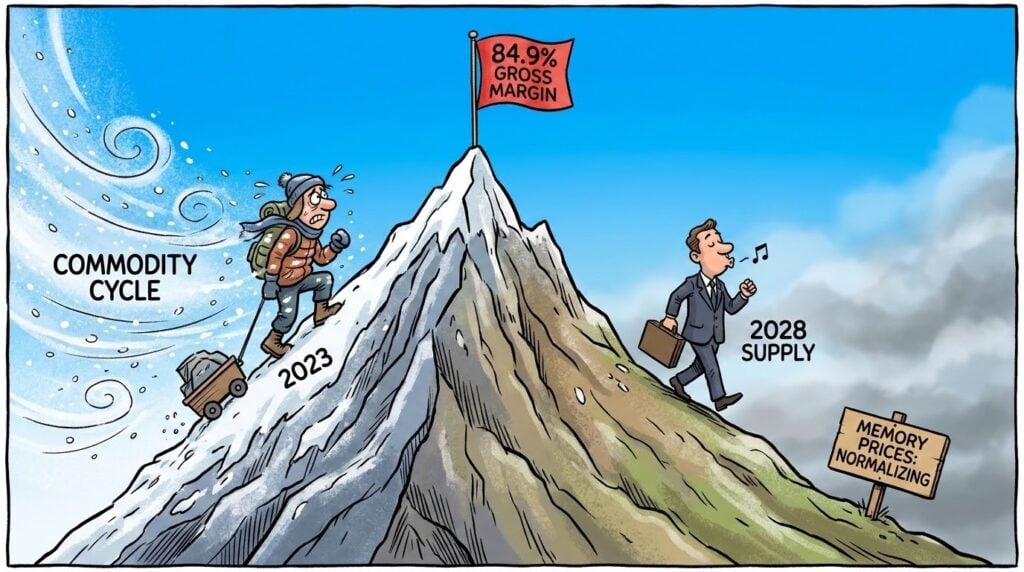
A blowout earnings number tells you something important about the business. It tells you almost nothing about whether the current stock price already reflects that information.
Micron’s stock has gained more than 900% over the past 52 weeks, rising from a 52-week low of $103.38 to an all-time high of $1,213.56 earlier this week. At Wednesday’s close near $1,048, the trailing price-to-earnings ratio sits near 49x. The forward P/E based on Q4 guidance is closer to 18x, because earnings are growing fast enough that the multiple compresses almost automatically.
That 18x forward multiple is where the bull and bear cases split.
The bull case: 18x forward earnings is genuinely cheap for a company growing at this pace. Apply a price-to-earnings-to-growth test using consensus FY2027 estimates and the ratio comes in well below 1.0, the threshold that has historically signaled a stock priced attractively relative to its growth rate. The SCA contracts reduce the revenue volatility that historically caused memory stocks to get punished on forward multiples. If 2027 and 2028 earnings hold near current levels, the stock is not expensive.
The bear case: the 18x forward multiple is a peak-cycle reading dressed up as a valuation. The 84.9% gross margin Micron reported this quarter is not a normalized margin. It is what happens when demand for high-bandwidth memory vastly outstrips the supply that only three companies on earth can produce. When supply catches demand, which Micron’s own management says begins around 2028, that margin compresses. A $1 trillion company valued on peak-cycle earnings in a rising-rate environment carries specific risk that a forward P/E calculation does not capture.
Both cases are coherent. The earnings beat did not resolve that tension. It sharpened it.
How the Fed’s Hawkish Shift Changes the Risk Math on a $1 Trillion Valuation
Micron’s earnings story does not exist in a vacuum. The Federal Reserve’s June meeting produced a dot plot showing the median policymaker now expects rates to end 2026 higher than today, a reversal from March when the median still implied a cut. Eight of 18 FOMC members projected at least one rate hike before year-end. New Fed Chair Kevin Warsh declined to submit his own projection and announced a task force to review the dot plot’s future, adding a second layer of uncertainty on top of the rate direction itself.
Higher rates compress the multiples that fast-growing technology companies trade on. A stock with a trailing P/E near 49x is meaningfully more sensitive to rate changes than a utility stock at 14x. The broader implications of that rate environment for stock portfolios are worth reviewing before committing to a position in any high-multiple name.
This does not close the door on Micron’s growth story. It raises the cost of holding a $1 trillion valuation on peak-cycle earnings while that rate path plays out. For context on how the chip sector’s policy environment is evolving, including domestic production mandates that could reshape Micron’s capex timeline, that piece is directly relevant.
Two Different Investors Are Looking at This Stock Right Now
The trader sitting on a large Micron position with gains from $400 is asking a different question than the investor who missed the entire run and is watching the pre-market slip today.
For the trader with significant gains: before making any move, ask whether Tuesday changed the investment thesis. It did not. A Korean leverage flush is not a Micron fundamental event. The real re-evaluation question is whether Q4 guidance, peak-cycle margins, and a hawkish Fed together change the risk-reward going forward. That is a legitimate question, and it belongs in a written decision log rather than a reactive trade placed on a Thursday morning price chart.
For the investor who has not yet bought Micron stock and is watching the post-earnings dip: position size matters as much as entry price. A 2% allocation in a high-conviction semiconductor name and a 15% allocation in the same name are different investment decisions at an identical price. If the thesis is that AI memory demand is structural and the SCA contracts have de-risked the revenue floor, a small disciplined position built over several weeks using a fixed-dollar schedule is a different decision from trying to time an entry the morning after a record earnings report.
“The valuations of the ‘Big 3’ assume that DRAM prices will remain in the stratosphere. It’s the same kind of optimism that drove memory stocks up 400%-plus in the years around 1995, 2000, and 2014,” one analyst wrote this week. That observation does not make Micron a sell. It makes it a position that deserves explicit sizing discipline rather than a conviction bet sized by FOMO.
Two Questions Worth Answering Before Deciding to Buy Micron Stock
Before deciding to buy Micron stock, or to add to a position you already hold, two checks are worth running.
- First, write down the failure scenario before you place the trade. Assume the position underperforms badly over the next 18 months. The most likely reason probably involves some combination of peak-cycle gross margins compressing as supply gradually returns, a Fed rate hike repricing high-multiple tech stocks, or an SCA customer renegotiating in 2027 when the memory shortage eases. If you cannot articulate that scenario in plain language, the position is not sized from conviction. It is sized from price momentum.
- Second, determine what percentage of your total portfolio this position represents. The SCA contracts have changed Micron’s revenue floor. They have not changed the fact that earnings are at an all-time high in a sector that has historically cycled hard. Both facts are true simultaneously. A well-sized position accounts for both.
The business case for Micron is one of the most compelling in the semiconductor sector right now. The price case is more complicated. Treating them as the same evaluation is what gets retail investors burned on stocks that were right about everything except when they bought and how much they owned.
For investors building a framework for how market prices relate to intrinsic value across cycles, Burton Malkiel’s “A Random Walk Down Wall Street” is a useful starting point. It covers the full spectrum of how prices and fundamentals diverge and eventually reconnect, with particular attention to how momentum and narrative drive short-term pricing in ways that eventually revert. It is an educational resource, not a recommendation to buy or sell any specific security.

FTC disclosure: This site may earn a commission from qualifying purchases made through links on this page. This does not influence our editorial coverage.
Frequently Asked Questions
What happened to Micron stock this week?
Micron fell 13% on June 23 due to a leveraged selloff in South Korean semiconductor stocks that spread to U.S. markets. The company then reported record Q3 earnings on June 24, beating estimates by 23%, with revenue of $41.5 billion and adjusted EPS of $25.11. The stock gained in after-hours trading but pulled back in pre-market trading on June 25.
What are Micron’s take-or-pay contracts?
Micron signed 16 strategic customer agreements during Q3 2026. Fourteen carry roughly $100 billion in minimum contracted revenue over their remaining terms, with $22 billion in upfront customer cash commitments. Take-or-pay means customers are obligated to purchase a set volume or pay a penalty, reducing Micron’s exposure to demand volatility.
Is Micron stock still reasonably valued after the recent run?
On a forward price-to-earnings basis using Q4 2026 guidance, Micron trades at roughly 18x forward earnings, below the semiconductor industry average. On a price-to-earnings-to-growth basis, the ratio falls below 1.0, which historically suggests attractive pricing relative to growth rate. The counterargument is that forward earnings reflect peak-cycle margins that may not persist when memory supply begins recovering around 2028.
What is the primary risk for Micron investors right now?
The primary risk is that Micron’s 84.9% gross margin reflects a peak in the memory supply shortage, not a new baseline. As the company has noted, meaningful new supply does not arrive until around 2028. A hawkish Federal Reserve also raises the discount rate applied to high-multiple growth stocks, compressing the valuation even if earnings hold.
For educational purposes only. Not financial advice. Consult a licensed financial professional before making investment decisions.
Researched and fact-checked by the TheCapitalist.com editorial team using a multi-source framework. Institutional citations verified. Contradictory expert positions represented. See our editorial standards.
Reader Poll: