
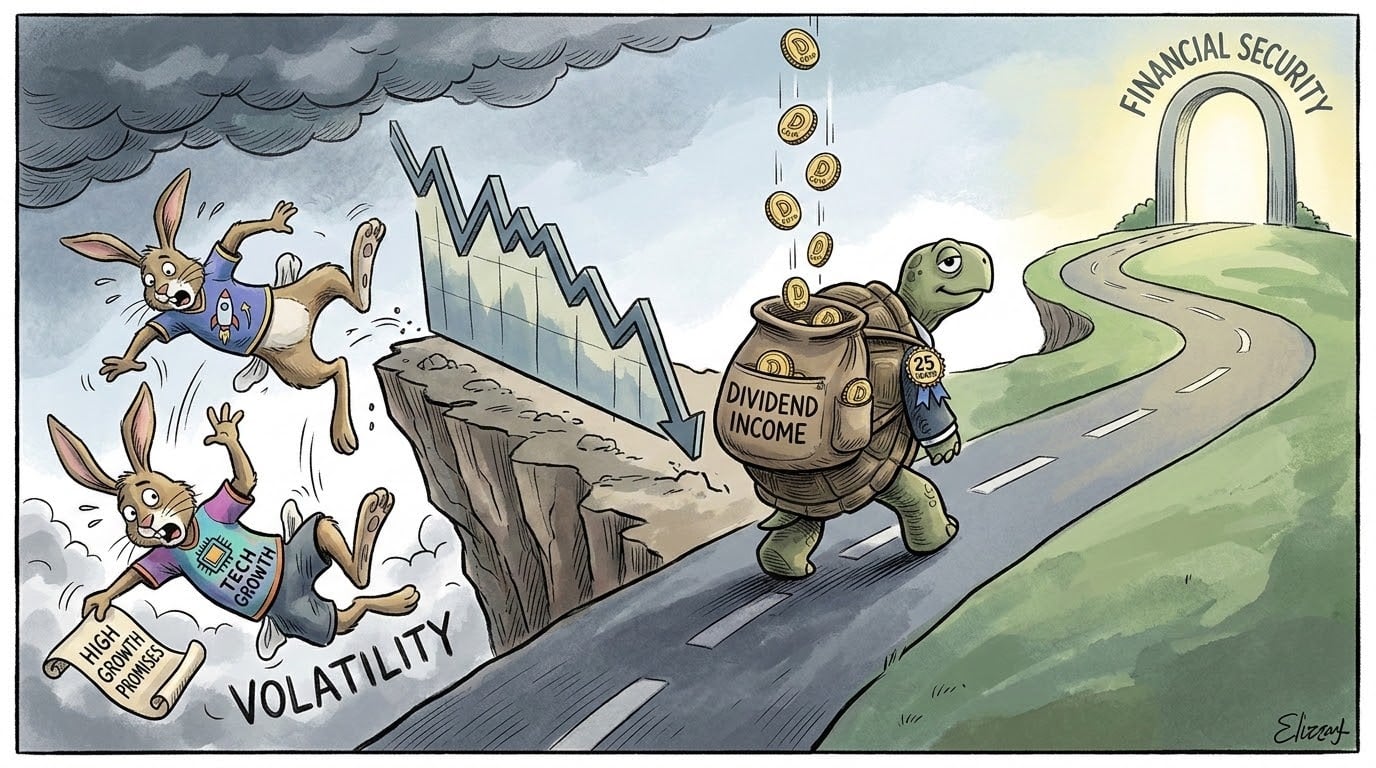

The tech trade cracked again this week. South Korea’s main index closed down 10% on June 23, chipmakers led losses across two continents, and the AI-spending unwind that desks have been bracing for finally showed up on the tape. In a week like that, the appeal of a company that has paid you a rising dividend for 40 years is obvious. That is the pull behind defensive dividend aristocrats, and the pull is real. The problem is what the pitch leaves out.
The Defensive Rotation is Real, and the Dividend Aristocrats are Catching the Bid
Through late February, the Morningstar US Dividend Growth Index had beaten the broad US market by more than five percentage points, a clean signal of money moving into stable cash flows, the same shift we flagged when we asked whether this rotation was real or a head fake. The macro backdrop pushed it along. Federal Reserve Chair Kevin Warsh held rates at 3.50% to 3.75% on June 17, but nine of eighteen policymakers now pencil in a hike this year, and inflation is stuck near 4.2%. JPMorgan puts the odds of a 2026 recession around 35%. When growth gets repriced and rates stay high, predictable payers look like shelter. One forum investor put the emotional logic plainly: defensive dividend aristocrats “feel like stable income, at least for some people.”
The Seven-Point Problem the Pitch Leaves Out
Here is the number the safety story skips. Year to date through late May, the Dividend Aristocrats returned 3.34% against 10.39% for the S&P 500. That is a gap of roughly seven points in five months. The aristocrat ETF NOBL was down 1.0% in May while the broad market rose. Stretch the lens and the picture holds: over the past decade, the group has compounded at nearly 9.5% a year versus about 15.5% for the S&P. These stocks have done their job, which is lower volatility, not higher returns. The case of the defensive dividend aristocrats is a drawdown. It’s not a get-rich case, and any pitch that blurs the two is selling you the wrong thing.
Defensive Dividend Aristocats: Paying Up For Safety Is Its Own Risk

A 25-year streak tells you a company is durable. It tells you nothing about price. When everyone rotates into the same defensive names at once, the safe stocks stop being cheap, and an overpriced safe stock is just a slow loss. The discipline that matters now is buying the quality at a discount, not at a premium. Morningstar’s screen of names trading below fair value is one place to see that gap in action: some aristocrats sit 30% to 45% under analyst fair value, while others have already been bid up past it. The streak is the same. The math is not.
Want to know more about defensive dividend aristocrats? If you want a primer on how dividend compounding actually works before you build a sleeve, the dividend-growth mechanics in Marc Lichtenfeld’s Get Rich with Dividends are a clear, plain-English starting point, and Lichtenfeld sits outside our usual sources, which is exactly why we point to him here as an educational partner.

Disclosure: TheCapitalist.com participates in the Amazon Associates program and may earn a commission on purchases made through this link. This never influences our coverage.
The Names Drawing the Defensive Dividend Aristocrats Bid
This is where the money has been hiding. Note that this is not a buy list and definitely not a promise:
- Coca-Cola, with more than 60 straight years of raises and a yield in the mid-3% range;
- Procter & Gamble and Colgate-Palmolive, household staples that sell through any cycle;
- Johnson & Johnson and Medtronic in healthcare, the latter trading well below Morningstar’s fair value;
- PepsiCo in consumer defensive;
- Atmos Energy, a regulated utility with a 42-year raise streak.
Seven names, one common trait: cash flow that does not need a strong economy to show up. The caveat from the section above still applies to every one of them. The streak is not the price.
Sizing the Trade Depends On Your Runway
The conventional wisdom is split on this, and the split is the whole answer. The defensive tilt is not one trade. It is three.
- If you are 10 or more years from needing the money, a heavy defensive tilt mostly buys you a lower expected return and a behavioral crutch. The stronger move is to keep buying your broad allocation on schedule and treat any income sleeve as small and optional. While the framework says to rotate to safety when valuations stretch, field reality says most accumulators who do it end up trailing for years.
- If you have lumpy cash needs, like a business owner who may have to sell at a bad moment, the aristocrat sleeve is a stability anchor. Balance it against cash and some duration. It is there to keep you from a forced sale, not to drive returns.
- If you are inside five years of retirement, this is where defensive income stops being optional. The first years of drawdown carry outsized weight, and selling equities into a down market early can break a plan that average returns would have funded. Fund one to two years of spending in cash or short Treasurys, hold the income sleeve through funds like NOBL, SCHD, or VIG for diversification, and refill from the sleeve only in up years. This approach works until inflation runs hot enough that bonds and rate-sensitive payers fall together, which is the specific risk the current 4.2% print keeps on the table.
For the broader read on which payers actually hold up when the Fed stays hawkish, see our breakdown of why not every dividend payer survives a hawkish pause.
Defensive dividend aristocrats are a tool, not a thesis. Used at the right price and sized to your runway, they lower the odds you panic at the bottom. Bought at a premium because a scary week made them feel safe, they are just a more comfortable way to underperform. The streak earns the click. The price earns the position.
For educational purposes only. Not financial advice. Consult a licensed financial professional before making investment decisions.
Frequently Asked Questions
What are defensive dividend aristocrats?
They are S&P 500 companies that have raised their dividend every year for at least 25 consecutive years. There are about 69 of them, spread across staples, healthcare, industrials, and utilities.
Are defensive dividend aristocrats a good buy right now?
They are catching a defensive bid as tech sells off, but they have trailed the S&P by about seven points this year. They lower volatility, not necessarily total return, and only at a sensible entry price.
What is the safest way to use defensive dividend aristocrats before retirement?
Hold one to two years of spending in cash or short Treasurys, keep the income sleeve in diversified funds, and refill that sleeve only in years the market is up, so you never sell equities into a decline.
Can I just own a defensive dividend aristocrat ETF instead of individual names?
Yes. Funds like NOBL track the index directly. The trade-off is that an ETF buys the expensive aristocrats alongside the cheap ones, so you give up the ability to screen on price.