

The Fed is going to hold rates on Wednesday, but that is not the story. CME FedWatch puts the probability of a hold at 97.4%. Prediction markets are at 99.6%. The federal funds rate stays in the 3.50% to 3.75% range. That has been priced in for weeks, and nothing in the May inflation data changed it. Every major institution from J.P. Morgan to Bloomberg’s economist survey has said the same thing: no move at the June FOMC meeting.
So what are markets actually watching? Three things that land alongside the rate decision and have nothing to do with the number itself.
The Bond Market Already Moved Before the Meeting
The 10-year Treasury yield is sitting above 4.5%. The 30-year is above 5%. Those moves did not happen because the bond market was waiting for Wednesday. They happened because bond traders have already priced what the Fed has not yet said out loud: rates are staying high longer than anyone expected at the start of 2026, and a hike is no longer an abstract risk.
Prediction markets now put 57% odds on zero cuts for the entire year of 2026. At the start of this year, markets were pricing two cuts. Economists have pushed their first cut expectations into the middle of 2027. The bond market moved first. Wednesday’s FOMC meeting is the moment the Fed either confirms that repricing or pushes back against it.
May headline CPI came in at 4.2% year-over-year, driven in part by energy prices tied to ongoing Middle East uncertainty. The labor market is holding near 4.3% unemployment. Neither number gives the Fed room to ease. The base case remains a hold, but a hike by year-end has moved from theoretical to a 42% probability priced by December futures.
Warsh’s First Dot Plot May Also Be His Last
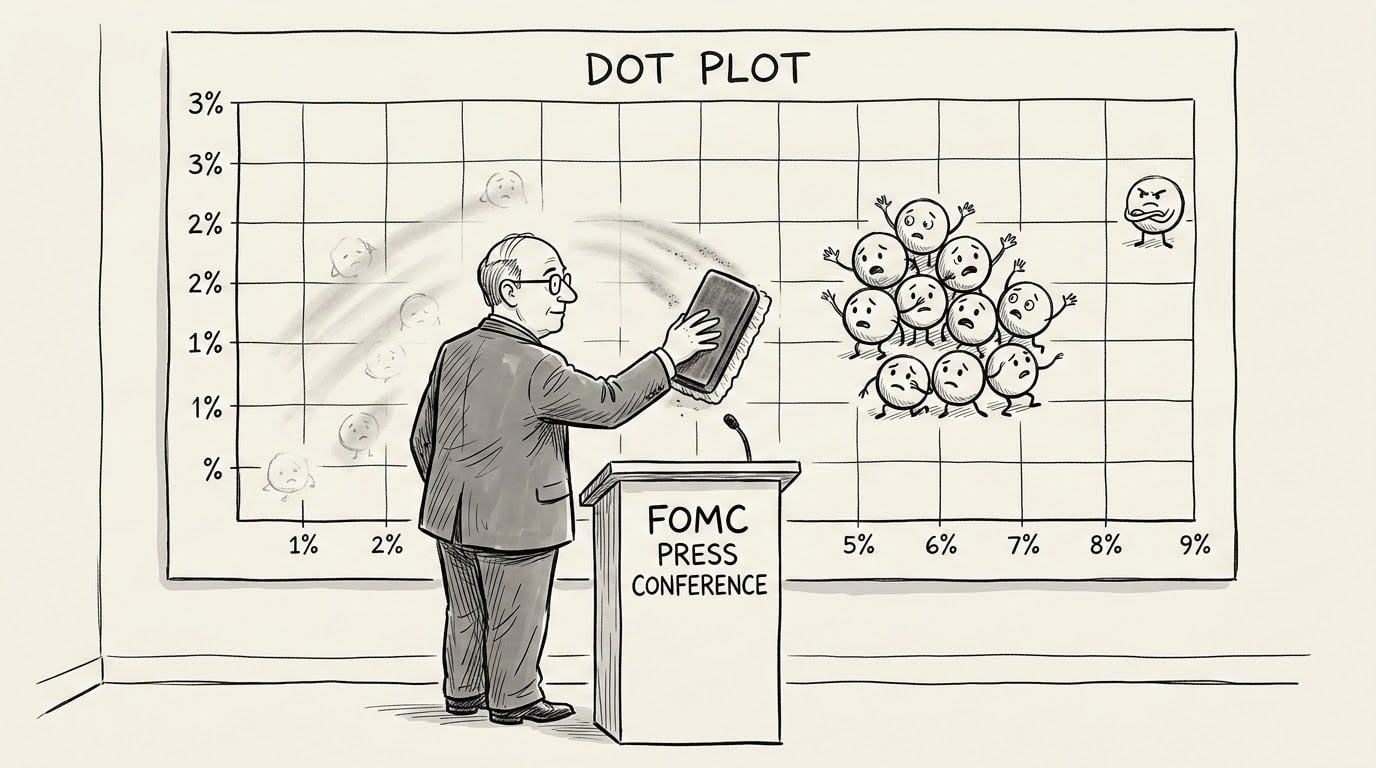
Four times a year the Fed publishes its Summary of Economic Projections. The dot plot inside it is a chart where each of the 19 FOMC members places a dot representing their projection for where the federal funds rate will sit at year-end. Wall Street treats those dots like a roadmap.
Wednesday is an SEP meeting. That makes it automatically higher-impact than a standard FOMC meeting. And this one carries an extra layer: it is Kevin Warsh’s first dot plot as Fed chair.
Warsh was confirmed by the Senate on May 13 in a 54 to 45 vote, the most divisive Federal Reserve confirmation in history. He was sworn in on May 22. His views on the dot plot are not ambiguous. At his Senate Banking Committee confirmation hearing, he said the Fed holds on to its forecasts longer than it should, that policymakers end up treating flexible projections as firm commitments because they have put those numbers in front of the public. He has argued that forward guidance locks the institution into stale positions and distorts how markets read the Fed’s actual intentions.
The dot plot could be eliminated as early as this meeting. More likely it publishes Wednesday but in altered form, with Warsh signaling in the press conference that its days are numbered. Either way, the market is watching this specific dot plot with unusual intensity, because it may be reading the last full edition of the tool it has depended on since Ben Bernanke introduced it in 2012.
The number that matters inside Wednesday’s chart: if the median 2026 dot moves above 3.75% to 4.00%, it signals that Fed officials themselves are pricing a hike this year. As recently as the March SEP, no dot showed a 2026 rate above the current range. Even one or two dots shifting upward would confirm what the bond market has already started pricing and put meaningful pressure on rate-sensitive equity sectors.
Four Dissenters Tell You Everything About Warsh’s Problem

The May FOMC vote was 8 to 4, the most fractured result since 1992. Three members voted against even an easing bias. One voted to cut immediately. Warsh does not inherit a consensus-driven institution. He inherits a committee split across three distinct positions on where rates should go.
That matters for Wednesday’s press conference in a specific way. When the committee is unified, the chair’s tone provides the nuance. When it is divided, every word in the policy statement and every answer in the press conference gets read as a signal about which faction is winning internally. A neutral tone from Warsh reads as a hold on the split. Any lean toward either the hawkish or dovish faction amplifies immediately in the bond market reaction.
J.P. Morgan Wealth Management strategists said ahead of this meeting that there will likely be an explicit move away from a bias toward easing to a neutral stance on rates. That shift in language, from an easing bias to neutral, is itself a tightening signal even with rates unchanged.
Two Scenarios, Two Different Dot Plots
The path from here splits cleanly on what Wednesday’s dots actually show.
In the hawkish scenario, one or more 2026 dots shift above 3.75%, Warsh’s press conference tone is firm on inflation, and the policy statement drops the easing bias entirely. Bond yields move higher, the dollar strengthens, and growth stocks reprice as the equity risk premium compresses. The small-cap and value rotation that has been building since May gets a short-term headwind as the market digests a longer-hold regime.
In the neutral scenario, the dots hold steady, Warsh reads as data-dependent and measured, and the market gets confirmation that the base case remains intact: rates on hold through 2026, first cut possible in early 2027. That scenario is incrementally constructive for equities in the near term and gives the small-cap rotation room to continue.
Active Traders: The Press Conference Moves More Than the Statement
For active investors watching the 48-hour window post-announcement: the press conference is historically where the intraday range gets made. Markets often reverse their initial reaction to the 2 p.m. ET statement once the chair takes questions. Watch the yield move on the 10-year in the hour after the statement before drawing conclusions about the press conference tone.
Ben Bernanke introduced the dot plot in 2012 as a tool to give investors a clearer window into Fed thinking. Warsh may close that window Wednesday. If you want to understand what the Fed has been doing with forward guidance and what it means when that guidance disappears, Bernanke’s account of how the modern Fed built its communication toolkit is the right foundation.
Affiliate disclosure: TheCapitalist.com participates in the Amazon Associates program. If you purchase through our link we may earn a commission at no additional cost to you.

- Hardcover Book

The bond market has been pricing tighter-for-longer since before Warsh sat down, a shift we tracked in detail as rate-cut expectations collapsed earlier this year.
The Number the Bond Market Set Before Warsh Sat Down
December futures price a 42% probability of a rate hike by year-end 2026. That number did not come from Wednesday’s meeting. It came from the bond market, which has been pricing tighter-for-longer for weeks before Warsh holds his first press conference.
Wednesday either validates that verdict or creates a sharp reversal. The investors who come out ahead are not the ones who predicted the dot plot correctly. They are the ones who understood their own time horizon and risk tolerance clearly enough that they did not need to.
“They are a bit worried and don’t know what else to do” is how one analysis described retail investors sitting on record cash heading into this meeting. The answer is not a trade. It is a plan that does not require the Fed to cooperate.
For educational purposes only. Not financial advice.
Frequently Asked Questions
What is the FOMC meeting on June 17 all about?
The Federal Open Market Committee meets June 16 to 17, 2026. The committee sets the federal funds rate, which influences borrowing costs across the economy. The June meeting is the first chaired by Kevin Warsh and includes the Summary of Economic Projections and dot plot, making it one of the four highest-impact meetings of the year.
Will the Fed raise rates at the June 2026 FOMC meeting?
No. CME FedWatch prices a 97.4% probability of no change. The federal funds rate is expected to hold at 3.50% to 3.75%. A rate hike later in 2026 has become a realistic risk. December futures price it near 42%, but it is not the base case at this meeting.
What is the dot plot, and why does it matter this week?
The dot plot is a chart published by the Federal Reserve four times a year showing where each of the 19 FOMC members projects the federal funds rate will sit at year-end. This week’s edition is Warsh’s first as chair, and he has publicly questioned whether the tool should continue to exist, making it unusually significant.
How should I position my portfolio before the FOMC meeting?
It depends on your time horizon. Long-horizon investors with ten or more years before a major capital event have historically done better holding through FOMC volatility than repositioning around it. Investors within five years of retirement should review long-duration bond exposure before Wednesday, since a hawkish dot plot surprise puts upward pressure on Treasury yields. Active traders should watch the 10-year yield reaction in the hour after the 2 p.m. ET statement before reading the press conference tone as settled.