
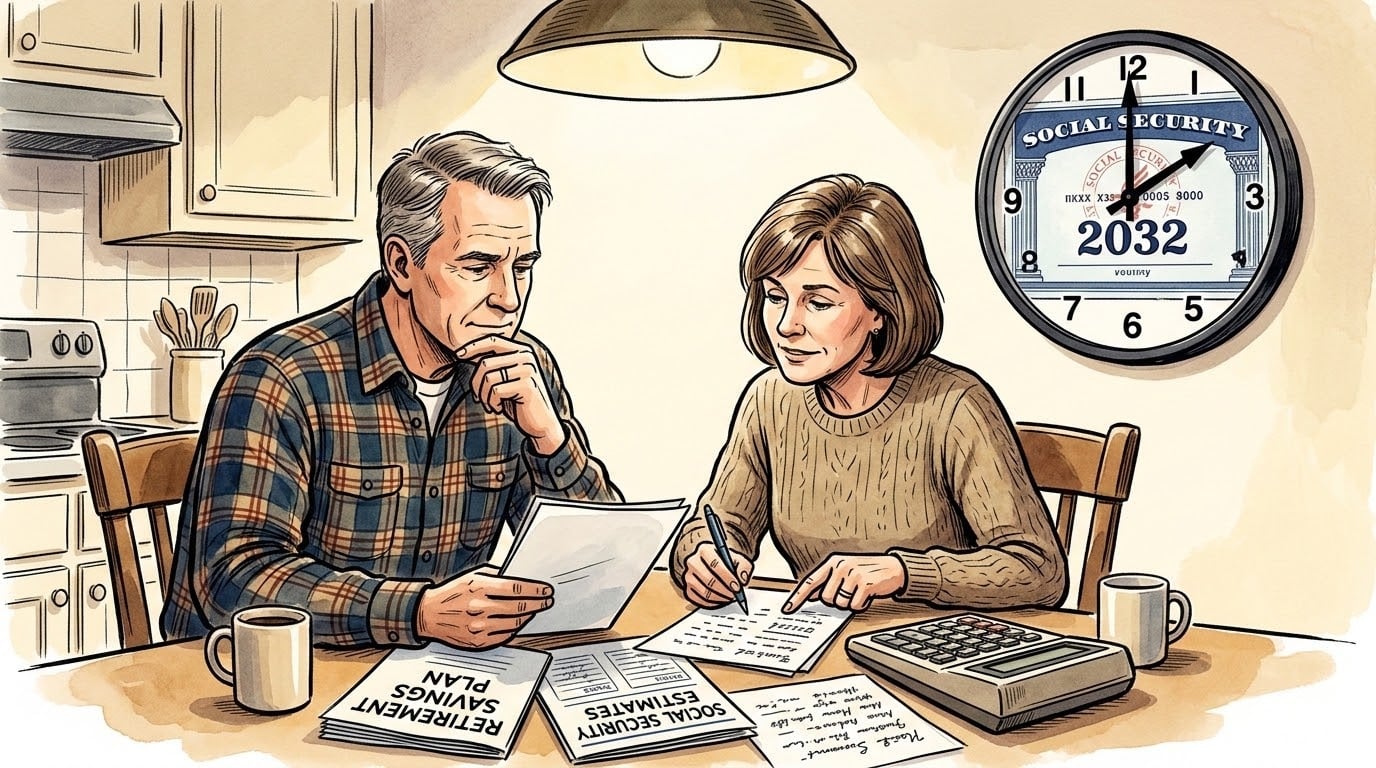

The number that matters is not 2032. It is 22. That is the percentage by which your Social Security check would be reduced, automatically, with no congressional vote required, if the Old-Age and Survivors Insurance trust fund runs dry on schedule. The 2026 Trustees Report, released June 9, put that date in the fourth quarter of 2032. One quarter earlier than last year’s estimate. The cause is not a single policy failure. It’s the compounding effect of lower birth rates, reduced immigration, and the One Big Beautiful Bill Act’s changes to how benefits are taxed, all arriving at once, all pulling in the same direction.
For anyone planning to retire between now and 2035, this is not a Washington problem to monitor. It is a retirement math problem to solve. Social Security cuts of this magnitude, arriving on this timeline, require a plan built around the possibility, not around the hope that Congress will act in time.
What Does Social Security Cuts Actually Mean for Your Monthly Checks?
The average Social Security retirement benefit in 2026 is approximately $2,026 per month for retired workers, according to the Senior Citizens League. A 22% reduction brings that to roughly $1,580. For a couple each receiving the average benefit, the combined annual loss runs close to $10,750 per year. For couples with above-average benefits, the Committee for a Responsible Federal Budget estimates the annual loss reaches $18,400.
Those numbers are not projections of a worst case. They are projections of current law if nothing changes.
The more relevant number for your situation is what percentage of your projected retirement income comes from Social Security. According to the Senior Citizens League’s 2025 Senior Survey, 73% of retirees depend on Social Security for more than half their income, and 39% depend on it for the entirety of their income. For that 39%, a 22% cut is not a planning adjustment. It is a financial emergency, and it is now six years away.
Should You Claim Social Security Early to Beat the Cuts?
“Headlines about Social Security’s trust fund running dry can stress even the most confident savers.” That stress is understandable. It is also producing one of the most damaging retirement decisions pre-retirees make: claiming Social Security early out of fear.
The logic sounds reasonable. If the benefit is going to be cut anyway, why wait? Take the money now while it is still full.
The math does not support it. Claiming at 62 instead of your full retirement age of 67 permanently reduces your monthly benefit by approximately 30%. Claiming at 62 instead of waiting until 70 reduces it by roughly 43%. If the 22% system-wide cut then applies on top of that smaller base, you have locked in a compounding reduction: a smaller check that is then cut again.
A higher base benefit, even reduced by 22%, beats a smaller early benefit that is also reduced by 22%. The break-even math shifts somewhat when you model the cut scenario rather than the full-benefit scenario, but for most people in good health with any bridge income available, the case for delaying remains intact.
The decision to claim early should be driven by your health, your spousal coordination strategy, and whether you have income to cover expenses during the delay window, not by fear of a 2032 headline.
Disclosure: This article contains affiliate links. If you purchase through these links, The Capitalist may earn a commission at no additional cost to you.
The claiming decision is one of the most consequential financial choices in any retirement plan, and most people make it without a systematic framework for thinking through the tradeoffs. “Just Keep Buying” by Nick Maggiulli is not a Social Security guide, but it is the clearest data-driven treatment of how accumulation behavior before retirement determines how much flexibility you have at the moment of claiming.


How Do You Stress-Test Your Retirement Plan Against Social Security Cuts?
The 2032 deadline is not too far away to act and not close enough to panic. It is close enough to plan around with precision.
Run the 22% scenario as a baseline, not a worst case. Open your retirement income model, whether that is a spreadsheet, a planner tool, or a financial advisor’s projection, and replace your full Social Security benefit with 78% of it starting in 2032. If your plan still works, you are in reasonable shape. If it breaks, you now know exactly how much additional income you need to generate from other sources before you retire.
Stress-test your short-term income bucket. If you are using a segmented bucket approach, your near-term spending bucket, typically two years of living expenses in cash, CDs, or short-term bonds, needs to be sized for reduced Social Security income, not projected full benefits. Identify the monthly gap in dollar terms. That gap tells you how large the bucket needs to be and whether your current savings rate closes it before your retirement date.
Audit the real return on your bond holdings. The same fiscal dynamics driving the Social Security shortfall, including expanding deficits, accommodative monetary policy, and elevated inflation, are also eroding the real (inflation-adjusted) return on the fixed-income instruments most retirement plans use as their stability layer. Nominal stability is not the same as real protection. Review what your bond holdings have returned net of inflation over the past three years before assuming they are doing their job.
Do not assume current retirees are safe from the cut. A persistent misconception is that Social Security locks in benefit levels at the point of claiming. It does not. Once the trust fund is depleted, the automatic reduction applies to everyone receiving benefits, including current retirees. If you are already retired and collecting Social Security, the 2032 date is relevant to your plan.
Build or extend income that does not depend on Congress. The most direct hedge against Social Security cuts is reducing the percentage of your retirement income that Social Security represents. That means maximizing tax-advantaged contributions while you are still working, building taxable investment accounts as a secondary layer, and identifying any earned income or part-time work you would be willing to continue into early retirement. “The more your retirement income comes from your own accounts, the less a future benefit cut can hurt you.” The 2032 Trustees’ Report is not the reason to start building that income. It is the reason to check whether you already have.
Will Congress Stop Social Security Cuts Before the 2032 Deadline?
Social Security has been here before. The 1983 reform package, the last time the trust fund faced near-term depletion, combined a gradual increase in the full retirement age, expanded payroll tax coverage, and partial taxation of benefits to restore solvency for decades. That fix took bipartisan negotiation under pressure and was enacted with less than six months of runway.
The current political environment is more fractured. President Trump has pledged not to cut Social Security benefits. Congressional Republicans have resisted tax increases. The options available, including raising the payroll tax cap, adjusting the full retirement age, and modifying the benefit formula for higher earners, all have constituencies opposed to them.
None of that means Congress will fail to act. It means the window for a gradual, less disruptive fix is narrowing. “We are kind of getting to the point where the rubber is hitting the road, and we’re running out of time to make changes,” as one retirement planning executive put it recently.
Plan as if the cut happens. Revise the plan if Congress acts. That sequence is more useful than the reverse.
For educational purposes only. Not financial advice.
Frequently Asked Questions
Will Social Security actually be cut in 2032?
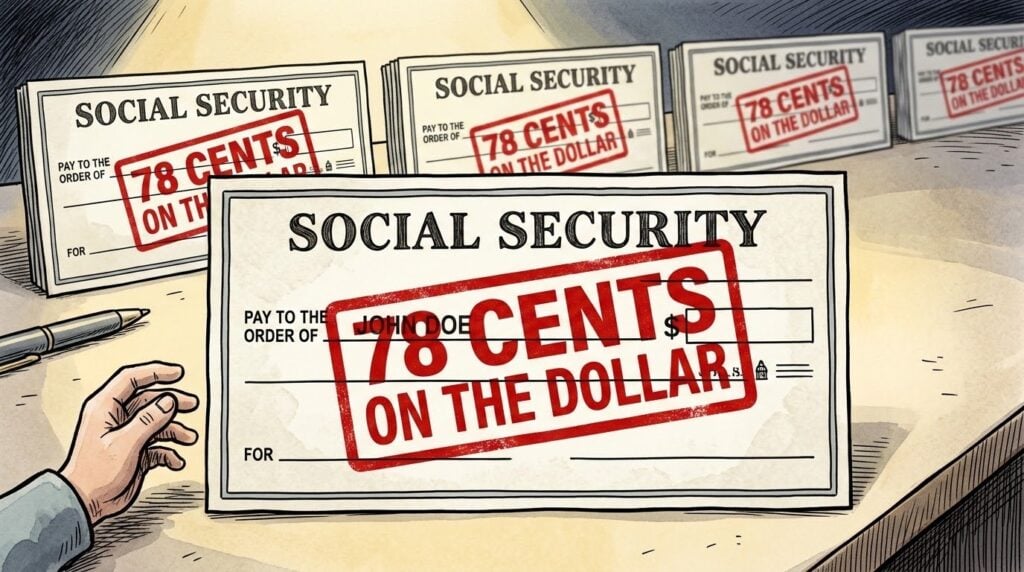
Under current law, if the trust fund is depleted in Q4 2032, benefits are automatically reduced to approximately 78 cents on the dollar, a 22% cut for all current and future beneficiaries. Benefits do not stop. Congress can prevent the cut, but your retirement plan should be stress-tested assuming it occurs.
Does the 2032 Social Security cuts apply to people already retired and collecting benefits?
Yes. A common misconception is that people already collecting are protected. The automatic reduction under current law applies to all beneficiaries regardless of when they began claiming, including current retirees.
Should I claim Social Security early to beat the 2032 cuts?
For most people, no. Claiming at 62 permanently reduces your monthly benefit by approximately 30% versus claiming at 67. A 22% system-wide cut then applies on top of that smaller base, compounding the damage. A higher benefit claimed at full retirement age or later, even after a 22% cut, typically produces more lifetime income than an early claim that is also reduced.
What is the single most useful action I can take about Social Security cuts right now?
Run your retirement income model with Social Security set at 78% of your projected benefit starting in 2032 and see whether the plan still works. If it does not, the gap you identify tells you exactly how much additional income you need to build from non-Social Security sources before you retire.