
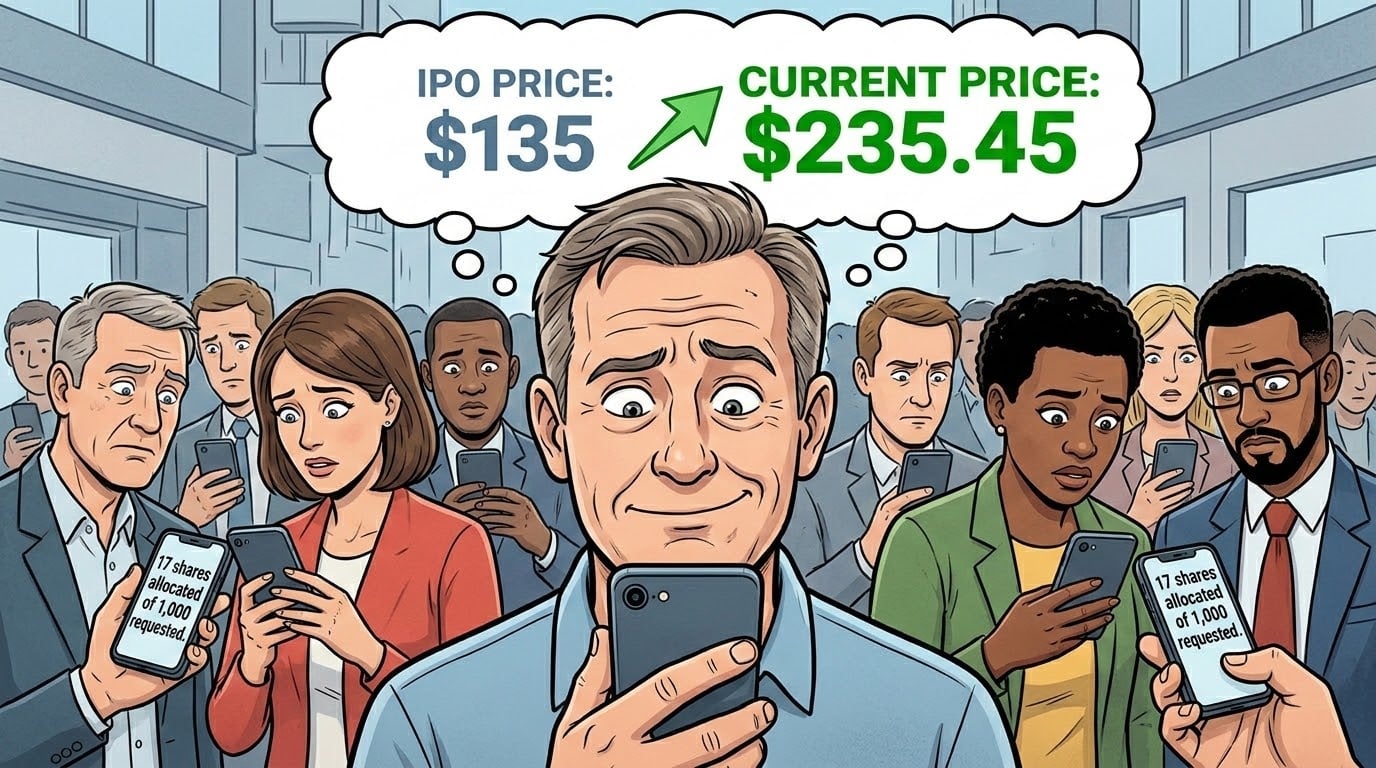

Retail investors rushed to buy SpaceX stock when the company went public on June 12, and most received a fraction of what they asked for. Now that SPCX is trading above $200, the feeding frenzy hasn’t stopped. But before you add it to your portfolio, the valuation, the business model, and the behavioral math all say something worth hearing.
What Happened at the SpaceX IPO
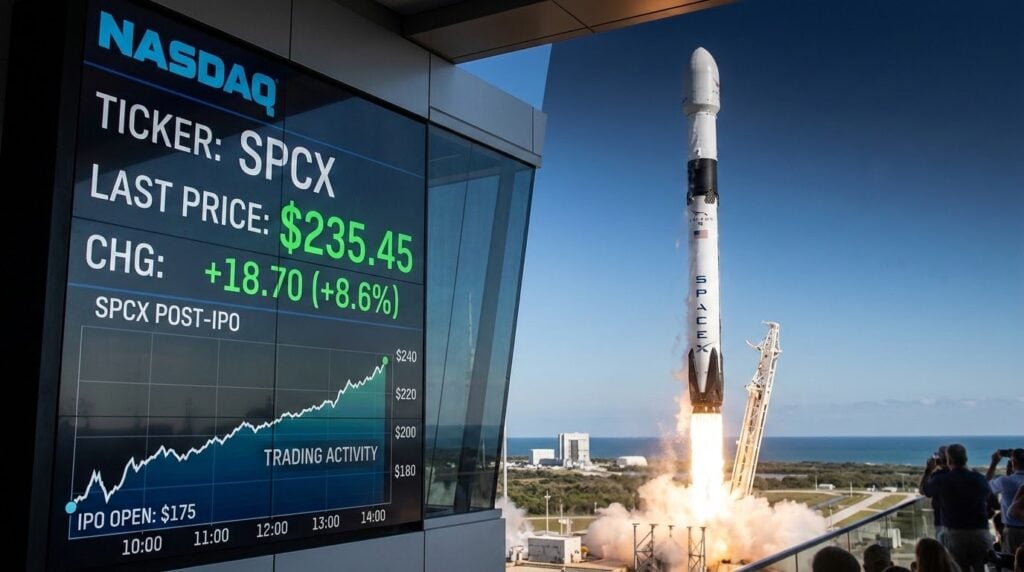
SpaceX priced at $135 a share on June 11, opened on the Nasdaq at $150 on June 12, and closed its debut session up roughly 19%. The company raised $75 billion in the largest initial public offering in U.S. history, valuing the business at more than $1.77 trillion. The overall order book ran more than two times oversubscribed, with approximately $150 billion in orders chasing a $75 billion raise.
Retail investors received 30% of the float, which sounds generous until you see what that meant in practice. Marvin Jung, a 51-year-old investor, requested 1,000 shares through Robinhood and received 17. Ross Cameron, founder of trading education platform Warrior Trading, requested 4,250 shares through Schwab and received 147. Those two numbers tell you more about what is happening here than any analyst price target.
The allocation process was not random noise. SpaceX did not need retail capital. The company has been cash-flow positive for years. It bought back its own shares twice annually to provide employee liquidity. The $75 billion raise was not a survival move. Retail got 30% of the float because Elon Musk wanted a broad, sticky shareholder base that would hold rather than flip. You were recruited as a long-term holder. Whether that serves your interests is a separate question.
Buy SpaceX Stock: What You Are Actually Buying at Current Prices
At roughly $200 per share as of June 17, SpaceX trades at a market capitalization above $2 trillion. To understand what that price requires, start with the business.
Analysts at Payload Space project that Starlink will account for approximately 79% of SpaceX’s total 2026 revenue. That means when you buy SpaceX stock, you are predominantly buying a satellite internet service. Not a rocket company. Not a Mars mission. A satellite internet business that needs to sign up paying customers in markets where slow internet is the norm, partly because those markets cannot yet afford to pay for faster alternatives.
One Reddit commenter put the tension plainly: “Ask yourself why 60% of the world has slow internet and then ask if they can pay for Starlink.” That question does not have a comfortable answer at a $2 trillion valuation.
Morningstar analyst Nicolas Owens pegged SpaceX’s discounted cash flow value at $780 billion, stating the company is significantly overvalued at its IPO target price. That figure is less than half the current market capitalization above $2 trillion. The gap between $780 billion and where SPCX trades today is not an error. It is the price tag on the narrative: Musk, Mars, the Super Bowl of IPOs, and the idea that this company will be the most valuable on Earth within a decade. Whether that narrative is correct is unknowable. Whether you’re paying for it or not, it comes true.
The Case for Owning SpaceX Stock Anyway
The bull case is real and worth stating clearly.
Starlink has no credible competitor at scale in low-Earth-orbit internet. The launch business operates at a cost structure its nearest rivals cannot match. During the IPO roadshow, SpaceX disclosed a Google revenue deal that more than doubled the company’s 2026 revenue projections. One aerospace portfolio manager called the revised forecast “conservative” while projecting SpaceX could reach $200 billion in annual revenue by 2030.
If that trajectory holds, $200 per share may look cheap in ten years. That is not an absurd statement. Amazon traded at valuations that looked insane by conventional metrics for most of its first decade as a public company. The investors who held through the noise were right.
The honest version of that analogy, though, cuts both ways. For every Amazon, there are dozens of companies that carried the same narrative premium and never delivered the revenue to justify it. The base rate on “this one is different” is not favorable.
For investors who want exposure to a company building infrastructure for a multi-decade technology transition, there is a case to own a small position in SpaceX and hold it through the volatility that will inevitably follow. If you want to think through the discipline required to make that kind of long-term commitment work regardless of short-term price swings, Nick Maggiulli’s “Just Keep Buying” makes the quantitative case for process-driven investing over reactive decision-making.


As an Amazon Associate, TheCapitalist.com earns from qualifying purchases. Book recommendations are editorially independent.
For educational purposes only. Not financial advice.
What the Behavioral Research Says About Buying Into an IPO Like This
“Lol no one is buying SPCX on fundamentals.”
That line, from a Reddit commenter writing in real time during IPO week, is the most useful thing written about this stock. Not because it is cynical. Because it is accurate, and the person writing it knew it.
The frenzy around SpaceX stock is not driven by a spreadsheet. It is driven by a story, and that tale is genuinely extraordinary. Musk may be the first trillionaire in history. SpaceX could be the infrastructure company of the next century. The IPO was called “the Super Bowl of IPOs” by investors who had been following the company for years. None of that is fabricated.
What behavioral research consistently shows is that the more compelling the story, the more dangerous the entry decision becomes. When a narrative is this powerful, the human tendency is to buy first and construct the rationale second. That is not investing. That is outcome-chasing in a particularly expensive disguise.
Before entering any position in SpaceX, name three ways you lose. Regulatory action against Musk-controlled entities. Starlink’s revenue trajectory misses its projections in emerging markets. A rising rate environment that compresses the growth multiples currently embedded in SPCX’s price. If you cannot articulate those three scenarios clearly enough to write them down, you have not made an investment decision. You have made a bet, and the distinction matters when the stock drops 30%, and you have to decide whether to hold or sell.
So, Should You Buy SpaceX Stock Now?
The answer depends entirely on who you are and what the position is supposed to accomplish.
If you are a long-term accumulation investor with a time horizon of 15 years or more, you do not need to make a decision today. The index will own SpaceX for you. As SPCX earns its weight in the Nasdaq-100 and total market funds, your existing index exposure will capture SpaceX’s upside proportionally, without requiring you to be right about a $2 trillion valuation or a dual-class share structure that gives one person 85.1% of the voting control.
If you are an active investor with a defined risk budget and a genuine thesis, the position math looks like this: size it at no more than 2% to 3% of your portfolio, treat it as speculative exposure, and define your exit criteria before you buy. That means a price level where you sell, a time horizon after which you reassess, and a failure scenario you have already accepted as a possibility.
If your reason for wanting to buy SpaceX stock is that you do not want to miss it, that is not a position. That is FOMO. The investors who asked for 1,000 shares received 17 at $135, and sold into the opening pop made a fine trade. The investors now buying above $200 because the stock went up are in a different situation, chasing a price that already reflects the story everyone knows.
The market never runs out of the next thing you are not supposed to miss.
For educational purposes only. Not financial advice.
Frequently Asked Questions
What is SpaceX stock trading under?
SpaceX trades on the Nasdaq under the ticker symbol SPCX. The company priced its IPO at $135 per share on June 11, 2026, opened at $150 on June 12, and has been trading above $200 as of mid-June 2026.
Is SpaceX stock overvalued?
Morningstar analyst Nicolas Owens pegged SpaceX’s discounted cash flow value at approximately $780 billion and stated the company is significantly overvalued at its IPO target of $1.75 trillion. At a current market capitalization above $2 trillion, buyers are paying a substantial narrative premium above independently modeled intrinsic value.
Can I still buy SpaceX stock after the IPO?
Yes. SPCX trades on the Nasdaq and is available through standard brokerage accounts including Robinhood, Fidelity, and Schwab. The IPO allocation window has closed, so shares purchased now are bought at the current market price rather than the $135 IPO offer price.
How much of SpaceX’s revenue comes from Starlink?
According to projections from Payload Space, Starlink is expected to account for approximately 79% of SpaceX’s total 2026 revenue. A position in SPCX is therefore predominantly a bet on Starlink’s ability to grow paying subscribers and not on rockets or space exploration.
How much voting control does Elon Musk have over SpaceX?
According to SpaceX’s S-1 registration statement filed with the SEC, Musk controls 85.1% of all voting power through a dual-class share structure in which his Class B shares carry 10 votes each. Public investors who buy SPCX receive economic exposure but virtually no governance influence.
Reader Poll:
x