

<div class="aeo-block"> QUICK SUMMARY: SpaceX filed for the largest U.S. IPO in history, targeting $2 trillion at a June 12 Nasdaq listing as SPCX. Up to 30% of shares go to retail investors through Robinhood, Fidelity, and Schwab. Buying SpaceX IPO stock also means buying into $41 billion in accumulated losses, 85.1% of voting power permanently held by Elon Musk, and $22 billion in government contracts tied to a single political relationship. This IPO is offering you a seat at the table. The prospectus shows $41 billion in losses, a CEO who has never hit his own deadlines, government revenue built on a political arrangement that does not transfer, and a share structure that gives you equity but no vote. In other words, the access is the product.</div>I’ve been in positions like this before. The story (and the underlying investment offer) is so good that you feel stupid for hesitating. The opportunity seems so large that sitting it out feels like a character flaw rather than a decision. I blew up two accounts learning the difference between a story that someone else needs you to believe and an investment worth making. What follows is what I would have wanted someone to tell me before I made those mistakes.
SpaceX Is Going Public, and Retail Investors Are Getting 30% of the Deal
SpaceX filed its S-1 with the SEC this week. The plan is to list on Nasdaq under the ticker SPCX on June 12, with the roadshow beginning June 4. The target raise is $75 billion, which is more than double Saudi Aramco’s $29 billion IPO record set in 2019. The target valuation is $2 trillion, which would make SpaceX the most valuable company ever to debut on a U.S. exchange at the moment of listing. In a break from standard IPO practice, SpaceX is reserving up to 30% of shares for individual investors through Robinhood, Fidelity, Schwab, SoFi, and E*Trade. The normal retail allocation on a deal this size is 5% to 10%. The company is also hosting a dedicated retail event on June 11 for 1,500 individual participants from six countries.
This is not standard procedure. It is deliberate. The question worth asking before entertaining ideas about buying SpaceX IPO stock else is why.
Buying SpaceX IPO Stock Means Funding a Deal That Needs You
A $75 billion raise requires $75 billion in buyers. Institutional books do not absorb that number cleanly when the company posted a net loss of $4.28 billion in Q1 2026 alone and carries $41 billion in accumulated losses on its balance sheet.
Retail capital is in this deal because SpaceX needs it.
The S-1 was not filed so that everyday investors could finally access a great opportunity. It was filed because the SpaceX IPO needs to raise $75 billion before June 12. The 30% retail allocation is a distribution strategy. The access is the product being sold to you. It’s not a benefit being extended to you. “The part that should make headlines is the $41 billion in accumulated losses.” That was the assessment from financial analysts who read the prospectus the day it dropped. Most headlines that day did not mention it.
Elon Musk Issued These Projections Before. Here‘s What Was Delivered
The S-1 projects a $28.5 trillion total addressable market, orbital AI factories, 100 gigawatts of compute deployed in space annually, and lunar satellite manufacturing. Each of these projections comes from the same person who made the following promises:
- Full Self-Driving was promised to Tesla customers by the end of 2018. The same promise was made in 2019, 2020, and 2021. Tesla remains a supervised driver assistance system in 2026.
- The Cybertruck was announced in 2019 with a production promise of 2021. Deliveries began in late 2023. Multiple mass recalls followed.
- Tesla Robotaxi was unveiled in 2024 and announced in 2025 as an imminent commercial product. However, it still hasn’t reached commercial scale at the time of SpaceX’s filing.
- Tesla Solar Roof was announced in 2016 as a near-term consumer product. A decade later, it hasn’t been meaningfully deployed.
- A crewed Mars mission was publicly projected for 2024. The mission has yet to be launched.
- Twitter was acquired in 2022 at $44 billion, accompanied by projections of 5x revenue growth by 2028. Revenue declined after the acquisition, while the asset has been written down substantially.
None of this is editorial opinion. It is a timeline drawn from the public record. Retail investors considering buying SpaceX IPO stock should hold that timeline next to the S-1 projections before the roadshow starts.
“A cash-printing satellite network, an entrenched launch monopoly, and a $14-billion-a-year AI furnace are about to be priced under a single ticker,” one analysis published the day the S-1 dropped observed. “The hard part isn’t the size. It’s deciding what SpaceX actually is.”
Starlink might be the answer to that question. It currently serves 10.3 million subscribers across 164 countries and generated $4.42 billion in profit in 2025. The company accounts for roughly 70% of consolidated revenue and is the only segment generating profit. The $2 trillion valuation isn’t pricing what Starlink built. It’s pricing what SpaceX says it will build next, per the CEO whose previous build timelines are documented above.
$22 Billion in Contracts That Politics Built and Politics Can Remove
SpaceX holds more than $22 billion in active contracts with NASA, the Department of Defense, the National Reconnaissance Office, and Space Force. That revenue is real. It‘s also not market-driven.
During Musk’s tenure running the Department of Government Efficiency, Department of Justice investigations into SpaceX and Tesla were dropped, Starlink was steered into GSA procurement, and SpaceX was positioned as the frontrunner for the Golden Dome missile defense contract. Competitors were cut while Musk’s companies were protected. These arrangements were reported in detail and confirmed by public procurement records.
Government contracts come up for renewal regularly as administrations change. The arrangement that produced $22 billion in politically constructed revenue was built on a specific relationship with a specific administration. Retail investors pricing SPCX at $2 trillion are treating that revenue as structurally durable. It is durable today because of a personal and political arrangement. That arrangement does not transfer to the next administration, or the one after that. The S-1 does not guarantee a single contract renewal.
Buying SpaceX IPO Stock Gets You a Share, But Not a Vote
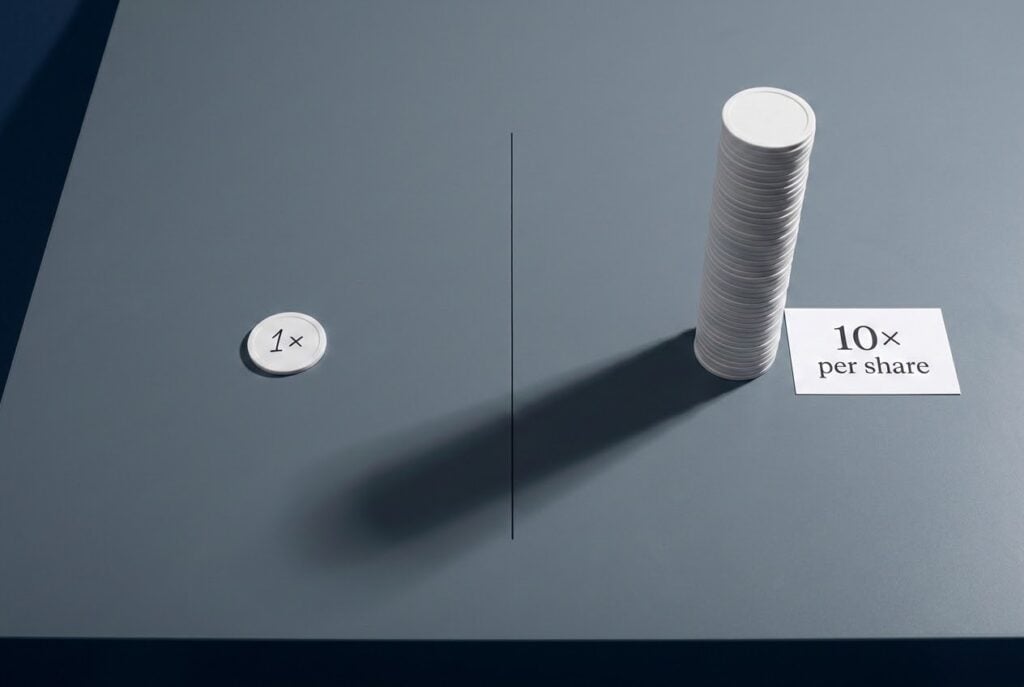
SpaceX uses a dual-class share structure. Class A shares, the ones retail investors receive, carry one vote each. Class B shares, held by Musk and a small insider group, carry ten votes each. Musk will hold 85.1% of SpaceX stock’s combined voting power at listing, permanently.
Retail shareholders cannot vote to remove management and cannot block a related-party acquisition. Also, they cannot challenge a governance decision. The xAI acquisition, a transaction in which the same person controlled the valuation on both sides of the deal, is already under SEC scrutiny according to the S-1 itself. If a similar transaction happens after the IPO, Class A shareholders have no structural recourse.
The American Federation of Teachers, representing 1.8 million members, formally asked the SEC to apply extraordinary scrutiny to this offering before the roadshow begins, calling the valuation one that “defies financial logic” and the financial disclosures “shrouded in ambiguity.”
Mega-IPOs Underperform the S&P 500. The Aramco Data Confirms It.
Research tracking IPO performance across decades and market cycles shows consistently that large IPOs underperform the S&P 500 in the years following their listing. Saudi Aramco, the previous record holder at $29 billion, traded below its IPO price for most of its first two years. That pattern is robust across market environments and deal sizes.
For investors who want a rigorous, data-based framework for thinking about entry discipline and long-term market behavior before June 12, Burton Malkiel’s work on market efficiency and individual investor decision-making remains one of the most useful tools available.

The SpaceX IPO stock lock-up expiration arrives 366 days after listing. At that point the insiders who built SpaceX, who paid a fraction of the IPO price over the previous decade, are free to sell. The retail investor who bought on June 12 at $2 trillion is on the opposite side of that trade on day 367.
5 Ways SpaceX IPO stock Goes Wrong, All of Them in the Prospectus
Before putting money into any position, the exercise is to assume it fails and work backward. Here are the five scenarios worth writing down before June 12 — each one disclosed in the S-1.
- One: the xAI burn rate proves unsustainable. The AI division is spending approximately $1 billion per month. If it does not generate revenue at scale, Starlink’s profits fund a bottomless obligation indefinitely.
- Two: lock-up expiration at 366 days creates a supply event the retail-heavy shareholder base cannot absorb at IPO-era prices.
- Three: a governance event triggers institutional selling. Class A shareholders have zero recourse under the dual-class structure.
- Four: Treasury yields sustain above 5% on the long end. At 90 to 110 times projected earnings, this valuation does not survive extended multiple compression.
- Five: Starlink subscriber growth decelerates. It is the only profitable segment in the filing. If it slows, every other projection in the S-1 loses its financial foundation simultaneously.
These are not invented risks. They are disclosed in the prospectus. Reading them before buying SpaceX IPO stock is not pessimism. It is the minimum standard for making a decision with your own money.
3 Positions Worth Taking Before June 12

Still unsure on whether to go buying SpaceX IPO stock? Take a breather and take stock of your current investment position. Here’s a quick list to help guide you:
- If you have a 10-year or longer horizon and conviction in Starlink’s standalone business: skip the IPO. Set a purchase schedule beginning 30 days post-listing. Let the lock-up expiration and one full year of post-merger audited results show you what the combined company actually earns before you size a position.
- If you are an active trader: write the pre-mortem before you allocate a dollar. Not a mental note. Written. If you can name all five failure cases above in your own words and still have a thesis on the opening-day trade, that is a decision. If you cannot name them, you are reacting to a story.
- If you are in or approaching retirement: this is not your instrument. No margin of safety, no voting recourse, a growth multiple that fails in a yield spike, and one quarter of audited data on a merged entity. That math does not work for a portfolio that needs to make withdrawals in the next five years.
For educational purposes only. Not financial advice.
Frequently Asked Questions
What is SpaceX’s ticker symbol and when does trading begin?
SpaceX will trade on Nasdaq under the ticker SPCX, with first trading targeted for June 12, 2026, following a roadshow beginning June 4.
Why is SpaceX losing money if Starlink is profitable?
Starlink generated $4.42 billion in profit in 2025, but the February 2026 all-stock acquisition of xAI added approximately $1 billion per month in losses, producing a $4.94 billion consolidated net loss for the full year and a $4.28 billion loss in Q1 2026 alone.
Why is SpaceX losing money if Starlink is profitable?
Starlink generated $4.42 billion in profit in 2025, but the February 2026 all-stock acquisition of xAI added approximately $1 billion per month in losses, producing a $4.94 billion consolidated net loss for the full year and a $4.28 billion loss in Q1 2026 alone.
What is the xAI acquisition and why does it affect the SpaceX IPO valuation?
SpaceX acquired xAI in February 2026 in an all-stock deal that added approximately $1 billion per month in operating losses to the balance sheet, converting Starlink’s profitable 2025 into a $4.94 billion consolidated net loss for the year.
Can retail investors actually buy SpaceX at the IPO price?
Yes, through Robinhood, Fidelity, Schwab, SoFi, and E*Trade. SpaceX is reserving up to 30% of shares for individual investors, roughly triple the typical retail allocation for an offering of this size.
Does the dual-class share structure mean retail investors have no say in governance?
In practice, yes. Class A shares carry one vote each while Class B shares held by insiders carry ten votes each. Musk holds 85.1% of combined voting power at listing, meaning Class A shareholders cannot remove management, block related-party transactions, or challenge governance decisions.
How durable is SpaceX’s government revenue base?
SpaceX holds more than $22 billion in active contracts with NASA, the DOD, the NRO, and Space Force. These contracts were awarded under a specific political environment and no S-1 language guarantees their renewal under future administrations.
What is the lock-up period for SpaceX insiders?
Insiders and major early investors are barred from selling shares for 366 days after the listing date, meaning the first large wave of insider supply enters the market in mid-June 2027.