
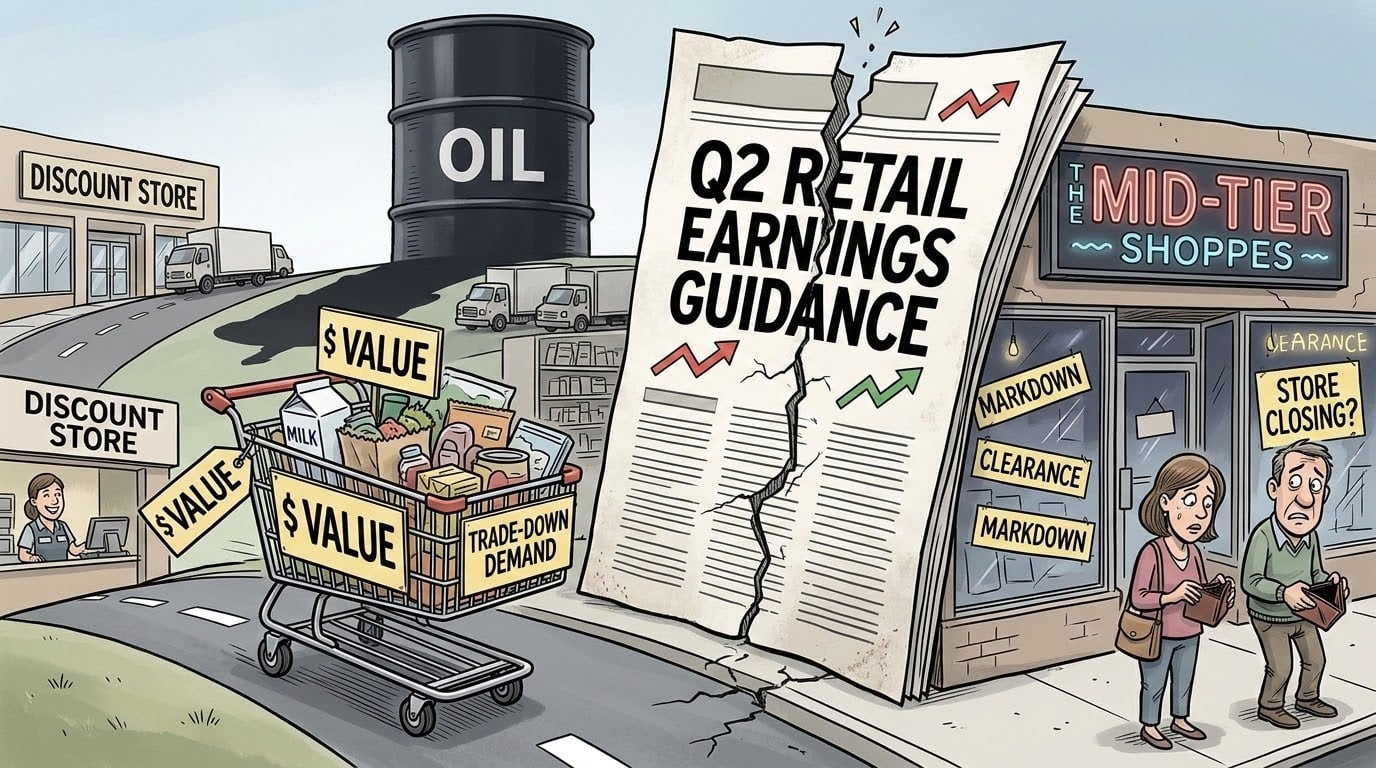

The numbers were strong. The stocks fell anyway.
Walmart, Target, Home Depot, Lowe’s, and TJX all gave investors some version of the same puzzle. Q1 results were better than expected. Guidance was cautious. The consumer was still spending, but the market was no longer willing to price retail as a single clean-sector trade.
That is the story inside the Q2 retail earnings guidance. Not a consumer collapse. Not a clean retail boom. A split.
Why Did Retail Stocks Sell Off After Q1 Earnings Beats?
Retail stocks sold off because investors looked past the Q1 beat and repriced the Q2 guidance.
Walmart reported first-quarter results on May 21 that beat Wall Street across the board. U.S. comparable sales grew 4.1%. Global eCommerce was up 26%. Operating income grew 5%. The company stood by its full-year outlook. Then the stock dropped sharply, giving back part of its recent gains. Walmart’s own release showed Q2 net sales guidance of 4% to 5% growth and adjusted EPS guidance of $0.72 to $0.74.
Target reported the day before, on May 20. The numbers were also stronger than expected. EPS came in at $1.71, net sales rose 6.7%, comparable sales increased 5.6%, and traffic rose 4.4%. Target also pointed to broad-based category strength and digital sales growth of 8.9%.
Home Depot, Lowe’s, and TJX reported in the same window. Lowe’s beat quarterly sales estimates and maintained its 2026 forecast despite pressure from housing and transport costs. TJX raised its full-year guidance as shoppers continued moving toward off-price retail.
The consumer was buying. The market was selling. The question is why.
What Did Q2 Retail Earnings Guidance Tell Wall Street?
Q2 retail earnings guidance told Wall Street that Q1 strength may not carry cleanly into summer.
The answer is in the part of the earnings calls that most retail investors do not listen to.
Walmart’s first-quarter beat came with a second-quarter outlook that disappointed Wall Street. Net sales were guided to grow 4% to 5%. Adjusted EPS was guided to $0.72 to $0.74. The Q2 retail earnings guidance, not the trailing quarter, is what spooked the stock.
Reuters reported that Walmart maintained its conservative annual targets even after strong Q1 results, with higher fuel costs and value-conscious shoppers weighing on the outlook. The same report noted that elevated fuel prices reduced operating income by $175 million and that Walmart expected Q2 sales growth slightly below some analyst expectations.
That language matters. Walmart serves a massive share of U.S. households. When its guidance points to caution, the market treats that as a real-time read on the American consumer.
The forward picture lines up. The retail story is not one signal. It is two signals layered on top of each other. The discount and value side is winning. The mid-tier discretionary side is being repriced down.
How Is the K-Shaped Consumer Splitting Retail in Two?
The K-shaped consumer is separating retailers that solve budget pressure from retailers that depend on discretionary confidence.
To understand why retail is splitting like this, look at who is doing the spending.
Higher-income households still have room to spend. Lower-income households are more exposed to food, fuel, rent, and credit costs. Middle-income households sit in the squeeze zone, where wages may still be growing but monthly budgets feel tighter.
The retail behavior that follows is visible in company results. Walmart’s value proposition is pulling in customers who want lower grocery prices, faster delivery, and fewer budget surprises. Target’s Q1 rebound shows that discretionary demand is not dead, but it still needs execution, sharper merchandising, and a clear reason for shoppers to return.
The same rising inflation pressure that the broader market has been digesting since April shows up here as a market-share opportunity for the discount lane.
That gap is why higher-income consumers can still trade down to Walmart even while their incomes hold up. It is also why off-price retailers like TJX can keep capturing demand from shoppers who want brands without full-price risk.
The middle of the consumer is the squeezed side. Mid-tier department stores, mid-price specialty retail, and general merchandise outside the value lane do not have a clean side to win on. The K-shape is not a metaphor. It is the operating reality of who is shopping where in May 2026.
Are Walmart and Target Even the Same Trade Anymore?
Walmart and Target are both retailers, but investors are no longer pricing them as the same kind of business.
The two-sided consumer story produces a two-sided valuation problem.
Walmart entered earnings week as a market favorite. The company had already been rewarded for grocery share gains, eCommerce scale, delivery growth, advertising revenue, and higher-income customer capture. Even after the selloff, Walmart still looked like a structural winner priced with little room for disappointment.
Target came into its report from a different place. The company had been working through a difficult period marked by weaker comparable sales, brand fatigue, and operational questions. The Q1 print was the first material evidence that the turnaround was gaining traction. Net sales rose 6.7%, comparable sales increased 5.6%, and traffic improved 4.4%.
This is the problem with treating “retail” as a single position. The sector contains two completely different businesses. One is a structural winner trading at a premium that already prices in the trade-down dynamic. The other is a turnaround trading at a discount that may or may not be earned.
The discipline of paying attention to the entry price exists for exactly this kind of moment. Index-level retail pricing tells you nothing about which retailers are being offered at fair value and which are being offered at full price for the same business. The price tag matters here. It always does. It just becomes more visible at sector extremes.
How Should Investors Position for the Retail Split?

Investors should separate retail exposure by time horizon, valuation, and consumer segment instead of treating the sector as one trade.
What you do with this depends on what kind of investor you are.
For the long-horizon index investor. If you are contributing on a schedule to broad market index funds, the right move is to keep contributing. Your portfolio already holds Walmart, Target, Home Depot, and every other major retailer in roughly the proportions the market assigns to them. Sector rotation in retail is difficult to execute consistently because the news cycle is loud, frequent, and emotionally charged.
Investor behavior in sector-rotation trades has historically lagged buy-and-hold returns in long-running studies of fund flows. That is the softer and more defensible point. The news cycle is loud. That loudness is the cost, not the signal.
For the active stockpicker or trader. Run the screen. The framework that matters here is not “retail good” or “retail bad.” It is which retailer is in which category. Walmart is a stalwart that has been re-rated by the market as a growth story. Target is a potential turnaround with the first quarter of supporting evidence. TJX is an off-price winner capturing trade-down demand. Lowe’s is showing resilience but is still tied to housing and transport costs.
Sort the names. Apply price-to-earnings-growth ratios. The names where PEG is below 1.0 and analysts are revising estimates higher are on the homework list. The names where PEG is well above 1.0 and revisions are flat are not.
For the pre-retirement investor. This is the doctrine break point. If you are within five years of drawing down your portfolio, concentrated positions in consumer discretionary names carry real risk if the Q2 consumer pullback plays out. Trim concentrated single-stock exposure in that lane. Hold diversified equity exposure, consumer staples, and value-oriented retail exposure where appropriate. Do not exit equities altogether to wait this out. Trading equity exposure for cash because you are nervous about one quarter is one of the most reliably destructive moves a pre-retiree makes.
For readers who want the data-driven case for why sector rotation has historically underperformed disciplined indexing, A Random Walk Down Wall Street by Burton Malkiel is one of the most accessible educational resources on the subject. It is the academic core of the indexing argument, written for an audience that wants the evidence laid out plainly.


How Does Brent Crude Decide the Q2 Retail Earnings Outlook?
Oil prices matter because higher fuel costs hit retail margins, delivery networks, and household budgets at the same time.
There is one macro variable that decides whether any of this matters six months from now.
Fuel costs are now part of the retail earnings story. Walmart said operating income was negatively affected by 250 basis points from higher fuel costs in distribution and fulfillment. Reuters also reported that higher fuel costs reduced Walmart’s operating income by $175 million.
Every retailer with a national supply chain is paying more to move goods. That matters for Walmart. It matters for Target. It matters for Lowe’s, Home Depot, TJX, and every retailer that depends on freight, fulfillment, and store replenishment.
If Brent stays elevated through the summer, the consumer trade-down accelerates. Discount retail keeps winning. Mid-tier discretionary keeps getting squeezed. The K-shape widens.
If oil rolls over, the picture changes fast. Retail margins recover. Delivery costs ease. Grocery price pressure becomes easier to manage. Trade-down loses urgency. Mid-tier discretionary stocks that were sold down on K-shape fears get a chance to reprice higher.
The retail trade is, underneath the consumer narrative, also an oil trade. Watch the wells, not just the earnings calls.
What Do Q2 Retail Earnings Mean for Investors Now?
Q2 retail earnings mean investors should watch guidance, fuel costs, and consumer mix more closely than headline EPS beats.
The signal is already in your life.
The friend who used to shop at Whole Foods and now mentions Walmart pickup. The Chipotle near your office that is suddenly busy at lunch again after a year of empty tables. The Target run is shorter because the household budget is doing the editing.
These are not just anecdotes. They are the same patterns Wall Street will try to name and price three months from now, in research notes published after the next earnings season closes.
What Q2 retail earnings mean for investors is not buried in a Morgan Stanley note that costs $40,000 a year to read. It is at your local Target parking lot on a Saturday morning. Read it there first.
Frequently Asked Questions
When does actual Q2 retail earnings reporting start?
Most large retailers report Q2 calendar results in mid- to late August 2026. The May 2026 reports from Walmart, Target, Lowe’s, and TJX covered fiscal Q1 and included company-issued Q2 guidance.
Why did Walmart stock drop after a Q1 earnings beat?
Walmart’s Q2 guidance came in cautious relative to investor expectations. The company guided Q2 net sales growth of 4% to 5% and adjusted EPS of $0.72 to $0.74, forcing investors to focus on the forward outlook instead of the Q1 beat.
Are tax refunds really driving Q1 retail strength?
Tax refunds likely helped support Q1 spending, but they are a temporary seasonal tailwind. That is why investors paid close attention to Q2 guidance, where the refund effect fades and household budgets face more direct pressure.
Should I sell Target and buy Walmart based on this?
That depends on your full portfolio, time horizon, and what you already own. Walmart has been priced like a high-quality compounder, while Target is still being evaluated as a turnaround story after stronger Q1 results.
Which retailers are winning the Q2 trade-down?
Walmart, TJX, Costco, and Ross Stores are the clearest trade-down beneficiaries. Walmart is capturing value-seeking grocery and delivery customers, while TJX is benefiting from off-price demand.
What is the K-shaped consumer in retail?
The K-shaped consumer refers to the split between households that still have spending power and households that are being squeezed by food, fuel, rent, and credit costs. Retailers serving value-conscious shoppers are better positioned than retailers dependent on discretionary confidence.
Why does oil matter for retail earnings?
Oil matters because fuel costs hit both sides of the retail model. They raise freight and fulfillment costs for companies while also pressuring household budgets through gasoline and food prices.