
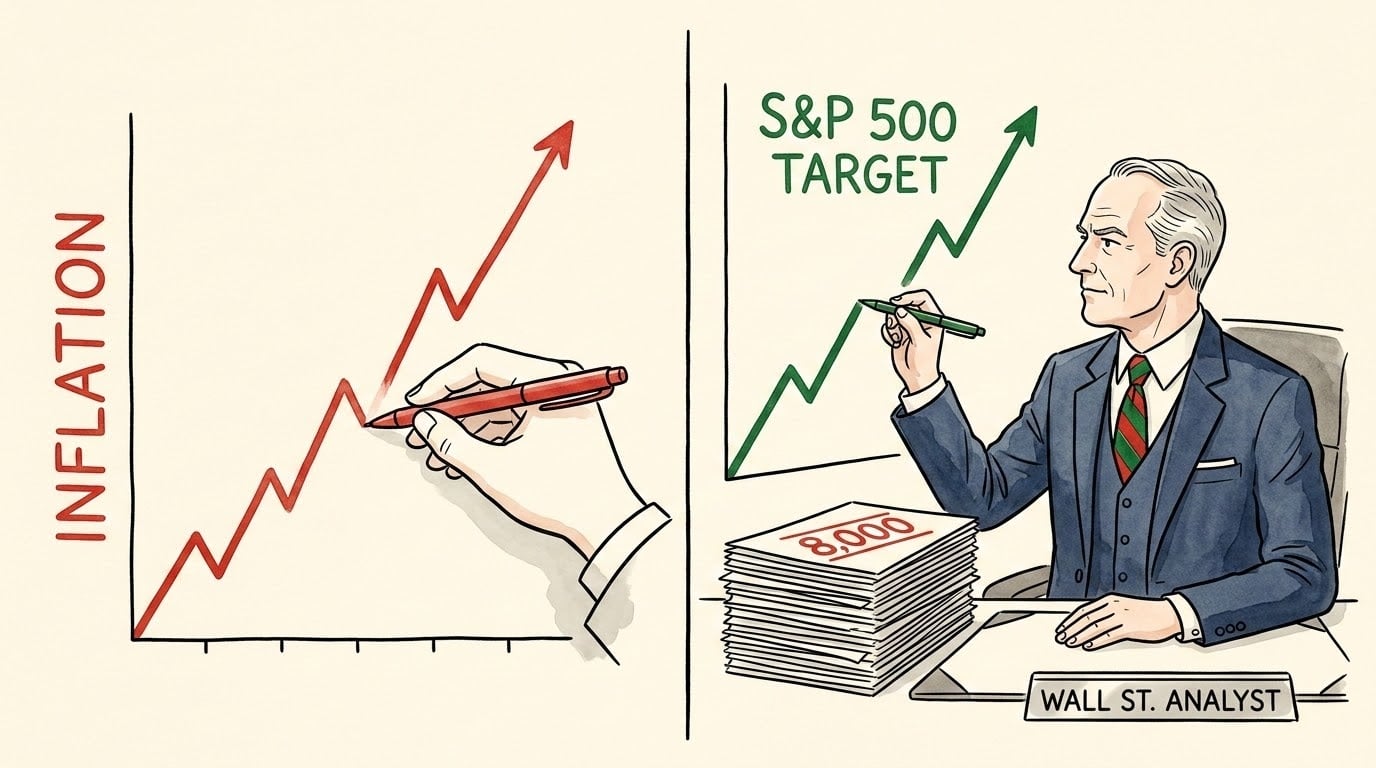

QUICK SUMMARY: Wholesale rising inflation hit 6% year over year in April, far above the 4.8% expected. Morgan Stanley still raised its S&P 500 target to 8,000. The right equity allocation now depends on time horizon: accumulation-phase investors hold; pre-retirees within five years should trim US large-cap and add international, short Treasuries, and commodities.
Wholesale inflation hit 6% year over year in April, far above the 4.8% economists expected. Consumer prices came in hot the day before. Morgan Stanley responded by raising its year-end S&P 500 target to 8,000 from 7,800. The contradiction is the story for retail investors deciding what their equity allocation should look like from here. Rising inflation just changed the math, and the move depends on where the reader’s time horizon actually sits.
What Did April’s 6% PPI Print Actually Change for Equity Investors?
April’s 6% Producer Price Index (PPI) print pushed the implied equity risk premium below 4.2%, well under the historic 5.5% to 6% average. April PPI rose 1.4% month over month and 6% year over year. Wholesale prices are pulling consumer prices higher, broadening from energy and tariffs into the supply chain. CME FedWatch shows roughly 3% odds of any 2026 rate cut, with hike odds at 36% by December. The 10-year Treasury yield sits at 4.48%, the highest of the year.
Every one of those numbers feeds into the implied equity risk premium, the extra return investors demand to own stocks over risk-free Treasuries. At an S&P forward earnings yield near 4.6% against the 10-year at 4.48%, the implied premium sits near 4.2%, well below the historic average of 5.5% to 6%.
An equity risk premium that low resolves through one of two paths. Earnings rise. Or prices fall. Rising inflation pulls the second outcome closer. Inflation that runs hot for several quarters compresses corporate margins and pushes discount rates higher. The whole valuation stack repriced this week.
Why Is Wall Street Raising S&P 500 Targets Despite Rising Inflation?
Wall Street is raising targets because Q1 2026 earnings grew 27% and 83% of S&P reporters beat estimates, supported by AI capex and operating leverage. Q1 2026 earnings came in 27% above the prior year, far above the 12% analysts expected. Roughly 83% of S&P 500 reporters beat estimates, according to LSEG data. The Magnificent Seven trade has added approximately $5.5 trillion in market value since the March 30 lows. AI capital expenditure guidance came in heavy enough to support a multi-year cycle.
The bullish case is real on the earnings side. It requires the equity risk premium to keep compressing from here, which requires no surprise. No recession. No further inflation acceleration. No megacap-tech earnings miss. No geopolitical escalation. No labor market crack. History rarely delivers that combination.
What Is the Right Equity Allocation When Rising Inflation Meets Vanishing Rate Cuts?
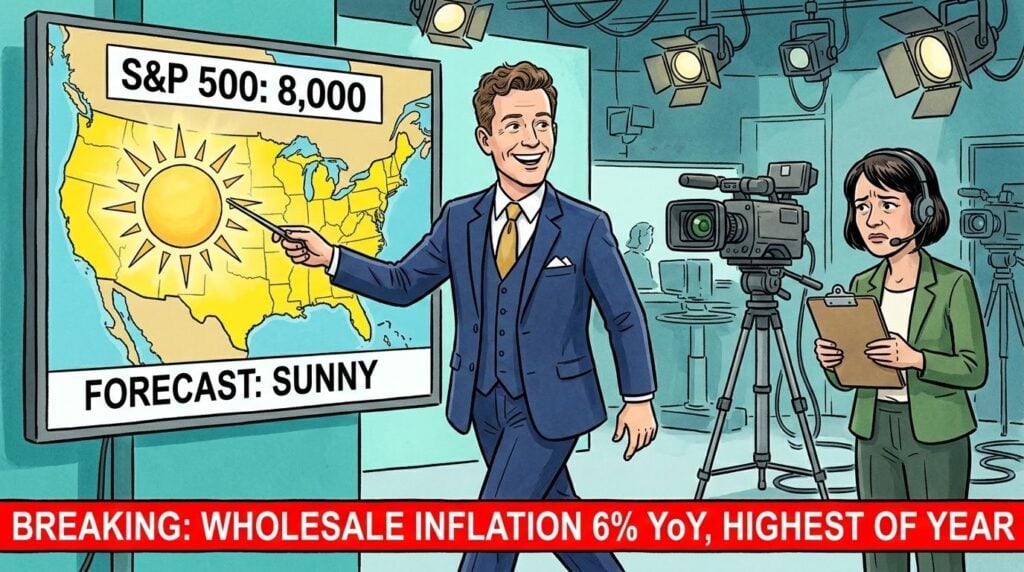
Time horizon decides: 15-plus years out, hold; inside 5 years, trim US large-cap and add international, short Treasuries, and commodities.
- For accumulation-phase investors with 15 or more years before any planned withdrawal, the right move is no move. Automated monthly purchases through a total market index fund (VTI, VTSAX, or equivalent) have outperformed market-timing attempts in roughly two-thirds of historical periods, according to Vanguard research spanning nearly a century of data across three major markets.
- For investors within 5 years of a planned retirement, college expense, or major capital event, the calculation flips. Sequence-of-returns risk is the most underestimated math in retail finance. Buying the S&P at a 4.2% implied premium inside that window means accepting that a normal 25% drawdown over the next 18 months would land at the exact wrong moment for capital preservation.
Specific instrument guidance: trim US large-cap exposure (SPY, VOO, QQQ) toward the lower end of the strategic band; add international developed-market equity (VXUS, IXUS) for valuation diversification; build short-duration Treasury exposure (SHV, VGSH) as dry powder; size gold or broad commodity exposure (GLDM, DBC) at 5% to 10% as a fiscal-debasement hedge. This is allocation discipline triggered by a verifiable change in the inputs to the model, not market timing.
A regime shift is not a forecast. It is the recognition that the conditions that built the last cycle’s plan are no longer the conditions in front of you. The educational partner read on staying clear-headed when the macro story shifts is Morgan Housel’s Same as Ever, a study of what does not change about human behavior under uncertainty.


The Capitalist may earn a commission on books purchased through links below, at no cost to you.
Which Mistake Do Retail Investors Make Most Often During Late-Cycle Rallies?
The most common mistake is buying heavy at the top out of Fear of Already Missing Out, the symmetrical opposite of selling at the bottom. The most common retail mistake during rising inflation regimes is the symmetrical opposite of the mistake during crashes. In crashes, investors sell at the bottom. In melt-ups, investors buy heavy at the top. The Fear of Already Missing Out is the most expensive position retail investors hold during a late-cycle rally.
One reader email recently captured the pattern: “I feel stuck sitting in t-bills.” However, that sentiment is the wrong half of the position. The right half is being clear about what each portfolio bucket is for, and sizing each one for the worst-case 12 months. Holding equities through rising inflation has worked on average across multi-decade horizons. The average masks the worst-case decade.
April’s 6% PPI print and Morgan Stanley’s 8,000 S&P target point in opposite directions for a reason. The institutional read is anchored on earnings momentum. The macro data is anchored on inflation persistence. Rising inflation does not require panic. It requires the reader to know which time horizon their portfolio actually serves, and to size for the regime in front of them.
For educational purposes only. Not financial advice.
Frequently Asked Questions:
How does rising inflation affect equity returns historically?
Rising inflation compresses corporate margins and pushes discount rates higher, which tends to weigh on equity multiples. The 1970s and early 2000s both produced periods where stocks delivered flat real returns despite rising nominal prices.
What is the implied equity risk premium?
It is the extra return investors demand to own stocks over risk-free Treasuries, calculated as the forward earnings yield minus the 10-year Treasury yield. At the current S&P forward earnings yield near 4.6% and the 10-year at 4.48%, it sits near 4.2%, below the historic average of 5.5% to 6%.
Should I rebalance my portfolio in response to one inflation print?
Rebalancing in response to a single data point is timing. Rebalancing in response to a confirmed regime shift is allocation discipline. The reader within 5 years of a major capital event has more reason to adjust than the reader 15 or more years from retirement.
Is gold a better inflation hedge than TIPS?
They hedge different risks. TIPS hedge measured CPI; gold hedges fiscal debasement and currency stress. Holding both at 5% to 10% combined addresses both transmissions and avoids over-relying on either mechanism alone.