
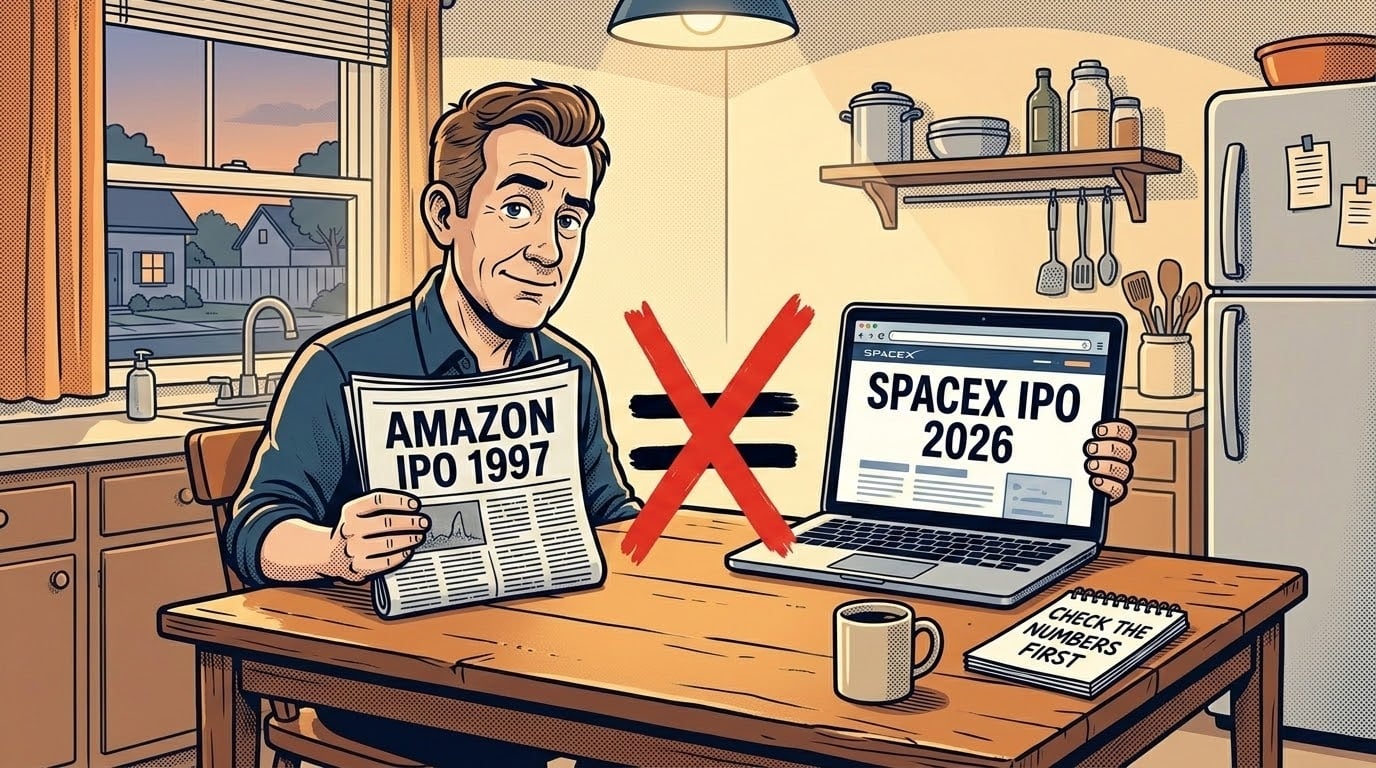

QUICK SUMMARY: SpaceX is targeting a $1.75 trillion IPO in June, the largest in history, and reserving 30% of shares for retail investors. At roughly 80 times forward revenue, it would be priced more expensively than any current trillion-dollar company. Before the S-1 drops, here is the framework for evaluating whether this offering belongs in your portfolio.
The SpaceX IPO is targeting a valuation of $1.75 trillion to $2 trillion. That number gets repeated constantly. Here is the number that does not: 80.
SpaceX generated roughly $15 billion to $16 billion in revenue last year, according to reporting by Reuters. At a $1.75 trillion valuation, the price-to-sales ratio is approximately 75 to 80 times forward-looking expected revenue.
For context: Nvidia, at the peak of its AI-driven rally, traded at 40 to 45 times revenue. Meta trades at roughly 10 times. Apple is closer to 8. No company currently in the trillion-dollar club is priced above 45 times sales. SpaceX, if it prices at $1.75 trillion, would nearly double that record on day one.
Altimeter Capital CEO Brad Gerstner said it plainly on CNBC: “Buying a company at a trillion dollars in value, or a trillion-and-a-half dollars in value, is not a get-rich-quick scheme.”
Gerstner is right. The question is whether retail investors planning to participate in June understand what a number that large actually requires of a business to justify.
At $1.75 trillion, SpaceX would enter public markets at nearly double the price-to-sales ratio of any current trillion-dollar company.
Why Do Retail Investors Keep Comparing SpaceX to Amazon, and Why That Comparison Fails?
Anthony Scaramucci, the financier and early SpaceX backer, captured the sentiment driving this IPO’s retail demand better than any ad campaign could. Explaining why he secured a pre-IPO stake, he said: “I missed Amazon. $10,000 invested in the Amazon IPO on May 15th, 1997, would be worth almost $20 million today. I’m not making that mistake again.”
The feeling behind that quote is understandable. However, the logic doesn’t hold.
Amazon went public in 1997 at a $438 million valuation. SpaceX is targeting $1.75 trillion. Amazon’s offering priced the company at roughly 3 times trailing revenue, for a business with a clear and growing retail model that consumers could already observe and use. SpaceX’s target is 80 times projected revenue for a company that has never filed a public financial statement.
PitchBook put it directly in a recent research note: “The challenge for investors ahead of the listing is that SpaceX has never filed a public financial statement, yet it is preparing to go public in what would be the largest offering in history.”
Every major technology trend since 1995 has produced an early-stage bubble event before eventually rewarding long-term holders. Cloud software, electric vehicles, genomics, and cryptocurrency all followed the same arc: peak enthusiasm at the IPO window, a significant correction, and then a multi-year recovery for the companies that survived. Investors who bought at peak IPO pricing in each of these cycles waited years before breaking even, and many never did.
One financial advisor quoted in Investment News made the same point about SpaceX directly: “People look at SpaceX and think of the trajectory of Apple, Amazon, and Alphabet and think that SpaceX would have the same one. But it’s a much more mature company. It would be good to temper one’s expectations about returns over the long term.”
The behavioral mechanics behind why retail investors systematically overpay at IPOs are well documented. If you want to understand the pattern before June, this is the resource worth reading before the roadshow begins.


The Amazon comparison assigns a random historical outcome to a structurally different present decision. The two IPOs share a category name and almost nothing else.
Is the SpaceX IPO One Investment or Three?
SpaceX is not one company. Buying the SpaceX IPO means taking a position on three distinct businesses simultaneously, and the case for each one is different.
The first is the launch business: government contracts with NASA and the Department of Defense, commercial satellite deployment for institutional clients, and the Starship program. This is SpaceX’s primary revenue driver. It is also the least visible to everyday investors, because its customers are agencies and institutions, not consumers.
The second is Starlink, the consumer satellite internet service. This is the business most retail investors are actually picturing when they say they believe in SpaceX. Starlink is in rural neighborhoods, on fishing boats, and in regions where broadband has never reached. It is growing. Its revenue margins are reportedly strong. It is also the most observable part of the business for an investor who uses the product or knows someone who does.
The third is xAI, the artificial intelligence startup SpaceX acquired in early 2026 at a valuation of roughly $230 billion. Its Grok chatbot competes with ChatGPT and Gemini. In the last reported quarter before the acquisition closed, xAI lost more than $1.4 billion on $107 million in revenue.
Before the brokerage app opens, every investor should be able to answer one question: which of these three businesses is driving your conviction? If the honest answer is “I believe in Elon Musk and rockets,” that is a narrative, not an investment thesis.
Buying the SpaceX IPO means taking a simultaneous position on government launch contracts, consumer satellite internet, and an AI unit that lost $1.4 billion in its last reported quarter.
What Should You Check Before the SpaceX Roadshow in June?
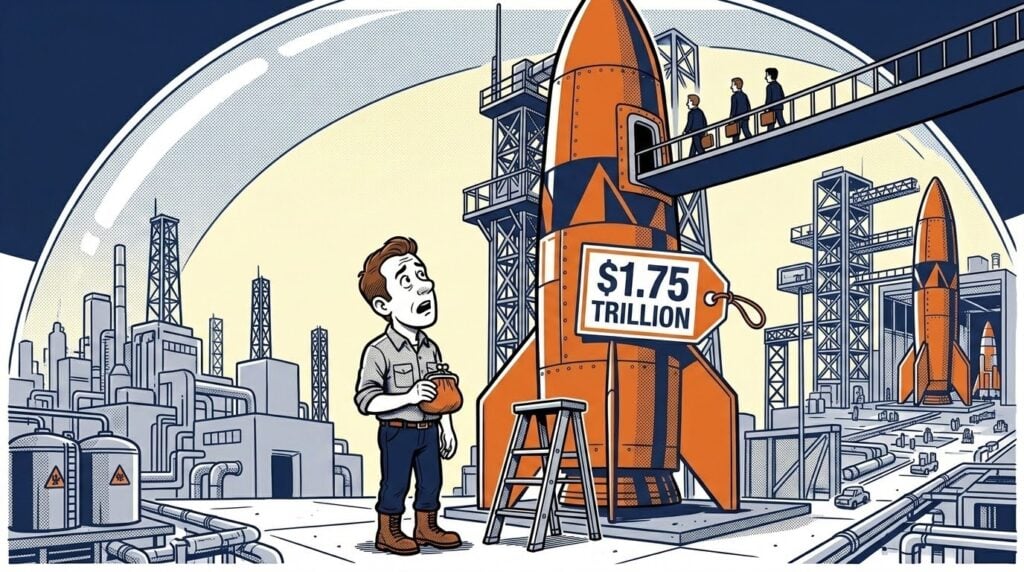
The S-1 prospectus has not been filed yet. SpaceX has indicated to bankers that the full financial disclosure is expected in May, with the roadshow following in June. Until that document is public and reviewed, no one outside the company has the data needed to evaluate whether the IPO price is justified.
That is not a reason to wait forever. It is a reason to wait until the document exists.
Before the roadshow, run three questions. Has the S-1 been filed and read? If not, no valuation judgment is possible. The full financial picture of the xAI acquisition, Starlink margins, and launch contract terms needs to be on the table before any position is sized.
Can you explain SpaceX’s primary revenue driver and its three largest customers in plain language? If not, you are buying a brand, not a business.
Is the planned allocation sized to lose entirely without altering the financial plan? If the answer is no, the position is too large for an IPO at this valuation profile.
Josef Schuster, founder of IPO research firm IPOX Schuster, offered a framework worth noting: “I think investors really need to be careful of jumping in at this point. However, down the road, once it starts trading, I think, let it trade and see. The entry points to IPOs have been, in many cases, much lower than the first trading day.”
The data backs that up. On average, the open-to-close return for IPO stocks on day one is approximately zero, according to Jay Ritter, one of the leading academic researchers on IPO pricing at the University of Florida. The offering price goes to institutional investors. Retail investors buy after initial pricing, often at the moment of peak enthusiasm and peak valuation.
No public financial statement means no margin of safety calculation is possible. Entry price discipline cannot be applied until the S-1 is filed and reviewed.
Should You Buy SpaceX IPO Shares, and If So, When?
For long-term investors building a portfolio over a decade or more: skip the pre-IPO SPV market. These vehicles carry fees of 6% upfront plus 20% of realized profits in some cases, with ownership chains that can be several degrees removed from actual SpaceX equity. One investor who accessed shares directly described the risk simply: “If it’s going several layers down, it can get a little murky.” The cleaner path to pre-IPO exposure is through Alphabet, which owns roughly a 7% stake in SpaceX and trades at approximately 30 times earnings with a diversified revenue base. Wait for the S-1 before making any direct decision on the IPO itself.
For active traders: the SpaceX IPO will generate a tradeable momentum window. That is a different thing from a business investment. Set a defined entry trigger, a hard stop-loss, and an exit target before the market opens on day one. If those three conditions are not in place before the opening bell, you are not trading the IPO. You are chasing it.
For investors within five years of retirement: an IPO priced at 80 times forward revenue, with no public earnings history and three unprofitable subsidiaries, does not belong in a portfolio built around capital preservation in a short window. There are better places to position in this market. (See our recent coverage of tech concentration risk and rebalancing strategy.)
The SpaceX IPO will be one of the most-watched market events of 2026. Market attention and portfolio fit are two different things. The framework for making that call clearly requires the S-1, a clear-eyed look at three separate businesses, and a position sized to reflect the real uncertainty, not the story circulating on social media.
The SpaceX IPO will be the most-watched market event of 2026. That doesn’t make it the right decision for every portfolio.
For educational purposes only. Not financial advice.
Frequently Asked Questions
When is the SpaceX IPO date?
SpaceX filed confidentially with the SEC in April 2026 and is planning its roadshow for June. Shares are expected to begin trading publicly by July 2026, though no exact date has been confirmed. The S-1 prospectus, which will contain full financial disclosures, is expected to be released publicly in May.
How can retail investors buy SpaceX IPO shares?
SpaceX has said it plans to reserve up to 30% of IPO shares for retail investors, compared to the 5% to 10% typical in most large offerings. Investors will be able to access shares through brokerage platforms once the IPO launches. Pre-IPO access exists through certain interval funds and ETFs with SpaceX exposure, though these carry additional fees and redemption restrictions that most retail investors should understand before committing capital.
Is SpaceX a good investment at a $1.75 trillion valuation?
At $1.75 trillion, SpaceX would be priced at approximately 80 times forward revenue, making it more expensively valued at IPO than any current member of the trillion-dollar club. Whether that valuation is justified depends on growth assumptions across three distinct businesses: government launch contracts, Starlink satellite internet, and the xAI unit. No public S-1 has been filed yet, which makes any definitive valuation judgment premature until the prospectus is available.
What is SpaceX’s revenue and is it profitable?
SpaceX generated approximately $15 billion to $16 billion in revenue in 2025, according to reporting by Reuters and the Wall Street Journal. Full profitability data has not been publicly disclosed. The xAI subsidiary, acquired in early 2026 at a valuation of roughly $230 billion, reported a loss of more than $1.4 billion on $107 million in revenue in the quarter before the acquisition closed. Complete financials will be available in the S-1 prospectus expected in May 2026.
What is SpaceX’s price-to-sales ratio at the IPO valuation?
At a $1.75 trillion valuation and approximately $15 to $16 billion in annual revenue, SpaceX would be priced at roughly 75 to 80 times forward revenue. By comparison, Nvidia at its AI-driven peak traded at 40 to 45 times sales, and no current member of the trillion-dollar club exceeds 45 times. SpaceX would more than double that record on day one of trading.