
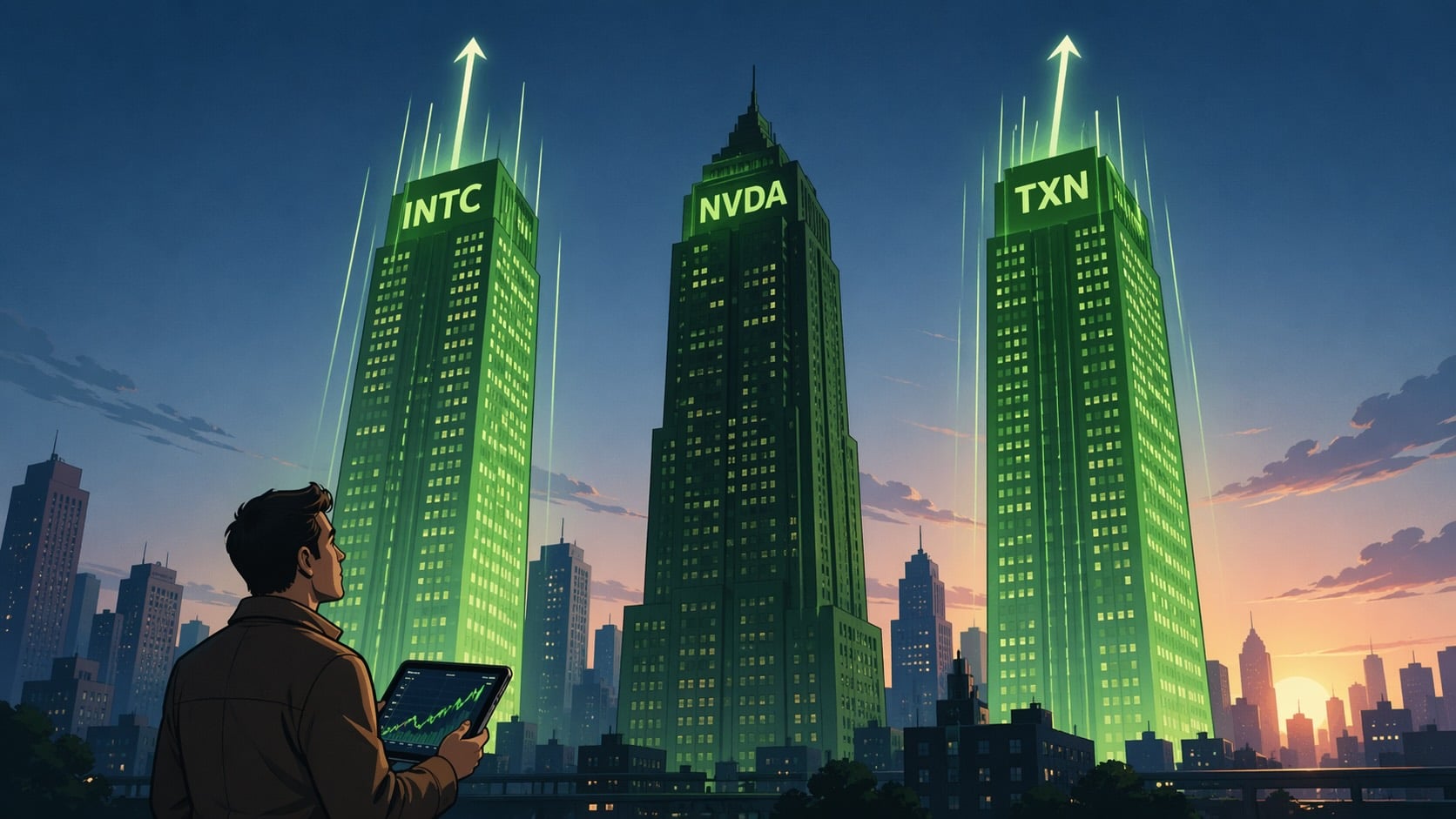

QUICK SUMMARY: Intel reported Q1 2026 EPS of $0.29 against an expected loss, sending shares up 19% after-hours. Texas Instruments posted Q1 revenue of $4.83 billion, up 19% year-over-year, and guided Q2 above consensus. Both cited data center and industrial demand. AI chip stocks broadened beyond Nvidia. What to do next depends on whether you own no semis, broad semis, or concentrated tech.
Intel reported Q1 2026 earnings Thursday after the close. Revenue came in at $13.6 billion against $12.26 billion expected. Earnings per share hit $0.29 against analyst expectations of a $0.01 loss. Shares jumped 19 percent in extended trading and briefly topped the all-time high the stock set during the 2000 dot-com peak. On the same day, Texas Instruments posted Q1 revenue of $4.83 billion, up 19 percent year-over-year, with earnings per share of $1.68, up 31 percent year-over-year. Management guided Q2 revenue to a range of $5.0 billion to $5.4 billion, well above the $4.87 billion consensus. TXN shares rose more than 18 percent during regular trading. Both companies pointed to the same underlying demand drivers: data center and industrial.
Intel also closed Q1 on a run of major business milestones. On April 1, it announced the repurchase of Apollo’s 49 percent stake in its Fab 34 facility in Ireland for $14.2 billion, ending the joint venture structure put in place in 2024 for $11.2 billion. On April 7, Intel joined Elon Musk’s Terafab project as the foundry partner alongside Tesla, SpaceX, and xAI. On April 9, Intel and Google announced a multiyear collaboration to deploy multiple generations of Intel Xeon processors across Google Cloud, including Xeon 6 in C4 and N4 instances, with co-developed custom IPUs. Intel shares jumped roughly 24 percent on the Google news alone. Thursday’s earnings beat is the fourth marquee event in three weeks.
Why This Is a Broadening Signal, Not a Single-Stock Story
For two years, the AI trade has been Nvidia plus everyone praying. Every hyperscaler capex dollar flowed to one name. Every retail investor who bought the AI thesis bought Nvidia and hoped the rest would follow.
Thursday was the first day that framing broke on both the CPU layer and the analog layer simultaneously. Intel is the legacy CPU giant that has been restructuring for years, partially government-owned, fighting a two-front war against Nvidia in AI and TSMC in foundry. Texas Instruments is an analog chip company that serves industrial and automotive end markets, a stalwart that has never been part of the AI narrative at all. Both ripped on the same day, on the same demand drivers.
That is observable demand data, not a story. When the analog layer and the CPU layer both show strength on data center and industrial breadth, it suggests the AI capex cycle is no longer a single-company phenomenon. TXN’s CEO said on the earnings call that data center revenue grew roughly 90 percent year-over-year. Industrial grew 30 percent. Intel’s Xeon 6 family is anchoring the new Google Cloud deal and the Ireland fab buyback. Both sets of numbers point in the same direction.
The caveat to hold in mind: broadening at the top of a cycle looks identical to broadening early in one. Both patterns produce the same one-day chart. One year from now, the two scenarios will be distinguishable. Today, they are not.
What You Do Depends on What You Already Own

This is where most retail coverage of earnings events goes wrong. A single frame gets applied to every reader: buy, sell, or hold. But the right move depends on your current allocation, not on the event.
- If you own no semiconductors and contribute systematically to broad index exposure: The earnings event is not a decision trigger. Data from the last three decades shows that buying consistently outperforms waiting for better entry points in roughly 70 percent of historical periods. The correct action is to continue scheduled purchases on your next contribution date. Not today. Not at the after-hours price. If you want semi-exposure specifically, the next scheduled contribution into a broad semi ETF such as SMH or SOXX is the disciplined answer.
- If you already own broad semi-exposure and are considering single-name adds: Now the framework matters, and it splits the two names cleanly. TXN is the stalwart category: industrial cycle proxy, dividend history, explicit forward guidance above consensus. The PEG ratio screen applies. Intel is the turnaround category: partially government-owned, mid-restructuring, one beat does not make a trend. Intel requires at least two consecutive quarters of margin expansion before meaningful sizing. The categories are different, and collapsing them into one “chip name” bucket produces mis-sized positions.
- If you already run concentrated tech weight above 30 percent of your portfolio: The after-hours move is not an add signal. It is a trim signal. Check your actual sector weight after a 3 to 4 percent day in tech. If the Shiller CAPE on the tech sector is sustained above two standard deviations from its historical mean, the disciplined move is to reduce tech exposure toward strategic weight and rotate into international equity and real assets. That is not market timing. It is staying inside the allocation you already chose.
Same event. Three different answers.
The Counter-Case Worth Taking Seriously
A disciplined investor takes the counterargument seriously before sizing any position on a breakout day.
Intel briefly touched its 2000 dot-com peak on a single earnings print. That is not the behavior of a stock early in a new cycle. That is the behavior of a stock in a late-cycle melt-up. Stocks testing 26-year highs on earnings catalysts tend to show up at cycle extremes, not cycle beginnings.
The analyst picture also complicates the clean-broadening narrative. Morgan Stanley’s Joseph Moore named Micron Technology its top 2026 chip pick at the start of the year on a breadth-driven thesis. On March 2, he reinstated Nvidia as the firm’s top pick, citing Nvidia’s stalled share price against continuing business growth and hyperscalers signing multi-year supply contracts with upfront prepayments. The breadth framework persists, but the specific top-pick rotation matters. The story has moved through Micron and back to Nvidia inside a single quarter.
Capex fatigue is the second risk. The entire broadening thesis depends on hyperscaler spending continuing to compound at current rates. Microsoft, Meta, Amazon, and Alphabet all report over the next two weeks. If any of those four softens their 2026 data center capex guidance, the broadening story loses its engine.
Industrial demand is the third risk. When the industrial chip cycle turns, it turns fast. TXN’s 31 percent year-over-year EPS growth and its Q2 guide above consensus are real. They are also the late-cycle industrial pattern that has preceded reversion in prior cycles.
The honest read is that the broadening signal is real, the late-cycle risk is real, and both can be true at the same time.
What to Watch Over the Next Two Weeks
The hyperscaler earnings sequence is the binary. Microsoft, Meta, Amazon, and Alphabet report over the next two weeks. Data center capex guidance from those four calls is the single most important input for the broadening thesis. If capex guidance holds or accelerates, the Thursday move was a confirmation. If it softens materially on even one of the four, the thesis is in question.
TXN Q2 execution is the second watchpoint. Management guided $5.0 billion to $5.4 billion against a $4.87 billion consensus. Meeting or exceeding that range validates the industrial breadth claim. Missing it confirms the late-cycle pattern.
Intel 18A node progress and margin trajectory is the third. One beat is a data point. Two consecutive quarters of margin expansion are a trend. Don’t promote Intel out of the turnaround category on one print.
Tech sector CAPE relative to the historical mean is the fourth. Not every reader has that number handy. It is worth pulling before making any rebalancing decision.
And your own sector weight is the fifth. A 3 to 4 percent day in tech can push a portfolio above strategic weight without any action on the owner’s part. Checking actual allocation after moves like this is the discipline most retail investors skip.
The discipline that matters here is not picking the right chip stock. It is deciding what to do with news like Thursday’s when it hits.


Just Keep Buying by Nick Maggiulli lays out the data on why automated, consistent purchases outperform single-event timing decisions in roughly 70 percent of historical periods, the exact data behind the “no semis, keep contributing” answer above.
The AI Chip Stocks Bottom Line
The broadening is real data. It is not a green light to chase a chart that already ran 18 to 19 percent after hours. The investor who treats Thursday as a decision test rather than a buy signal will make better positioning decisions over the next year than the investor who chases the move.
What you own determines what the news means for you. That is true before every earnings event, not just this one. Thursday just made it visible.
Frequently Asked Questions
Why did Intel stock jump 19 percent after earnings?
Intel reported Q1 2026 EPS of $0.29 against an expected loss of $0.01. Revenue came in at $13.6 billion versus $12.26 billion expected. The beat followed three earlier April catalysts: the $14.2 billion Ireland Fab 34 buyback, the Terafab foundry partnership with Tesla and SpaceX, and the multiyear Google Cloud Xeon deal.
What are AI chip stocks beyond Nvidia?
The AI chip universe extends past Nvidia to Broadcom, AMD, Taiwan Semiconductor, Micron Technology, Marvell Technology, Texas Instruments, and Intel. Each plays a different role in the AI infrastructure stack, from GPUs to custom AI accelerators to high-bandwidth memory to foundry services to analog industrial chips.
Should I buy AI chip stocks after the big earnings day?
The right answer depends on your current portfolio. Investors with no chip exposure who contribute systematically should stay on their scheduled contribution plan rather than chase a single day’s move. Investors with broad semi exposure, considering single-name adds should apply different frameworks to stalwarts like TXN and turnarounds like Intel. Investors already concentrated in tech above 30 percent of portfolio should treat the move as a trim signal, not an add signal.
Is the AI trade still only about Nvidia?
Thursday’s simultaneous moves in Intel, Texas Instruments, and the broader semiconductor index suggest the answer is no. The AI capex cycle is reaching the analog and CPU layers, not just the GPU layer. Morgan Stanley cycled its top chip pick from Nvidia to Micron and back to Nvidia inside a year on a similar breadth debate. One day is a data point, not a confirmed trend.