
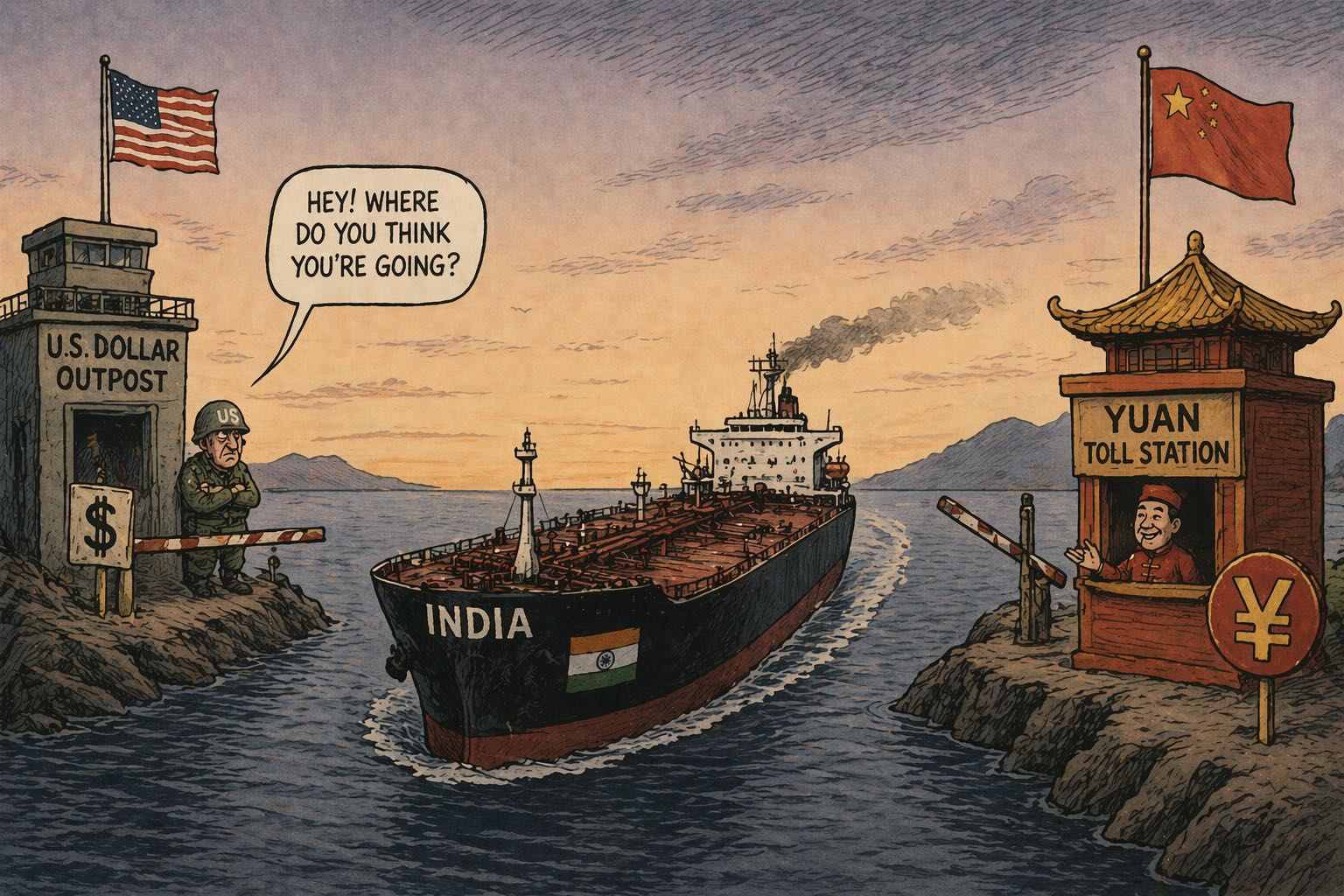

SHORT SUMMARY: On April 17, Indian refiners settled purchases of Iranian oil in Chinese yuan through ICICI Bank’s Shanghai branch. This yuan for oil payment was the first in seven years. Iran’s Strait of Hormuz tolls already run in yuan. The dollar’s SWIFT share dropped 3.7 points last quarter. The payment system is shifting. Dollar reserves are not.
On April 17, Reuters reported that Indian refiners had settled payments for rare cargoes of Iranian crude in Chinese yuan, routed through ICICI Bank’s Shanghai branch to yuan-denominated seller accounts. State-run Indian Oil Corp bought approximately 2 million barrels, the country’s first purchase of Iranian crude in seven years. Private refiner Reliance Industries took an additional four vessels, one of which, the MT Felicity, has already discharged. Both transactions fell inside a narrow 30-day US sanctions waiver the Treasury Department had issued on March 20 to ease oil price pressure from the US-Israeli war on Iran. Treasury Secretary Scott Bessent announced the waiver would not be renewed, and it lapsed on Sunday, April 19. Indian Oil Corp does not plan further Iranian purchases.
This single transaction is not the story. The context around it is. Iran’s Strait of Hormuz tolls, imposed after the February military confrontation and formally codified by Iran’s parliament on March 30-31, now charge transiting vessels up to $2 million per voyage. Lloyd’s List has documented at least two vessels paying those tolls in yuan, with payments routed through Kunlun Bank via China’s Cross-Border Interbank Payment System. On April 23, Iran’s parliament deputy speaker confirmed the first toll revenues had been deposited into the Central Bank. Separately, Indian refiners also purchased approximately 60 million barrels of Russian crude in March under a different US waiver that expired April 11, with payment structured through Indian rupees deposited into Russian offshore accounts and converted into UAE dirhams or Chinese yuan. China’s CIPS hit a daily average transaction volume of $134 billion in March, a record, though the Atlantic Council cautions that the volume does not by itself prove Iranian oil payments drove the surge.
Two separate reports in the last 10 days also confirmed that during the IMF and World Bank Spring Meetings in Washington, UAE Central Bank Governor Khaled Mohamed Balama met with Bessent and Federal Reserve officials. The Wall Street Journal reported on April 19 that Balama raised the possibility of the UAE using Chinese yuan in oil trade if a dollar liquidity crunch develops, while formally requesting a currency swap line as a precautionary measure. No formal request has been made. The UAE embassy publicly denied it needs external financial backing. Bessent himself acknowledged publicly that “many” Gulf allies have asked for financial backstops.
India’s Yuan for Oil Payment Does Not Mean the Dollar’s Collapse
The temptation with a story like this is to read it as the beginning of the end for the dollar. That reading is wrong, and it will produce worse portfolio decisions than the actual story warrants.
The Bank for International Settlements 2025 Triennial Central Bank Survey, the most comprehensive measure of global currency usage, found the US dollar was on one side of 89.2 percent of all foreign exchange transactions in April 2025. That share actually increased from 88.4 percent in 2022. The dollar still clears roughly 58 percent of global trade. Foreign official holdings of US Treasuries increased by 4 percent in 2025 through July. Other foreign ownership is up 8 percent over the same period.
Foreign investors are not abandoning dollar assets. They are hedging the currency exposure while keeping the assets. Those are two different things, and conflating them produces the “dollar collapse” framing that misses what is actually happening.
What is happening is more specific and more durable. The payment rail, which is how countries pay each other for goods and particularly oil, is fracturing measurably. The reserve holding, which is what central banks actually save in, is not. Both stories matter. They move on different timelines. A reader who mixes them up will either panic about the wrong thing or miss the signal that actually matters.
What the Measurable Shift Actually Is

The 3.7-point drop in the dollar’s SWIFT share in a single quarter is not a rounding error. It is the largest quarterly decline in the reporting history of the system. The yuan’s share climbed from 4.7 percent to 6.2 percent over the same period. Those yuan for oil numbers are small in absolute terms. They are large in terms of velocity.
Three structural features make the current shift different from prior de-dollarization headlines.
The infrastructure exists now in a way it did not five years ago. China’s CIPS settled the equivalent of $245 trillion in yuan transactions in 2025. The mBridge cross-border central bank digital currency platform, originally incubated under the BIS, continues to operate after the BIS stepped away from it in late 2024. The Atlantic Council’s GeoEconomics Center documents more than 4,000 mBridge transactions totaling approximately $55 billion, with China’s digital yuan representing 95.3 percent of the volume. Over 40 central banks now hold bilateral yuan swap lines with the People’s Bank of China. In November 2025, the UAE executed its first government payment using the wholesale digital dirham on mBridge, testing readiness for settling energy and commodity trade.
The motivation exists. Washington’s use of sanctions as a foreign policy tool, from the 2022 freeze of $300 billion in Russian central bank reserves to the Iran SWIFT restrictions, has given dozens of countries a practical reason to build dollar alternatives. Even US allies now keep non-dollar settlement capabilities on their balance sheets as insurance.
The scale is growing. But one quarter of data does not confirm a trend. Four consecutive quarters of the same direction would. That is the question the next three SWIFT reports will answer.
Four Portfolio Types, Four Actions
Most retail coverage of de-dollarization applies one frame to every reader: buy gold, buy international, reduce Treasury duration. The right move depends on your current allocation and time horizon, not on the story.
- If you own a standard 60/40 US-equity-heavy portfolio: The current data does not yet justify restructuring. Build a tracked dashboard with three inputs: SWIFT dollar share of international payments, yuan share of the same, and quarterly central bank gold purchase volumes. Revisit quarterly. Do not reallocate on one quarter of data. Being wrong about a multi-year trend that reverses costs more than being six months late to a trend that confirms.
- If you already hold international equity and some gold exposure (VT-style or permanent-portfolio style): You are partially positioned. Check whether gold is above or below strategic weight at current prices. Spot gold is trading near record highs after hitting an intraday all-time high earlier this year. Do not add at record prices without a specific trigger. Chasing a hedge that has already worked is the behavioral error that kills hedge performance.
- If you are within five years of retirement and holding concentrated US Treasury exposure: Duration matters more than the headline. Long-duration Treasury holdings are the specific asset most exposed to a structural shift in foreign Treasury demand. Discuss this with an advisor before the next rebalancing cycle, based on the broader direction of foreign Treasury ownership rather than the April 17 India-Iran transaction alone. TIPS allocation and duration tilt are the two levers.
- If you run a business with foreign supplier or customer exposure: The hedging question becomes operational, not just financial. Multinational firms are extending currency hedges from one-year horizons to two-to-five-year horizons, according to Reuters reporting. The small-business version is forward contracts or currency-hedged payables, arranged with a bank familiar with multi-currency treasury management. This is the planning version of the institutional trend.
Same event. Four different portfolios. Four different actions.
The Counter-Case Worth Taking Seriously
A disciplined investor takes the counterargument seriously before sizing any allocation move.
TD Securities’ 2026 strategy outlook reads the data this way: de-dollarization is more hedging than divesting. Foreign investors are still buying Treasuries. They are just hedging their dollar exposure at the portfolio level. That is a very different story from “dumping dollars.” It is consistent with the data on both sides, with payment share down and reserve holdings up.
Morningstar’s December 2025 analysis reached a similar conclusion. The firm’s cross-currency strategists described the dollar’s current weakness as a prolonged phase of cyclical softness rather than a secular decline. Their view is that the recent dollar weakness reflects slowing US growth, narrowing rate differentials, persistent fiscal deficits, and elevated inflation, which are cyclical drivers rather than structural ones.
The TINA argument also still applies at scale. At any plausible time horizon under ten years, no alternative currency has the depth, liquidity, and institutional trust of the dollar. The yuan faces fundamental constraints. China maintains capital controls that limit free convertibility. Foreign investors cannot freely move capital in and out of Chinese markets. BRICS members have publicly stated they are not pursuing a common currency. Russia confirmed in January 2026 that talks on a unified BRICS currency are not taking place.
There is also an honest question about whether the April 17 India-Iran transaction was trend-establishing or window-closing. The payment happened inside a 30-day US waiver that the Treasury then allowed to expire. IOC does not plan further purchases. That is a single data point inside a closing regulatory window, not a unilateral defiance of sanctions. The yuan-for-oil mechanism is real. Its directional velocity is genuinely uncertain.
None of that means the measurable shift in 2026 is noise. It means the honest conclusion is that the current data is enough to monitor, prepare, and position modestly. It is not yet enough to restructure around.
Yuan-for-Oil: The Trigger Levels
Defining what would confirm a regime shift before the confirmation arrives is the discipline that separates regime-aware allocation from reactive chaos.
- Level 1 Current signals (confirmed as of Q1 2026): Hormuz tolls in yuan. India-Iran yuan settlement under a 30-day waiver. 3.7-point SWIFT dollar share drop. Indian rupee-to-yuan-or-dirham conversion on 60 million barrels of Russian crude. UAE central bank’s private signaling of yuan contingency. Third consecutive year of central bank gold buying above 1,000 tonnes. Action: Monitor. Add the dashboard. Do not reallocate.
- Level 2 Confirmation signals (not yet present): Dollar SWIFT share below 40 percent sustained for two consecutive quarters. A Gulf state OPEC member publicly pricing benchmark crude in a non-dollar currency or basket, not just accepting yuan for specific transactions. The implied US equity risk premium is diverging materially from the 30-year mean while the dollar share continues falling. Central bank gold purchases are accelerating above 1,200 tonnes per year. Action: Begin sizing hedges toward strategic weight. Move gold allocation toward the upper end of the range. Add meaningful international equity. Consider Treasury duration reduction and TIPS allocation.
- Level 3 Reversal signals: Dollar SWIFT share stabilizes or rebounds over the next two quarters. Yuan use in oil trade stays narrow, sanctions-driven, and waiver-dependent. Gulf oil producers continue dollar pricing for OPEC benchmark crude. UAE and US reach a swap-line agreement that removes the yuan contingency from the table. Action: The 2026 data was a geopolitically driven blip. Maintain current allocation. The narrative priced ahead of the data.
What to Watch Over the Next Two Quarters
What single data point confirms a regime shift is underway? A Gulf state OPEC member publicly pricing benchmark crude in a non-dollar currency or currency basket. Not the acceptance of the yuan for specific transactions. Not a central bank signaling a contingency. A formal, publicly announced change in benchmark pricing. Nothing else in the current data set carries the same structural weight.
Which monthly number matters most? The SWIFT dollar-share figure. One quarter is a data point. Two consecutive quarters in the same direction are a pattern. Three quarters is a trend. The next SWIFT monthly release is the first test of whether the Q1 2026 drop continues or reverses.
What valuation signal would confirm the framework? The US equity risk premium relative to Treasury yields. If the implied premium widens materially at the same time the dollar’s payment share keeps falling, that is empirical confirmation that changes entry-price discipline on US equities. Until both conditions hold, the standard valuation process applies.
What should you track in your own portfolio? Allocation drift. A gold position that outperforms for two quarters can push you above strategic weight without any action on your part. Checking actual allocation after periods like this is the discipline most retail investors skip.
The risk in a story like this one is the temptation to act on the narrative before the data confirms it.


Same as Ever by Morgan Housel makes the case for why investors who position around slow-moving structural trends, rather than chasing the headline-driving shifts, consistently outperform those who trade the news cycle.
Watch the Data, Not the Narrative
The dollar’s role in the oil trade is fracturing in measurable ways. That is not the same as the dollar collapsing. The investor who treats the April 17 India-Iran yuan for oil payment as a monitoring signal rather than a positioning trigger will make better decisions over the next five years than the investor who either panics or dismisses the data entirely.
A multipolar currency system does not require the dollar to lose reserve status. It requires the dollar to slide from “the only option” to “the primary option among several.” The data says that the slide is measurable right now. At the same time, the data does not yet say it is irreversible.
What you own determines what the news means for you. Define your trigger level before the next data point arrives. The investors who come out ahead in a regime transition are rarely the ones who called it correctly. They are the ones who built an allocation framework that did not require them to call it at all.
Frequently-Asked Questions
What does yuan for oil mean?
Yuan for oil refers to the settlement of international oil purchases in Chinese yuan rather than US dollars. This includes direct payments between buyers and sellers, yuan-denominated tolls such as Iran’s Strait of Hormuz transit fees, and multi-party transactions routed through Chinese yuan clearing infrastructure like CIPS and mBridge. The practice expanded measurably in Q1 2026.
Is the US dollar about to lose its reserve currency status?
Not based on current data. The dollar remains on one side of 89.2 percent of all foreign exchange transactions according to the BIS 2025 Triennial Survey. Foreign central bank Treasury holdings increased in 2025. What is changing is how countries pay each other for goods, particularly oil. Reserve status and payment rail are two different systems.
How should de-dollarization affect my retirement portfolio?
For most retail investors, the current data does not yet justify restructuring. For pre-retirees holding concentrated long-duration US Treasury exposure, the specific question worth asking is whether Treasury duration and TIPS allocation are appropriate for a scenario where foreign Treasury demand stabilizes but does not grow. This is a conversation for an advisor, based on the broader trend rather than any single transaction.
Should I buy gold or international stocks because of yuan for oil?
It depends on what you already own. If you hold no gold or international equity, modest exposure for diversification can make sense regardless of the de-dollarization story. If you already hold those assets, checking whether they are above or below strategic weight at current prices matters more than adding on the news. Gold at record highs is a different trade than gold at a three-year low.