
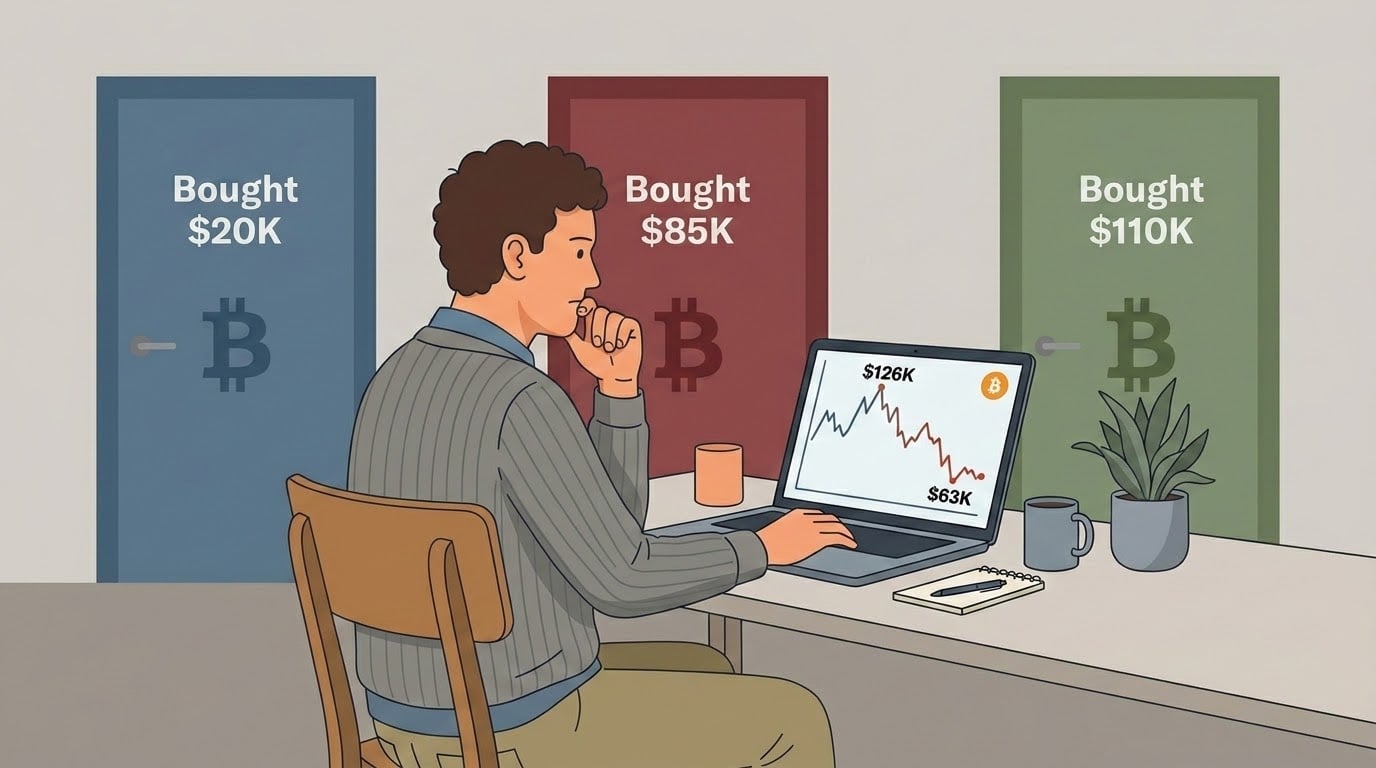

Bitcoin is around $63,000 this week. Seven months ago, it was at $126,000. If you are holding Bitcoin right now and you are not sure what to do next, you are not alone. On-chain data from CryptoQuant shows nearly 92% of short-term Bitcoin holders are currently at a loss. The average cost basis for US spot Bitcoin ETF investors sits at $83,400. Nearly half of all circulating Bitcoin supply is underwater.
That is a lot of people staring at a number they do not like.
I have been there. Twice. What I learned both times is that the holding decision and the buy decision are not the same. Most people treat them like they are. That is where the expensive mistakes get made.
The Three Rooms Every Bitcoin Holder Is Sitting In
Not every Bitcoin holder is in the same situation right now. There are roughly three groups, and the right move for each one is different.
The first group bought below $30,000, most of them before 2023. At $63,000 today, they are still sitting on meaningful gains even after this correction. Their question is not whether to hold. Their question is how much of that gain they want to protect, and at what tax cost.
The second group bought somewhere between $60,000 and $100,000, largely during the ETF launch wave in 2024 through mid-2025. Bitwise analysis of Bitcoin’s full price history through early 2026 puts the average cost basis for holders in this window at roughly $78,150 for those who have been in for one to two years, representing an unrealized loss of about 15 to 20% at current prices. This is the largest group by number of retail participants. It is also the group most likely to be frozen.
The third group bought near the October 2025 peak, somewhere above $100,000. Those holding for six to twelve months carry an average cost basis of approximately $101,250, a paper loss of around 35% at today’s prices. This is the most acute pain cohort. They bought into what felt like a confirmed bull run and watched it reverse almost immediately.
Three rooms. Three very different conversations.
What Actually Drove This Drop
Before you decide anything, it helps to understand what happened. Bitcoin did not fall because something broke. It fell because the same macro forces compressing risk assets across the board hit crypto harder than most.
Sticky inflation data kept the Federal Reserve from cutting rates. The dollar strengthened. Geopolitical tensions in late spring pushed investors toward cash. Spot Bitcoin ETFs saw sustained outflows for the first time since launch. On February 5, 2026, Bitcoin investors locked in $3.2 billion in realized losses in a single 24-hour period, one of the largest capitulation events in the asset’s history. By late March, roughly 46% of all circulating Bitcoin supply was held at a loss.
None of that is unique to Bitcoin. It is the same risk-off environment that pressured equities in the same window. The difference is that Bitcoin’s volatility amplifies every move in both directions.
This is also not new behavior. In 2014, Bitcoin fell 57%. In 2018, it fell 74%. In 2022, it fell 64%. Every one of those events felt like the end. None of them were.
The Thesis Audit: Was Your Reason for Buying Still True?

Here is the question most people are not asking right now, because it is uncomfortable. Not “is Bitcoin going to recover?” but “why did I buy it in the first place?”
Write down the three reasons you bought Bitcoin. Then ask, for each one: has that reason changed, or has only the price changed?
- If you bought Bitcoin as a hedge against currency debasement and expanding fiscal deficits, check the macro environment. US deficits are still widening. Real interest rates remain pressured. The conditions that made the debasement thesis compelling in 2023 and 2024 are more intact today than when most retail buyers entered. If that was your thesis, the price drop has not invalidated it. It has just made it uncomfortable to hold.
- If you bought Bitcoin because it was going up, that is a different situation. “The price was rising” is not a thesis. It is a position with no exit criteria. If this describes your original reasoning, you do not have a thesis to audit. What you have is a loss with no framework for deciding what to do next.
A price drop alone invalidates zero thesis points. It is not new information about Bitcoin’s underlying case. It is Bitcoin doing what Bitcoin has always done.
When the hold decision gets difficult, the clearest framework for thinking through it comes from decision science: separate the quality of your decision from the outcome of your decision. Losing money does not mean you made a bad choice. It might mean you made a sound choice and landed in the unlucky 10%. Understanding the difference is what keeps you from making the real mistake, which is abandoning a sound strategy because of a bad outcome. Annie Duke’s Thinking in Bets walks through exactly this kind of high-stakes decision under uncertainty. It’s the most practically useful book on decision-making we have come across for investors managing positions through volatile markets.


Disclosure: TheCapitalist.com participates in the Amazon Associates program. We may earn a commission if you purchase through our links. This does not affect our editorial recommendations.
The Position Size Problem
Most retail Bitcoin holders did not make their critical mistake when they chose the asset. They made it when they chose the size.
Ask yourself: what percentage of your total portfolio is Bitcoin right now at $63,000? If the answer is above 5 to 10%, and a further drop to $30,000 would materially change your financial situation, the position was never sized appropriately for the risk you were taking. That is not a Bitcoin problem. It is a portfolio construction problem.
Bitcoin at 3% of a diversified portfolio is a manageable asymmetric bet. Bitcoin at 30% of your net worth is a concentrated position in the most volatile major asset in the world. They are different instruments wearing the same name.
The practical implication: if you cannot hold through a further 50% drawdown without panic-selling or changing your financial plans, the right move is to reduce to a size you actually can hold. Not because Bitcoin is going to $30,000. It might not. But you can only capture Bitcoin’s long-term upside if you are still in the trade when it happens. Selling after a 50% drop and buying back after a recovery is the most reliably expensive pattern in retail investing.
There is a genuine split on this point. The macro-driven thesis says: if the debasement case is intact, hold the full position. The cost-certainty counter-argument says: the only variable you can control is how much you own. If the current size is producing behavior that will hurt you, right-size it now. While the thesis-based framework says hold, field reality says most retail buyers did not have a thesis firm enough to hold through this kind of drawdown. That gap is where the real damage happens.
Holding Bitcoin for 3 Years Has Never Produced a Loss
There is one data point that belongs in every holding Bitcoin conversation.
Bitwise reviewed Bitcoin’s complete price history from July 2010 through February 2026. The finding: holding Bitcoin for at least three years reduces the probability of loss to 0.70%. Holding for five years drops that figure to 0.2%. No ten-year holding period in Bitcoin’s history has ever produced a loss.
At $63,000 today, the three-to-five-year realized price for Bitcoin sits around $34,780. Investors who bought and held through that window are still up roughly 80% despite everything that has happened since October 2025.
“Despite anxiety, most holders remained on the sidelines,” Bitcoin Magazine reported in March 2026, summarizing survey data from US Bitcoin holders during the correction. The data tracks with on-chain behavior. Most retail holders are not selling. They are frozen. Holding Bitcoin through a correction without a framework for why is survivable. Doing it without one is just expensive waiting.
The math works over time. The only question is whether you have the time horizon and the position size to let it work.
Holding Bitcoin: When to Keep Still and When to Pull the Trigger
Here’s the key distinction: holding Bitcoin should not be an act of faith, and selling should not be an act of fear. Your decision should depend on three things: your entry price, your original thesis, and whether the position still fits your retirement plan. A younger speculator can afford to wait out chaos. A retiree, or someone nearing retirement, has to think differently. The goal is not to prove conviction. The goal is to preserve enough capital, income, and emotional discipline to stay solvent through the next cycle.
- If you bought below $30,000, hold. You have already absorbed multiple 50% corrections and come out ahead. Consider taking some profit to reduce your emotional exposure, especially if Bitcoin now represents a large portion of your net worth. You do not have to sell. But you have earned the right to take something off the table.
- If you bought between $60,000 and $100,000 in 2024 or 2025, run the thesis audit above. If the macro conditions that drove your original purchase are still intact, the hold case is defensible. If you had no explicit thesis, right-size the position to what you could hold without panic at $30,000. That number is your real risk tolerance. Build to it now, not during the next move down.
- If you bought above $100,000 in late 2025, this is the hard one. If your financial plan cannot absorb another 50% drawdown, reduce now. Not because Bitcoin cannot recover. It has recovered from worse. But because you need to still be in the trade when it does. A smaller position you can hold is worth more than a full position you will sell at the bottom.
The loss does not make this decision for you. Your thesis does. Your time horizon does. Your position size does. All three of those were set before the price moved a dollar.
Frequently Asked Questions
What is the average cost basis of Bitcoin holders right now?
On-chain data from CryptoQuant shows nearly 92% of short-term Bitcoin holders are currently at a loss as of March 2026, with the average cost basis for US spot Bitcoin ETF investors sitting around $83,400. Investors who entered the six-to-twelve-month window ending June 2026 carry an average cost basis of roughly $101,250.
How long do you have to hold Bitcoin to reduce your risk of loss?
Bitwise analysis of Bitcoin’s price history from 2010 through early 2026 shows that holding for at least three years reduces the probability of loss to 0.70%. Holding for five years drops that figure to 0.2%. No ten-year holding period in Bitcoin’s history has produced a loss.
Should I sell Bitcoin at a loss or wait for a recovery?
The answer depends on three variables: whether your original investment thesis is still intact, whether your time horizon is long enough for the three-year data to apply, and whether your current position size is one you can hold through a further 50% decline without damaging your financial plan. If all three answers are favorable, the historical case for holding is strong. If position size is the problem, reducing to a manageable level now is more defensible than waiting for a recovery that may take years.
What percentage of my portfolio should Bitcoin be?
No universal rule exists, but most risk-aware portfolio frameworks treat Bitcoin as a high-volatility alternative asset and size it accordingly. A position between 1% and 5% of total portfolio value gives meaningful upside exposure without making a 50 to 70% correction catastrophic. Positions above 10% of net worth carry concentration risk that most retail investors cannot behaviorally sustain through Bitcoin’s normal drawdown cycles.