
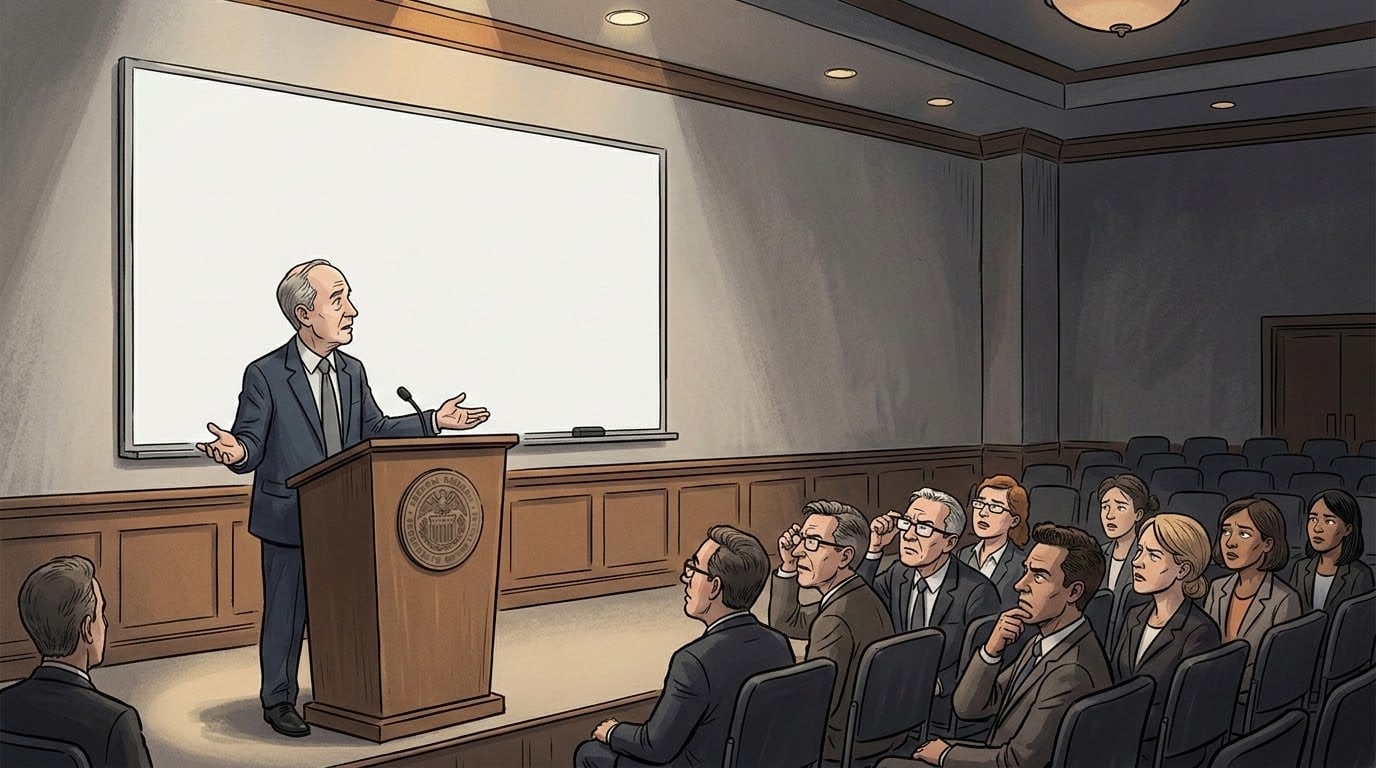

The Federal Reserve held its benchmark rate steady at 3.50% to 3.75% on June 17. That was the expected outcome. The vote was 12-0. There was nothing surprising about the decision itself. What was surprising was everything underneath it. With the July Fed meeting approaching, nine of 18 officials who submitted projections penciled in at least one rate hike before December. The median year-end rate projection moved to 3.8%, up from 3.4% in March — a shift that reversed a full year of market expectations for cuts. Seventeen of 18 officials judged the risks to their inflation forecast to be tilted to the upside. Chair Kevin Warsh said “price stability” twelve times during his first press conference as Fed Chair. The statement itself shrank to 130 words, stripped of the forward guidance language markets had used for years to read the room.
“We’ve gone from talking about how many cuts we’d see from the Fed to asking if they’ll raise rates,” LPL Financial’s chief technical strategist Adam Turnquist said after the meeting.
Now comes July 28.
What the July Fed Meeting Is and Isn’t
The July 28-29 FOMC meeting is a non-SEP meeting. That means no Summary of Economic Projections. No dot plot. No updated forecasts for GDP, unemployment, or inflation. The committee will vote, issue a statement, and Warsh will take questions for roughly 45 minutes.
If the Federal Reserve holds in July, investors will get a 130-word statement and a press conference. They will try to read Warsh’s tone and word choices for signals about September.
If the Fed hikes in July, investors will get a 130-word statement, a press conference, and no dot plot to anchor what comes next. That is the specific structural problem. In every other hawkish surprise in modern Fed history, markets could turn to the Summary of Economic Projections to understand whether the hike was the beginning of a cycle or a one-time adjustment. The July meeting offers neither.
The July meeting will produce a rate decision, a 130-word statement, and a press conference and nothing else. If the Fed surprises hawkish, then there is no projection matrix for markets to interpret what follows.
CME FedWatch priced the July hold at approximately 89% probability immediately after the June meeting; as of early July, that figure has shifted to approximately 70%, reflecting tightened market expectations heading into the data window. Bank of America revised its forecast in late June to project three hikes before year-end, lifting its rate target to 4.25%-4.50%. Prediction platform Kalshi prices a 53% chance of at least one hike arriving before year-end. None of these numbers are guarantees. All of them are higher than they were six weeks ago.
What Changed Between March and Now
Three things shifted simultaneously between the March dot plot and the June one, and investors who built portfolios for a 2026 rate-cut environment need to account for all three.
- First, inflation. The Federal Reserve raised its PCE inflation forecast for 2026 to 3.6%, up from 2.7% in March. Core PCE, which excludes food and energy, came in at 3.4% in May and 3.3% in April. The 10-year Treasury yield stood at 4.47% after the June meeting, near the high of its recent range. In mid-May, 30-year Treasury yields crossed above 5% for the first time in this cycle.
- Second, the rate path. The median 2026 year-end dot moved from 3.4% — implying a cut — to 3.8%, implying a hike. That is a directional reversal, not a modest adjustment.
- Third, the chair. Kevin Warsh was sworn in on May 22. His first meeting produced the most communication-sparse Fed statement in years. U.S. Bank Asset Management strategist Tom Hainlin put it directly: “For bond investors, that means the path of rates may matter less than building a portfolio that can handle more than one policy outcome.”
The Fed’s rate path reversed direction between March and June — from an implied cut to an implied hike — driven by a PCE forecast revised to 3.6%, a hawkish dot shift, and a new chair who communicated less, not more.
What Rate-Sensitive Positions Actually Face
The sectors most exposed to a July surprise hike are the ones most investors associate with income and stability.
REITs underperformed the broader U.S. market index significantly from the onset of the U.S.-Iran conflict through mid-June, according to Morningstar. Realty Income, the largest triple-net-lease REIT and one of the most widely held income stocks in retail portfolios, carries nearly $29 billion in total debt and executes billions in acquisitions annually. When its acquisition spread — the difference between its acquisition return and its cost of debt compresses due to higher rates, the business model feels it immediately.
Utilities face the same structural pressure. They borrow to build. Higher rates reduce capital spending flexibility and compress the dividend yield advantage utilities hold over Treasuries when the 10-year is at 4.47%.
Long-duration bonds carry the most direct rate risk. A 25-basis-point hike moves bond prices inversely. Investors holding 20-to-30-year Treasuries or long-duration bond funds built for a rate-cut scenario are carrying positions that lose principal value if rates move higher. Fidelity’s bond team noted in its June midyear outlook that Treasuries remain attractive but that the firm is selectively positioning rather than concentrating in any single rate outcome. Income investors who moved into private credit over the past two years as a bond alternative are facing a parallel version of this problem — that liquidity and rate risk combination is worth reviewing before the July decision. A breakdown of what happened to those products in Q1 2026 is here.
“Best case would be a choppy market,” Turnquist said of a rate hike scenario.
The good news is that banks and financial stocks tend to benefit. Wider net interest margins — the spread between what banks earn on loans and what they pay on deposits — expand when the Fed raises rates. Investors with meaningful financial sector exposure are partially hedged against the rate hike scenario they may not be thinking about.
REITs, utilities, and long-duration bonds are the three positions most exposed to a July surprise. Banks are the one common portfolio holding that benefits from a hike rather than suffers from it.
What To Check Before the July Fed Meeting
The answer to the July Fed meeting is not to predict the outcome. It is to make sure your portfolio structure survives being wrong about it.
- For pre-retirees within five years of a retirement date, the first question is whether near-term spending needs are protected from the equity and long-bond volatility a surprise could produce. Short-term spending needs should be funded with instruments that do not reprice meaningfully on a single rate decision — cash, money market funds, or CDs maturing within 12 months. Medium-term needs, roughly three to seven years out, belong in shorter-to-intermediate duration bonds rather than long-duration instruments. The 10-year at 4.47% is attractive in absolute terms. It is not attractive if a surprise hike takes it to 4.72% and forces you to sell at a loss to fund living expenses.
- For investors still in the accumulation phase with a time horizon beyond ten years, this is where the argument for discipline over prediction becomes concrete. The 2-year Treasury jumped 11 basis points on June 17 when the dot plot landed. Investors who repositioned their portfolios that afternoon based on that move were trading on information the market priced within hours. The data confirms it: investors who sell after bad news and buy after good news consistently underperform the funds they hold. “Far more money has been lost by investors preparing for corrections, or trying to anticipate corrections, than has been lost in corrections themselves,” Peter Lynch said in 1995. The observation has not aged.
- For active allocators managing across asset classes, the compressed equity risk premium is the number that matters. At a forward P/E of 20.1x on the S&P 500 and a 10-year Treasury at 4.47%, equities are offering less premium over risk-free bonds than their historical average. That is not a sell signal. It is a sizing caution. New money entering the market at current valuations is buying into a thinner margin of safety than existed six months ago when the rate path pointed the other direction.
- For investors in bond-heavy portfolios built around the assumption that rates were heading lower, the practical move is duration reduction rather than wholesale exit. Shifting from long-duration bond funds to short-to-intermediate alternatives preserves income while reducing price sensitivity to whatever Warsh announces on July 29.
Understanding why duration matters and how a single 25-basis-point move ripples differently across a 5-year bond versus a 20-year one is the foundation of that decision. Burton Malkiel’s A Random Walk Down Wall Street covers the mechanics in plain terms for investors who are not fixed-income professionals.


Disclosure: TheCapitalist.com participates in the Amazon Associates affiliate program. If you purchase through this link, we may earn a commission at no additional cost to you.
The right response to an uncertain Fed meeting is not to predict the outcome. It is to make sure your portfolio structure survives being wrong about it.
The One Number That Could Change Everything
The June CPI report lands on July 15. The June PCE report arrives July 31, two days after the meeting ends. These data releases will arrive before and just after the July 29 decision, and either can move the probability distribution significantly.
A soft CPI print on July 15, with headline inflation pulling back toward 3.5% or below, would materially reduce the case for a July hike and likely send rate-sensitive sectors higher. A hot print would harden the case for action and put the 70% hold probability under pressure.
Warsh told markets in June that the committee is “data dependent.” With no dot plot attached to the July meeting, the decision will be interpreted almost entirely through his words at the press conference. Every sentence will carry more weight than usual.
“For bond investors, that means the path of rates may matter less than building a portfolio that can handle more than one policy outcome.” That is the operational principle for every investor heading into the next four weeks — not a bet on what Warsh will say, but a structure that survives whatever he decides.
A soft July 15 CPI print reduces the case for a July hike and likely sends rate-sensitive sectors higher. A hot print hardens it. Both outcomes are plausible. Neither is priced as certain.
For educational purposes only. Not financial advice.
Frequently Asked Questions
What is the date of the July Fed meeting in 2026?
The July 2026 FOMC meeting runs July 28-29, with the rate decision and statement released at 2 p.m. ET on July 29. Chair Kevin Warsh’s press conference follows at 2:30 p.m. ET. This is a non-SEP meeting, meaning no Summary of Economic Projections or dot plot will be published alongside the decision.
Will the Fed raise rates at the July 2026 meeting?
As of early July, CME FedWatch prices the probability of a hold at approximately 70%, down from 89% immediately after the June meeting. Nine of 18 FOMC officials signaled at least one hike before year-end in the June dot plot, with the median year-end projection at 3.8%. Whether a hike arrives in July, September, or October depends heavily on CPI data due July 15 and PCE data due July 31.
What does the July Fed meeting mean for my bond investments?
The July meeting is particularly significant for bond investors because it has no dot plot to contextualize the decision. If the Fed hikes, there is no projection matrix to signal whether more hikes follow. Investors holding long-duration bonds — 10 or more years to maturity — face the greatest price sensitivity to a surprise. Short-to-intermediate duration bonds carry significantly less risk from a single 25-basis-point move.
What should I do with REITs and dividend stocks before the July Fed meeting?
REITs and utilities are the equity sectors most sensitive to rate hikes because they rely on debt financing and compete with Treasury yields for income investors’ attention. Neither category needs to be sold wholesale in anticipation of a Fed move. The more useful question is whether you own rate-sensitive income stocks specifically because you expected rate relief that may no longer materialize on the timeline you assumed. Reviewing your original thesis for these positions before July 28 is more productive than reacting after the decision lands.