

Happy Independence Day! The stock market closed early Thursday and is shut Friday in observance of Independence Day. It reopens Monday, July 6.
Most investors will spend the long weekend at a cookout, watching fireworks, or doing nothing in particular. According to 57 years of data on stock market performance on July 4th, that is probably the right call.
Since 1969, the S&P 500 has averaged a gain of 0.32% during the week of July 4th, with positive returns 60% of the time, according to research from Bespoke Investment Group. That is roughly double the typical weekly return of 0.20%. In years when the market was already up more than 10% in the first half of the year, the number climbs further — to 0.93% with positive returns 79% of the time. The S&P 500 is up significantly in the first half of 2026. By that measure, this qualifies as a historically favorable setup.
But that is not the whole story. And the part that gets left out is more useful than the part that gets quoted.
Stock Market Performance on July 4th: What the Data Actually Shows
The seasonal pattern is real. It is also small, inconsistent across subperiods, and nearly impossible to separate from a different and better-documented effect: the turn-of-month bias.
Markets have a persistent tendency to perform better in the last few trading days of a month and the first few days of the next one. July 4th week sits almost perfectly on top of that window every year. When researchers at CXO Advisory analyzed daily S&P 500 data going back to 1950, they found the July 4th-centered 10-day window averaged 0.088% per day versus 0.036% for all days — a real but thin margin that breaks down across subperiods and is difficult to separate from the mid-year calendar turn.
The win ratio for a specific pre-holiday entry strategy — buying the S&P 500 a few days before Independence Day and selling shortly after — runs at 74% with an average gain of 1.11% per trade going back to 1993. That sounds compelling until you account for the fact that this trade is active only 2.7% of the time per year. The annualized contribution is thin. July itself is a different story. Over the last 20 years, the S&P 500 has finished July higher than it opened 80% to 85% of the time, with average monthly gains above 2.5%. The holiday week is a data point within a genuinely strong month — not a standalone signal.
The July 4th seasonal effect is real, but it is thin, inconsistent across subperiods, and nearly inseparable from the better-documented turn-of-month effect.
The Market Also Closed Early Today
A practical note for anyone checking accounts this week: July 4 falls on a Saturday in 2026, so the market observed the holiday on Friday, July 3. The NYSE, Nasdaq, and bond markets are all closed. Both markets also closed early on Thursday, July 2 — stocks at 1 p.m. ET and bonds at 2 p.m. ET. Regular trading resumes Monday, July 6 at 9:30 a.m. ET.
Orders placed over a holiday weekend queue for execution at Monday’s open. Investors using market orders should be aware that prices can gap up or down significantly between Thursday’s close and Monday’s open. A limit order removes that execution uncertainty.
$15.5 Billion in Independence Day Spending. What That Tells You About Your Portfolio.
Americans are expected to spend an estimated $15.5 billion in total across food, alcohol, fireworks, and travel for the Fourth of July 2026, according to consumer research aggregated by Capital One Shopping. Food alone accounts for $9.4 billion of that figure. Fireworks spending reached $2.2 billion in 2025, with the average celebrating American spending $44.22 on fireworks. The 2026 total is expected to set records — July 4 marks America’s 250th anniversary, and the fireworks industry has publicly described demand for this year as record-breaking. Over 72 million Americans are expected to travel more than 50 miles from home over the holiday period, according to the National Retail Federation, which has tracked Independence Day spending annually since 2003.
This is not a trivia note. It is a portfolio observation.
Every dollar spent at a grocery store, a big-box retailer, a brewery, or a fireworks stand flows into the earnings of companies that a total market index fund owns. The consumer who spends $130 feeding ten people at a cookout is contributing to the quarterly revenues of consumer staples companies, food and beverage producers, and retail chains. The 72 million Americans traveling this weekend are generating revenue for airlines, hotels, and fuel retailers. The record fireworks demand — despite 99% of U.S. fireworks being imported from China and subject to tariff pressure — reflects a consumer base that continues to prioritize experience spending even under inflationary conditions.
Research on investor behavior has consistently found that retail investors underperform the very funds they hold because they buy after strong performance and sell after weak performance, according to DALBAR’s annual Quantitative Analysis of Investor Behavior. The irony of the July 4th holiday is that the spending happening in backyards and on highways this weekend is the economic activity that drives the returns investors keep trying to time rather than simply own.
Every dollar Americans spend on food, fireworks, and travel this weekend flows into the earnings of companies a total market index fund already owns. You do not need to trade to participate.
For investors who want to understand how consistent accumulation captures these spending cycles automatically, Burton Malkiel’s A Random Walk Down Wall Street covers the compounding mechanics in plain terms for investors who are not finance professionals.


Disclosure: TheCapitalist.com participates in the Amazon Associates affiliate program. If you purchase through this link, we may earn a commission at no additional cost to you.
The Most Profitable Move This Weekend
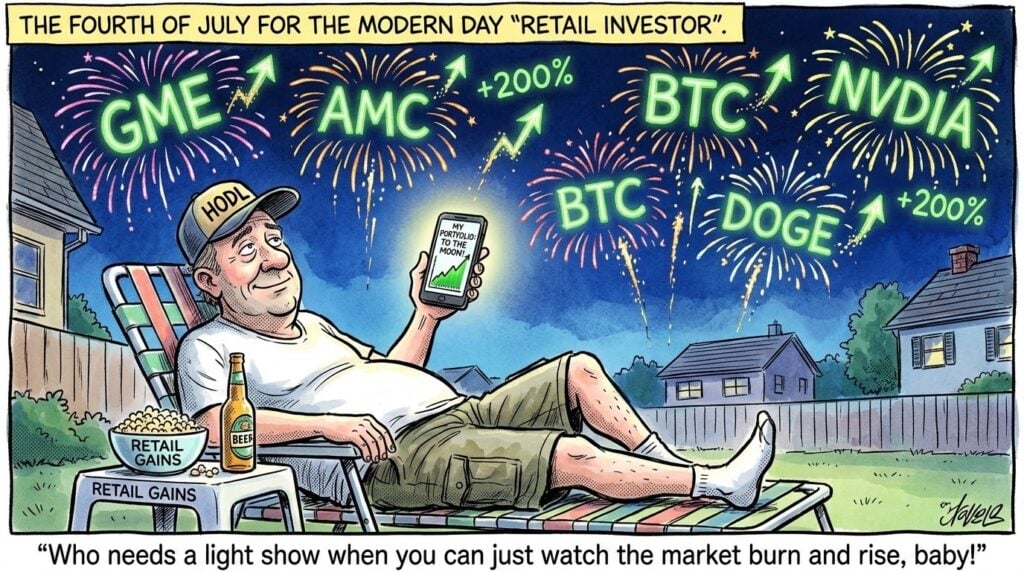
The investor who has automated contributions running does not need to make a single decision this week. The contribution schedule runs on the calendar. If it happens to fire during one of the historically stronger weeks of the year, that is a coincidence, not a strategy. It works the same way in historically weaker weeks.
The investor sitting on uninvested cash faces a different question, and it is not “should I buy before the holiday?” The right question is why the cash is sitting there in the first place. “I assumed things would get a lot worse before they got better and I would have plenty of time to buy,” one reader wrote to finance blogger Ben Carlson at A Wealth of Common Sense. Markets recovered before the entry point arrived. The seasonal pattern did not cause the problem. The waiting caused the problem.
This is where the historical record is clearest. Investors who sell after bad news and buy after good news consistently underperform the funds they hold. “Far more money has been lost by investors preparing for corrections, or trying to anticipate corrections, than has been lost in corrections themselves,” Peter Lynch said in 1995. The July 4th holiday pattern is one of several seasonal hooks investors use to justify a decision they were already inclined to make. The data supports the holiday as a curiosity. It does not support it as a catalyst.
For a broader look at how to stay invested through volatile markets, including how to size equities for stress and automate contributions, that framework applies here as much as in any other week.
The data does not support the July 4th holiday as a buying catalyst. It supports it as a reminder that doing nothing is a legitimate investment strategy.
Stock Market Performance on July 4th: The Contradictory View
The data on the holiday week is modestly positive. The data on the market’s current valuation is more complicated.
At a forward P/E of 20.1x on the S&P 500, equities are offering less premium over Treasury yields than their historical average, according to FactSet. The Shiller CAPE, a longer-run valuation metric, remains elevated by historical standards. Neither reading means the market is about to fall. Both readings mean that the expected return from new money entering the market today is lower than it was when the same index traded at 15x or 16x forward earnings. July is historically one of the strongest months of the year for equities — a broader seasonal pattern covered in our analysis of the best months to invest — but seasonal strength and valuation compression can coexist, and one does not cancel the other.
- For the pre-retiree within five years of a retirement date, trading during Independence Day is the wrong frame entirely. The relevant question is whether the equity portion of the portfolio is sized to survive a 20% to 30% correction in the next 36 months without forcing liquidation at the worst possible time to fund living expenses. That question has the same answer whether the market gains 0.93% this week or loses 0.93%. The holiday pattern is noise. The sequence-of-returns risk is structural.
- For the long-horizon investor with more than a decade to a liquidity event, monitoring stock market performance on July 4th is not a question worth asking. The market is open Monday. Your contribution schedule is running. Use the long weekend for its actual purpose.
Seasonal optimism and valuation compression can coexist. One does not cancel the other. The holiday pattern applies to the week. Sequence-of-returns risk applies to the decade.
For educational purposes only. Not financial advice.
Frequently Asked Questions
Is the stock market open on July 4, 2026?
No. July 4 falls on a Saturday in 2026, so the market observed the holiday on Friday, July 3. The NYSE, Nasdaq, and bond markets are all closed on July 3. Both markets also closed early on Thursday, July 2 — stocks at 1 p.m. ET, bonds at 2 p.m. ET. Regular trading resumes Monday, July 6 at 9:30 a.m. ET.
Does the stock market usually go up during the week of July 4th?
Historically, yes. Since 1969, the S&P 500 has averaged a gain of 0.32% during the July 4th holiday week, with positive returns 60% of the time. In years when the market was already up more than 10% in the first half, that average climbs to 0.93% with positive returns 79% of the time. Analysts note the pattern is difficult to separate from the turn-of-month effect and is inconsistent across subperiods.
Should I buy stocks before the July 4th holiday?
The historical data shows a modest positive bias in the week surrounding July 4th, but it is not strong or consistent enough to serve as a reliable trading signal. For long-term investors, the more relevant question is whether scheduled contributions are running automatically. The investor who adjusts contribution timing to capture a 0.32% average gain typically captures less of it than the one who ignores the calendar entirely.
What sectors perform best during the July 4th week?
Technology has historically been among the strongest performers during the July 4th holiday week, with large-cap software and internet companies appearing most consistently in the top performers list over the past decade. Consumer discretionary and travel-related companies also benefit from the surge in Independence Day spending, which totaled an estimated $15.5 billion across all categories in 2025.