
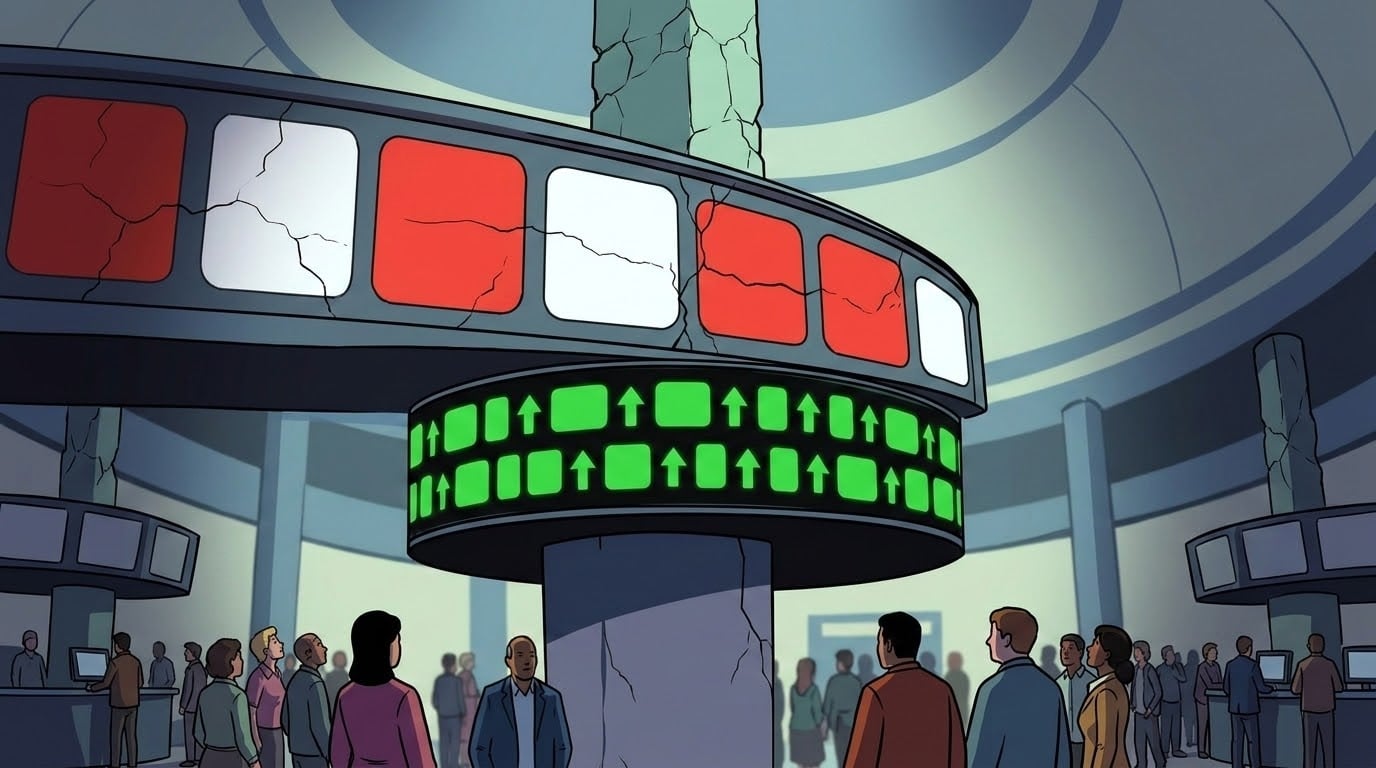

For the first time in eight months, the average stock in the S&P 500 is beating the index itself. That’s what an equal-weight rally means. Instead of a handful of trillion-dollar companies dragging the whole market higher, the other 493 stocks are pulling their weight again. What does this mean? It means the small-cap stock rotation is back.
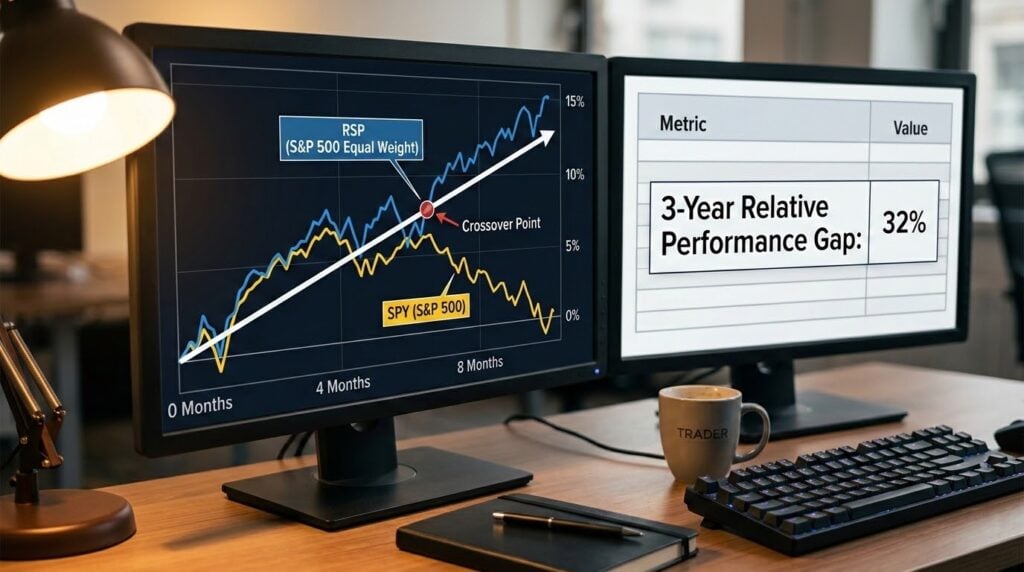
The setup coming into this year was extreme. Over the past three years, the market-cap-weighted S&P 500 beat its equal-weight counterpart by roughly 32 percent, the widest three-year gap on record since 1971, narrowly exceeding the gap that preceded the dot-com collapse. The equal-weight index has now put together its strongest start to a year relative to cap-weight since 1992, with energy, industrials, and materials leading technology year to date.
The Last Time This Gap Was This Wide, It Was 2000
History has one real precedent for a gap this size, and it isn’t subtle. After the cap-weighted S&P 500 peaked relative to equal-weight in early 2000, the equal-weight index went on to outperform for seven straight years. The mechanism was simple: the biggest companies had run out of room to keep growing into their valuations, and an “arithmetic ceiling” forces capital to look elsewhere once a handful of stocks get too large to double again. The same math applies now. Apple alone would need to add more market value than Walmart, JPMorgan, and Pfizer combined just to double from here.
That doesn’t mean this rotation plays out the same way. It means the historical pattern that would produce a multi-year reversal has shown up before, at almost this exact magnitude, and it took seven years to fully unwind the last time.
The Verdict: Trim the Concentration, Not Just the Trend
Here’s the actual call, not a hedge. If your equity exposure runs through a total stock market fund, you already own this rotation. Small caps and mid caps sit inside that fund at market weight. Adding a separate small-cap or equal-weight sleeve on top mostly adds cost for exposure you already have. Don’t do it.
If your equity exposure is concentrated in mega-cap tech, whether through choice, an employer stock plan, vested RSUs, or a legacy 401k that never got rebalanced since 2023, trim it now. Not because the rotation is guaranteed to continue for seven years like it did last time. Trim it because concentration risk you didn’t choose to take on is a problem independent of whatever this rotation does next. A rebalancing framework built for exactly this kind of concentration doesn’t require you to predict the next twelve months correctly. It just requires you to stop holding a bet you never meant to make.
Chasing performance is the real portfolio killer, as one investor on a long-running Bogleheads thread on small-cap tilting put it, and that cuts against action here too. The move isn’t chasing the rotation. It’s correcting a concentration problem that this rotation happens to be making visible right now.
For a longer read on why market-timing calls are so hard to execute even when the reasoning is sound, Burton Malkiel’s A Random Walk Down Wall Street remains the clearest case for staying invested through exactly this kind of uncertainty rather than trying to time the next leg. Worth reading before making any tactical shift, regardless of which side of this you land on.

What Would Actually Prove The Small Cap Stock Rotation Wrong
Small-cap and value companies posted a 65 percent earnings beat rate last quarter, and Morningstar strategist Dave Sekera has said current valuations leave room for a real rebound in smaller companies. That’s the bull case holding up so far.
The bear case showed up on the same forum thread that produced this article’s central data point. One Bogleheads poster tracking the move this spring noted that small caps had already dropped faster than the S&P 500 during a subsequent pullback, calling it proof that smaller companies decline harder once sentiment turns. That’s a real risk, not a footnote.
This call works until the rotation reverses inside of twelve months. If equal-weight gives back its lead before next summer, the skeptics were right and this was noise. If the gap keeps widening past where it sits now, the 2000 parallel gets stronger, not weaker.
For educational purposes only. Not financial advice.
Frequently Asked Questions
What is the small-cap stock rotation everyone is talking about?
Smaller and mid-sized companies are outperforming the mega-cap technology stocks that led the market since 2023. The clearest signal is the S&P 500 Equal Weight Index beating the standard cap-weighted S&P 500 for the first time in eight months.
Should I sell my S&P 500 index fund and buy small caps?
No, if you hold a total stock market fund. It already holds small caps at market weight. Yes to trimming mega-cap concentration, specifically if your exposure is concentrated through RSUs, employer stock, or an unbalanced 401k, regardless of how the rotation plays out.
How wide is the current valuation gap, and how does it compare to 2000?
The cap-weighted S&P 500 has outperformed the equal-weight version by roughly 32 percent over three years, the widest gap since 1971, narrowly wider than the gap that preceded the 2000 dot-com peak.
What happened the last time this gap got this wide?
The equal-weight index outperformed the cap-weighted S&P 500 for seven consecutive years starting in 2000. That is the closest historical precedent, not a guarantee.