
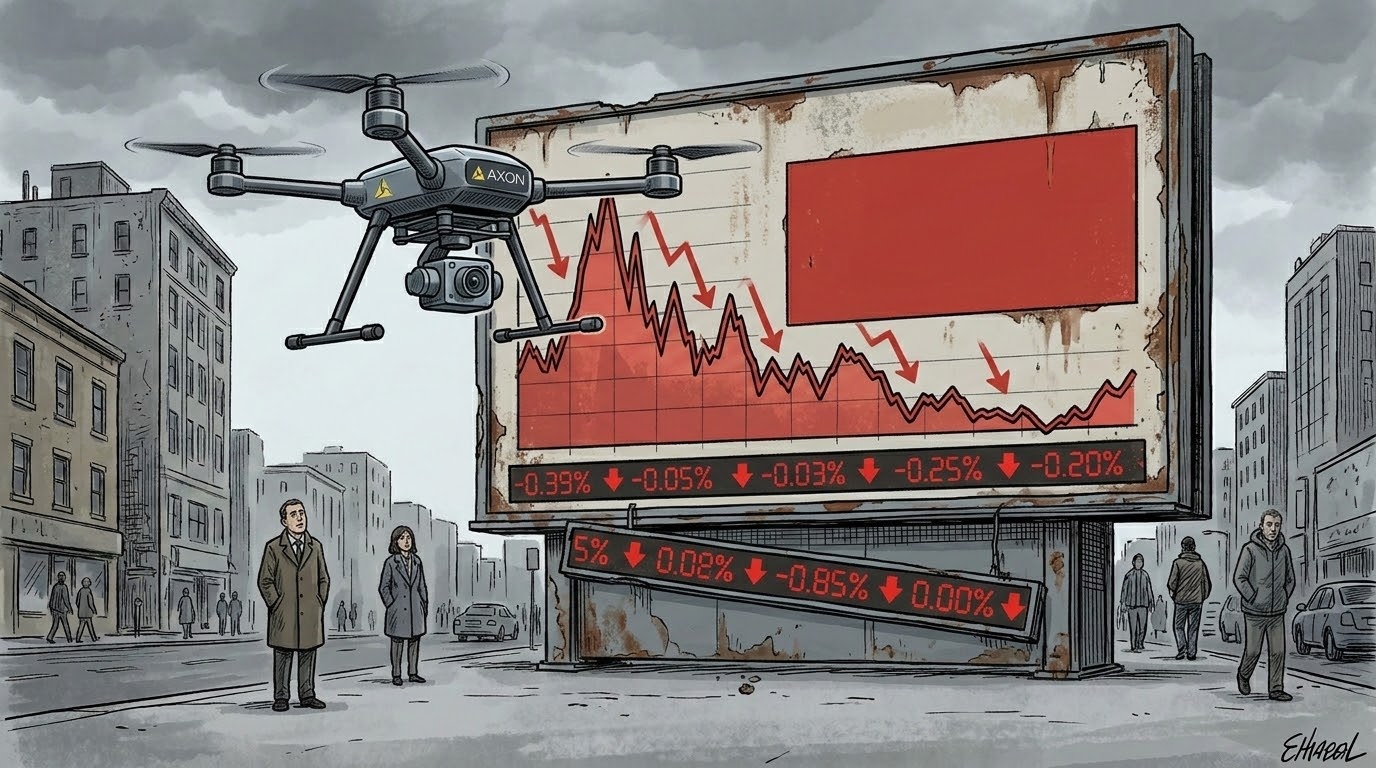

QUICK SUMMARY: Axon Enterprise posted Q1 2026 revenue of $807 million, up 34% year over year, and raised full-year guidance to 31% growth. The stock remains 58% below its August 2025 high. At a P/E of 148 with return on invested capital below the cost of capital, the thesis depends entirely on future growth, not current economics.
At $371 per share, Axon stock is one of the more confusing setups in the market right now. The company just posted its best earnings in two years. It raised guidance. Its AI bookings are growing at triple digits. The stock surged 11% after the report and is already fading again.
The business is not the problem. The price is still the question.
What Did Axon’s Q1 2026 Earnings Actually Show?
Axon Enterprise posted Q1 2026 revenue of $807.3 million, up 34% year over year, beating analyst estimates of $778.9 million. The company raised its full-year revenue growth guidance to a midpoint of 31%, up from 29%. AI Era Plan bookings grew 140% year over year. Counter-drone revenue jumped 300%, with bookings up 500%.
That counter-drone number deserves more attention than it received. Axon’s drone business is growing faster than any other segment in an environment where geopolitical risk has accelerated law enforcement and national security procurement cycles. Readers who have been tracking the Iran war’s impact on defense and energy portfolios already know this backdrop. Axon is sitting directly in that spending pipeline.
The company maintained its full-year adjusted EBITDA margin guidance of 25.5%, signaling management confidence in the earnings trajectory even as gross margin fell 150 basis points to 59.1%. Tariffs were cited as the primary driver of that compression.
Axon posted 34% revenue growth in Q1 2026 while adjusted EPS grew only 10%. That spread between top-line momentum and bottom-line delivery is the number most investors glossed over.
Why Is Axon Stock Still Down 58% From Its August 2025 Highs?
Axon’s collapse from its August 2025 high of $885.91 was not caused by a failing business. The company has beaten earnings expectations in each of its last ten quarters, averaging roughly 12% in post-earnings gains. The problem was category assignment.
As Motley Fool’s earnings coverage noted, the pullback reflects “a rough 2026 for Axon, which has gotten swept up in a broader sell-off in software stocks despite a strong earnings report in February.” That diagnosis is accurate. The sell-off was a SaaS sector sentiment event. Axon was collateral damage.
The market treated Axon as a software company. It is not, at least not primarily. Its core products, TASERs, body cameras, drones, and virtual reality training systems, form the foundation of every software subscription and AI package that follows. Agencies that buy into the Axon ecosystem are making a five-plus-year infrastructure commitment. They are not signing up for a subscription that they can cancel next quarter.
Axon’s hardware-first flywheel insulates it from AI disruption in ways pure software companies cannot claim. The market has not fully corrected for that distinction.
Does the P/E of 148 Justify Buying Axon Stock Right Now?

The business case for Axon stock is not hard to make. The valuation case requires more precision.
At $371 per share, Axon trades at a P/E of 148. Adjusting for its revenue growth rate of 34%, the PEG ratio sits near 4.4. A PEG above 2.0 typically signals that investors are paying for sustained high performance without a stumble. At 4.4, the entry price does not just require growth. It requires perfection.
There is a harder data point beneath the headlines. Axon’s return on invested capital currently sits at 1.87%, below its cost of capital of 12.63%. A company earning returns below its cost of capital is not automatically in trouble, but it does mean the entire investment thesis is forward-looking. The current economics do not justify the price. The projected economics do.
At a P/E of 148 with ROIC below cost of capital, the Axon investment thesis is entirely forward-looking. Current economics do not justify the price. Projected economics do. That distinction matters when sizing a position.
The insider activity compounds the question. Axon’s CEO and CFO sold more than $38.5 million in shares in Q1 2026. Executives sell for personal financial reasons unrelated to the company’s outlook. But in a valuation-sensitive entry decision, that number earns a paragraph rather than a footnote.
Investors who want a disciplined framework for evaluating high-multiple growth stocks like Axon stock will find the core principles in Burton Malkiel’s work on paying the right price for a business rather than chasing the narrative. It remains one of the most useful educational resources for understanding when premium valuations are justified and when they are not.


What Do the Counter-Drone Numbers Signal for Long-Term Investors?
Counter-drone revenue up 300% in a single quarter is a procurement signal, not a product metric. The geopolitical environment TC has covered since the Iran war escalation has accelerated defense and public safety spending cycles at the federal and local levels. Axon is the market leader in law enforcement technology infrastructure, and that positioning matters when government contracts are being written.
Revenue growth driven by structural procurement cycles is more durable than growth driven by software upsells. That changes the quality of the growth embedded in Axon’s multiple, even if it does not change the math on the multiple itself.
Counter-drone bookings up 500% in a single quarter is not a product metric. It is a procurement signal driven by structural geopolitical demand, and that makes Axon’s growth more durable than the category sell-off implied.
Should You Buy Axon Stock Now, or Wait for a Better Entry?
The honest answer is that reasonable investors can look at the same data and reach different conclusions. Here is how to separate them.
- If you are in the accumulation phase with a 10-plus-year horizon and Axon stock would represent under 3% of your portfolio, the business quality test clears. The earnings track record, the hardware flywheel, and the drone-driven tailwind give the thesis legitimate structural support. Buy systematically and stop watching the daily price action.
- If you are within five years of retirement, or if Axon would sit above 5% of your portfolio, the valuation framework governs. A P/E of 148 with gross margin under tariff pressure does not offer a cushion against being wrong. The investor who buys a great business at a price that requires sustained perfection and then cannot hold through a further 30% drawdown has made an optimistic decision, not a disciplined one. A smaller initial position or a lower target entry price is the structurally correct move.
The right move on Axon stock depends on where you are in your financial timeline, not how much you believe in the product.
The 52-week low is $339.01. That level, if tested, would push the margin of safety into more defensible territory for valuation-conscious investors. It is worth knowing before you decide.
For educational purposes only. Not financial advice.
Frequently Asked Questions
Why is Axon stock down so much from its highs?
Axon was caught in a broad software sector sell-off driven by AI disruption fears in 2025 and early 2026. The decline reflected a category misread: Axon’s hardware-first model insulates it from AI competition in ways pure software companies cannot claim.
Is Axon stock a buy after its Q1 2026 earnings beat?
The business quality test clears. At a P/E of 148, the valuation requires sustained high growth to justify the entry price. Long-horizon investors with small position sizes have a reasonable case. Investors near retirement or sizing a concentrated position should wait for a better entry or size the position conservatively.
What is Axon’s ROIC, and why does it matter for investors?
Axon’s return on invested capital currently sits at 1.87%, below its cost of capital of 12.63%. This means current operations do not justify the stock price on present economics alone. The thesis is entirely forward-looking. Investors are paying for projected growth, not current returns. That distinction matters significantly when sizing a position.
What does Axon’s counter-drone revenue growth mean for investors?
Counter-drone revenue grew 300% year over year in Q1 2026, with bookings up 500%. Elevated geopolitical risk is accelerating law enforcement and national security procurement cycles. That is a structural tailwind supporting the long-term growth thesis.
What is the biggest risk of buying Axon stock right now?
At a P/E of 148, the investment thesis depends entirely on future growth, not current economics. Axon’s return on invested capital currently sits below its cost of capital. If revenue growth decelerates, the multiple compression would be significant.