


Gold hit a record above $5,100 an ounce in January. Silver hit an all-time high too. The S&P 500 and Nasdaq just posted their best quarter since 2020. U.S. home-price indexes are still sitting near record levels.
Bitcoin is moving the other way.
The cryptocurrency is down more than half from the all-time high it set in October 2025. It recently touched a 21-month low.
That is not how the story was supposed to go.
Bitcoin spent the last decade being pitched as digital gold. The argument was simple: if governments debase currencies, investors should want scarce assets. Gold would benefit. Bitcoin would too. For more on how gold fits into that hedge argument, see our guide to gold prices in 2026.
Right now, that trade is not working.
The key problem: Bitcoin is down while the assets it was supposed to resemble are holding up much better.
Why Is Bitcoin Falling While Every Other Hard Asset Hits a Record?
The split is hard to ignore.
Gold and silver have already hit fresh highs this year. The S&P 500 has pushed to records. U.S. home prices remain elevated even with mortgage rates still high.
Bitcoin has not joined that move.
That raises a harder question: is this just a temporary lag, or is bitcoin being repriced as something else?
For years, bitcoin traded like a hybrid asset. Sometimes it acted like a hedge. Sometimes it acted like a high-growth tech stock. Sometimes it acted like pure speculation.
That flexibility helped the bull case when everything was rising. It hurts now.
When gold is up and bitcoin is down, investors stop asking whether bitcoin is scarce. They ask whether it actually behaves like a hedge when the hedge trade matters.
What’s Actually Driving Bitcoin’s ETF Outflows?
The first pressure point is the ETF market.
U.S. spot bitcoin ETFs saw a 13-day streak of net outflows this spring. The outflow run totaled about $4.4 billion, one of the sharpest stretches since spot bitcoin ETFs launched.
That sounds ugly. But it needs context.
Bloomberg Intelligence analyst Eric Balchunas has argued that the outflows look small compared with the broader bitcoin ETF asset base. In his view, billions leaving a roughly $100 billion ETF market is not the same thing as a mass exit.
Both things can be true.
ETF outflows do not mean every institution has abandoned bitcoin. Funds can lose assets because of short-term positioning, profit-taking, tax moves, or risk reduction.
But the direction still matters.
ETF demand was one of the cleanest arguments for bitcoin’s 2025 rally. If that demand cools while gold and stocks keep climbing, bitcoin loses one of its strongest near-term supports.
ETF outflows do not kill the bitcoin thesis, but they do remove a major source of buying pressure.
Is Institutional Selling Pushing Bitcoin Down Even Worse?
The second issue is corporate demand. Strategy, the company that turned bitcoin accumulation into a corporate treasury strategy, disclosed that it sold 32 bitcoin between May 26 and May 31. The sale raised about $2.5 million and was expected to help fund preferred-stock distributions.
The sale was small. The signal was not.
Strategy still held 843,706 bitcoin as of May 31. But this was still the company’s first disclosed net reduction in years. When the market’s best-known corporate bitcoin buyer becomes even a small seller, traders notice.
Bitcoin does not need Strategy buying every week to survive. But it does rely on the belief that institutional demand keeps expanding over time.
That belief is harder to defend when the most famous corporate holder is no longer only adding.
The sale matters less because of its size and more because of what it says about institutional behavior.
Is Bitcoin Losing Speculative Capital to AI Stocks?

The third pressure point is competition. Speculative money has more places to go now. AI infrastructure stocks, mega-cap tech, and a wave of large IPOs are all fighting for the same risk capital that once flowed more naturally into bitcoin.
That matters because bitcoin is not competing only with gold. It is competing with every other story investors can buy.
In 2020 and 2021, bitcoin was one of the cleanest ways to express a high-risk, high-upside macro trade. In 2026, that trade has more rivals.
AI is the easier story for many investors right now: big spending, big earnings potential, and direct links to public companies they already know.
The S&P 500 and Nasdaq just finished their best quarter since 2020, helped by optimism around earnings and growth. Bitcoin, meanwhile, is still trying to prove that ETF demand and institutional adoption are enough to carry the next leg.
Bitcoin’s problem is not just selling pressure. It is attention pressure.
Is Bitcoin Still a Currency-Debasement Hedge?
The bull case has not disappeared as Bitcoin remains a hard-money argument. It still has a fixed supply and still attracts investors who want an asset outside the traditional banking system.
But the hedge argument is weaker than it was.
Gold is behaving more like the currency-debasement hedge investors expected. Bitcoin is behaving more like a risk asset. It has been rising with tech sentiment in good weeks and falling with it in bad ones.
That is not classic hedge behavior. It is growth-asset behavior.
There is also miner stress to watch. JPMorgan has estimated that roughly 20% of bitcoin miners are now unprofitable, with bitcoin trading below estimated production cost for several months. That kind of stress can force selling from weaker miners. It can also mark periods when the market is closer to capitulation than euphoria.
That is the optimistic view: weak holders get flushed out, ETF selling fades, and bitcoin eventually catches up.
But investors should not treat that as a guarantee.
Bitcoin can still be a long-term scarcity bet without acting like a reliable inflation hedge today.
How Much Bitcoin Should You Hold Right Now?
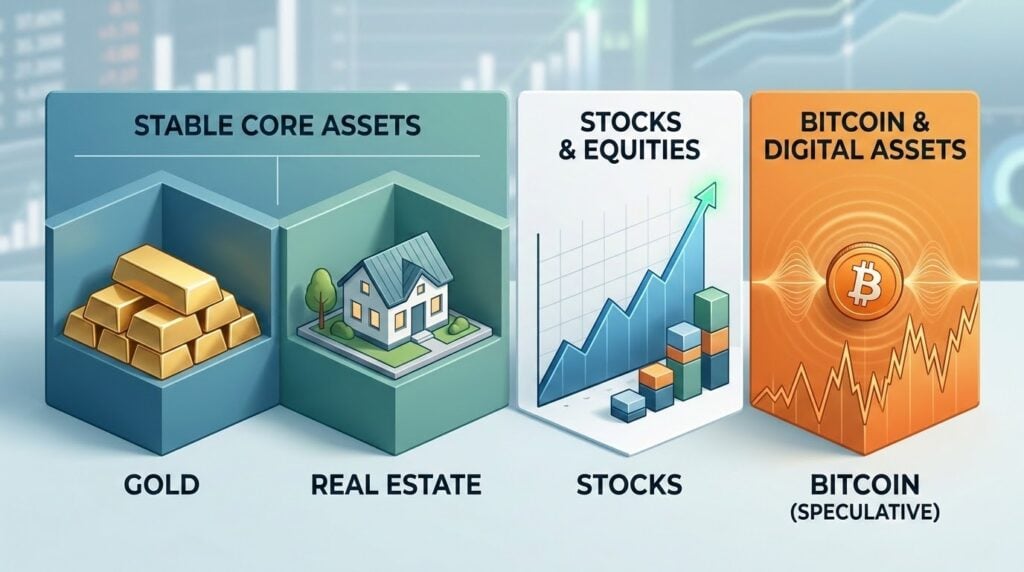
The answer depends on whether you already own it.
If you do not hold bitcoin and are looking at this as a dip to buy, be careful. Buying an asset only because everything else is up and this one asset is down is still performance chasing. It just looks contrarian.
A total market index does not need an opinion on bitcoin. If you are not already in this trade, you do not need to force one.
If you do hold bitcoin, the question is different. You do not need to panic. You need to decide what job bitcoin is supposed to do in your portfolio.
If bitcoin is a speculative sleeve, a drawdown like this is part of the deal. The position should already be sized for volatility.
If bitcoin is supposed to replace gold or real estate in your hard-asset allocation, this divergence is a warning sign. Gold is doing the hedge job. Bitcoin is not.
A cleaner approach is to treat gold as the proven inflation hedge and bitcoin as a separate, unproven bet. That means bitcoin should stay small enough to help if the bull case returns, but not large enough to damage the whole portfolio if the decoupling lasts.
For more context on how bitcoin holding periods have affected loss risk historically, see our analysis on holding bitcoin through a market correction.
Bitcoin should be sized like a volatile speculative asset, not treated as a one-for-one replacement for gold.
One practical test is the trailing 12-month correlation between bitcoin and gold. If that relationship stays broken, the divergence may not be over. If the correlation starts to rebuild, the current lag may be temporary.
That is not a perfect signal. It is just cleaner than guessing.
Will Bitcoin Catch Up to Gold and Stocks Eventually?
Maybe. But there is no clean answer yet.
Bitcoin has recovered from brutal drawdowns before. That history is part of the reason long-term holders are not rushing for the exits.
But markets also change. An asset can lose a narrative and never fully regain it.
If institutional capital decides bitcoin is a risk asset, not a hedge, then waiting for it to reconnect with gold may mean waiting for something that is not coming back.
That is the uncomfortable part.
Bitcoin is not broken. But it is losing the argument right now against gold, stocks, and hard assets.
Investors do not need to settle that debate today. They do need to be honest about what they own.
This section contains an affiliate link. TheCapitalist.com may earn a commission from qualifying purchases.
For readers who want the clearest version of bitcoin’s hard-money argument, Saifedean Ammous’s The Bitcoin Standard remains one of the most direct explanations of the monetary case behind the cryptocurrency. Read it as education and not as proof that current price action will recover.
For educational purposes only. Not financial advice. Bitcoin and other cryptocurrencies carry substantial volatility and risk of loss. Past performance does not indicate future results.
Frequently Asked Questions
Is bitcoin still a hedge against inflation?
Not clearly. Over the past year, bitcoin has tracked risk-asset sentiment more than inflation expectations. Gold has acted more like the hedge investors expected. Bitcoin has not.
Why did bitcoin ETFs see outflows if institutions still believe in it?
ETF outflows reflect near-term positioning, not a final verdict on bitcoin. Investors may be reducing risk, taking profits, or shifting capital elsewhere. The concern is not that outflows exist. It is that they are happening while gold and stocks are holding up better.
Should I sell bitcoin if I already own it?
That depends on why you bought it. If bitcoin is a speculative sleeve, this kind of drawdown is part of the risk. If you bought it as a substitute for gold or hard assets, the current divergence shows that substitution is not working right now.
Will bitcoin catch up to gold and stocks eventually?
It might, but there is no clean signal yet. Bitcoin has recovered from major drawdowns before. It has also never faced this exact mix of ETF outflows, corporate selling, miner stress, and competition from AI-driven speculation.