
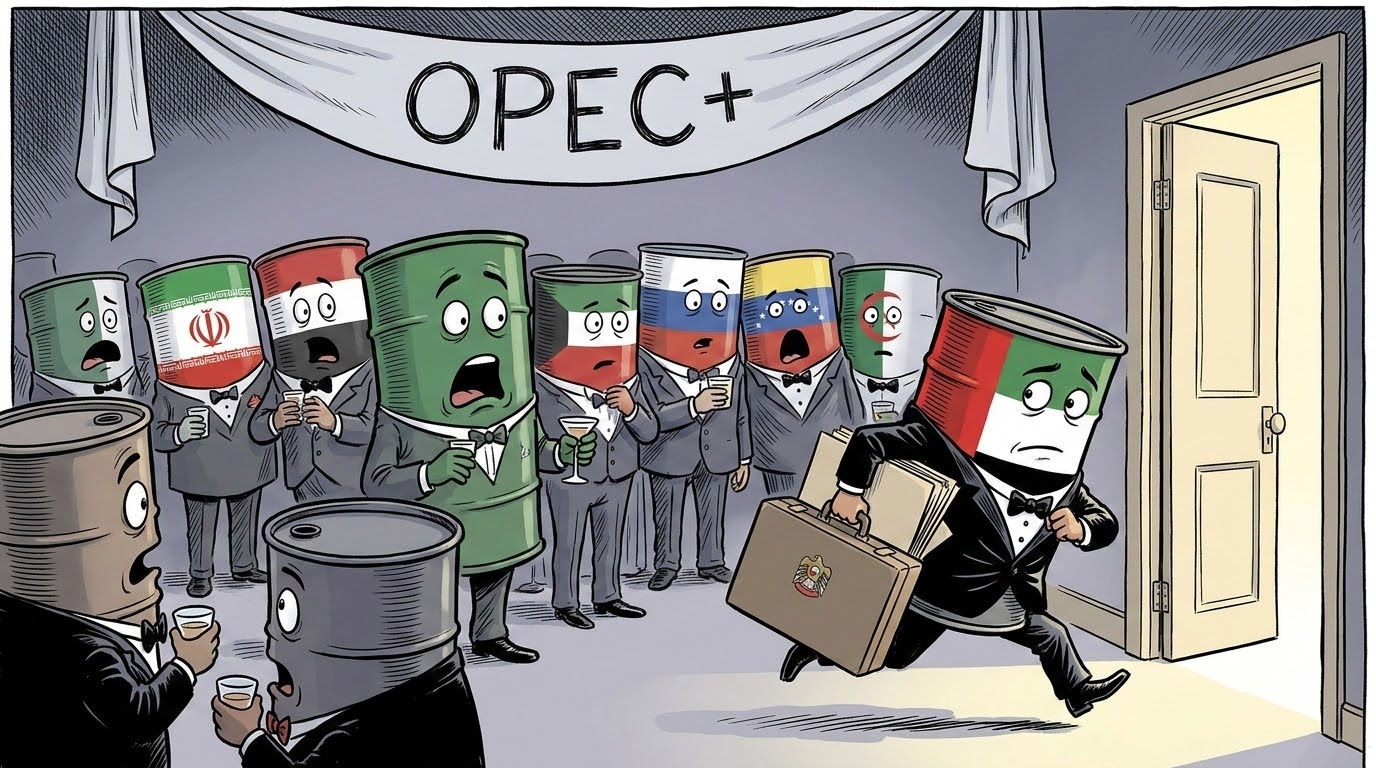

QUICK SUMMARY: The United Arab Emirates exited the Organization of the Petroleum Exporting Countries (OPEC) and OPEC+ on May 1, 2026, and Abu Dhabi National Oil Company (ADNOC) opened ship-to-ship oil transfers off Fujairah, bypassing the Strait of Hormuz. For U.S. operators with meaningful diesel exposure, the UAE leaving OPEC is an input-cost regime change, not a headline event. Refresh the cost model, harden surcharge architecture, and pre-set bear-case decision thresholds now.
The United Arab Emirates (UAE) walked out of the Organization of the Petroleum Exporting Countries (OPEC) and its broader OPEC+ alliance effective May 1, 2026. That same week, Abu Dhabi National Oil Company (ADNOC) told term buyers they could pick up cargoes via ship-to-ship transfer off the port of Fujairah, outside the Strait of Hormuz. Two announcements, one operator-side message: the supplier landscape just fragmented, and one Gulf producer is offering an alternative route that doesn’t depend on Iranian permission to function.
The intuitive read on this news is that a weaker cartel means cheaper oil and cheaper fuel. That read is wrong, or at least premature. For investors trading energy equities, the UAE leaving OPEC is a sector-rotation story. For the operators reading this site, it’s something more direct. If your business runs on diesel, jet fuel, refined products, or anything downstream of crude, the UAE leaving OPEC is an input-cost regime change. The question on the table is whether your operating plan was built for the regime that just ended or the one that just started.
How Does the UAE Leaving OPEC Actually Affect American Businesses?
The hard numbers first. The UAE held production capacity of roughly 4.8 million barrels per day, against an OPEC quota that capped it at 3.2 million. That gap was the catalyst. The cartel’s logic of restraint to keep prices firm only works if every member abides by it. The UAE decided the math no longer favored that trade.
OPEC loses about 0.85 million barrels per day of spare capacity contribution from the exit, according to International Energy Agency (IEA) estimates cited by Axios. Rystad Energy summarized the structural read in a research note this week: a structurally weaker OPEC, with less spare capacity concentrated within the group, will find it increasingly difficult to calibrate supply and stabilize prices.
Less calibration means more volatility, and operators built on smooth diesel curves are now planning against a regime that no longer exists.
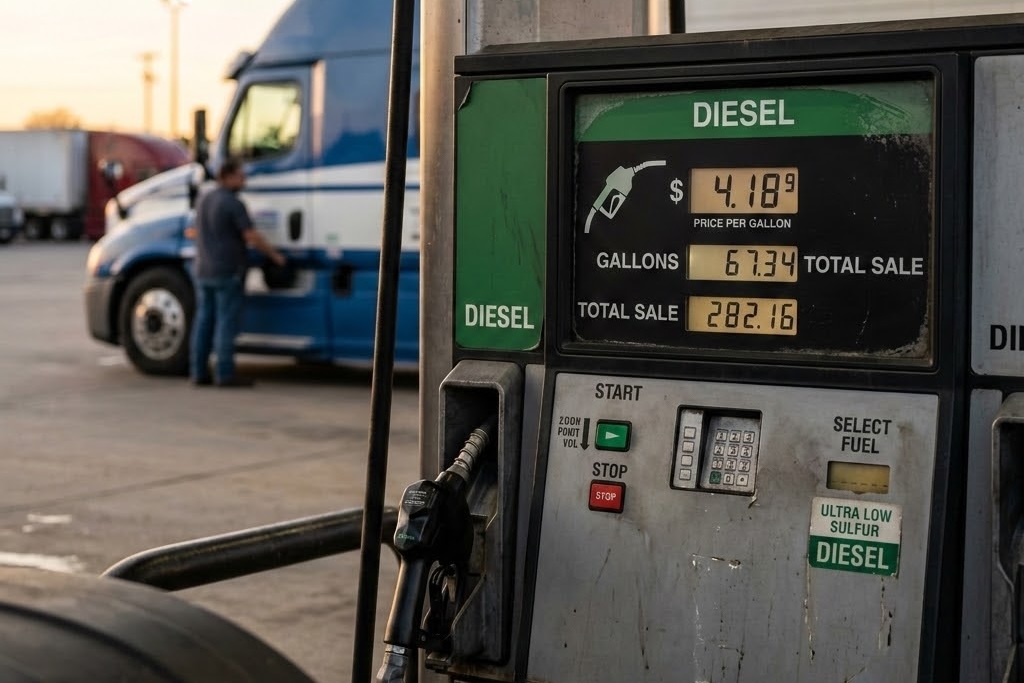
The 2026 numbers underline the urgency. The National Federation of Independent Business (NFIB) reported earlier this year that more than 80% of small businesses see energy as a “significant” cost factor in their operations, and 42% had seen costs grow “substantially” in the last three years. The retail diesel average hit $4.176 per gallon, the highest since August 2, 2022. Trucking industry analysis from earlier this year estimated that fuel expenses now represent 30 to 40% of total operating costs for many U.S. fleets.
The voices from the field tell the same story without the macro framing. Nick Friedman, co-founder of College Hunks Hauling Junk and Moving, told CNBC this month that historically, fuel had taken 3 to 5 percent of revenue as an expense line item, but had doubled to 6 to 10 percent since the war started. A delivery business owner in Marketplace’s coverage put it more concretely: since the Iran war began, fuel costs had risen, on average, $5,000 a week. A coffee truck operator in North Carolina described the trade-off in the bluntest terms available: “I thought, I need to do it by myself because it’s either pay for gas or pay for labor.”
This is what an input-cost regime change looks like at street level. It is not abstract. It is a payroll decision against a fuel bill, made every week, by people who don’t have the spare cycles to read OPEC press releases.
Why Is This an Input-Cost Story, Not an Oil-Price Story?
Most coverage of the UAE leaving OPEC will frame it as an oil-price story. That framing misses what matters for operators. The price of West Texas Intermediate (WTI) crude on any given day is the wrong unit of analysis. The right unit is the standard deviation of your weekly diesel cost as a percentage of revenue.
A fragmenting cartel doesn’t usually mean lower prices. It means less predictable prices.
A coordinated supplier group, even one operators dislike, calibrates output to defend a price band. Once that coordination breaks, the price band widens in both directions. Operators who survived 2022 inflation by hoping the spike was transitory now know what happens to a business that bets on mean reversion when the mean has shifted.
The UAE positioning Fujairah as an alternative export route is the operator-relevant news inside the headline. Bloomberg reported on April 28 that ADNOC informed term customers that grades including Upper Zakum were available for ship-to-ship transfer off Fujairah, with cargoes mainly available for May loading. Those shipments are coming out of storage filled before the war began, transferred onto tankers that never enter the Strait of Hormuz. For Asian buyers, China, India, Japan, South Korea, who took 69% of all Strait of Hormuz crude flows in 2024, that’s a real alternative. For U.S. operators reading this article, the timeline from “Fujairah scales” to “your fuel surcharge moderates” is 60 to 120 days at the earliest, and only if the war winds down on a manageable schedule.
The structural read: a fragmented cartel, plus an alternative export route that bypasses the most contested chokepoint in global energy, plus a closed Strait of Hormuz, equals sustained price volatility for the rest of 2026. Not a return to 2018 stability. The operators who plan against that reality survive. The operators who plan against the bull case lose ground every quarter the bull case fails to arrive.
Will the Fujairah Reroute Actually Lower U.S. Diesel Prices?
The most important second-order read on the UAE leaving OPEC is what it means for global supplier dynamics over the next 24 months. The UAE is signaling, with both the OPEC exit and the Fujairah re-routing, that it intends to maximize production and capture market share in a world where peak oil demand is closer than the cartel’s official forecasts admit. Saudi Arabia wants quotas and high prices long-term. The UAE wants throughput now.
Dubai is changing the game. The reach of the new game is not universal.
That divergence creates a structural alternative supplier, but the alternative is geographically constrained. The Habshan-Fujairah pipeline runs at 1.5 to 1.8 million barrels per day of capacity. Last year the UAE exported 1.7 million barrels per day via that route. The capacity ceiling is close. Against the 20 million barrels per day that normally transits the Strait of Hormuz, Fujairah is not a replacement. It is a partial bypass that reaches Asian refiners faster than American ones.
The honest implication for U.S. operators: the supply side is unlocking, slowly, and the price relief reaches the East Coast diesel market last. The structural advantage of the UAE leaving OPEC accrues primarily to refiners and buyers who can take physical delivery in the Gulf of Oman. American trucking fleets, agricultural operators, and food-service businesses are downstream of two more pricing layers, the global crude benchmark and the domestic refined-product distribution chain, before the supply news reaches the fuel card.
What this means in practice: don’t plan against a Q3 price relief that may not come. Plan against the price you’re paying today, sustained.
What Does the UAE Leaving OPEC Mean for Energy Investors?
For the readers running a business and managing an investment portfolio in parallel, the UAE leaving OPEC reads differently from each side of the desk.
On the operator side, the message is defensive: harden the cost structure, refresh the model, build the surcharge architecture.
On the portfolio side, the war premium has already priced in. The trade is sub-sector selection, not direction.
Energy equities have already absorbed much of the war premium since February. Exxon Mobil and Chevron both report May 1, and the read-through from those calls will say more about refining margins than about crude direction. The cleaner second-derivative trades are sub-sector specific: refiners with Gulf-of-Oman-routed feedstock access, oil services companies positioned for sustained capital expenditure in the Middle East, and shipping logistics names with route flexibility outside Hormuz.
Geopolitical commodity exposure is the highest-tail-risk asset class on the menu. A ceasefire headline can compress war-premium pricing inside a single trading session. Position sizing matters more than direction. This is not a back-up-the-truck environment in the energy sector. It is a be-selective one.
What Should Fuel-Heavy Businesses Do This Quarter?
The synthesis the field reporting and institutional analysis converge on, translated into operator-grade actions:
1. Refresh the model. Run a three-scenario operating profit and loss (P&L) statement: bear case ($5.50 diesel sustained 18 months), base case ($4.30), bull case ($3.40 by Q4). The base case is the planning case. The bull case is the upside, not the assumption.
2. Stress-test gross margin. At base case, calculate gross margin after current pass-through. If the answer is below 18%, the pricing model is broken regardless of what oil does next. The cost shift has already happened. The pricing response hasn’t.
3. Build the surcharge architecture. Not a one-time fee. A contractual mechanism tied to a published index, the U.S. Department of Energy (DOE) retail diesel average, U.S. Energy Information Administration (EIA) weekly numbers, or a regional benchmark, reset quarterly, communicated to customers as policy rather than as an emergency surprise. As one shipping analyst told CNBC this month, when small business owners see the fee on their invoice it feels less like a shock absorber and more like a direct financial impact they have no control over. Architecture turns the surprise into a system.
4. Sequence the bear case decisions before they arrive. If layoffs, capital expenditure deferral, or route consolidation are required at $5.50 sustained, decide the trigger threshold now, in writing, before stress arrives. Operators who decide under stress decide badly. Operators who pre-commit to thresholds execute cleanly.
5. Diversify the supplier base. If your business buys fuel from one supplier under one contract structure, you are running the small-business version of the OPEC dependency the UAE just exited. Mirror the move. Two suppliers minimum, with right-of-first-refusal language, indexed pricing, and quarterly review.
When Not to React
Not every reader of this article should reorganize their cost structure this month.
The honest operator filter:
- If fuel is less than 5% of revenue, watch and absorb. The UAE leaving OPEC is real news, but not your news.
- If fuel is 5 to 15% of revenue and your contracts allow surcharges, refresh the model and harden the surcharge architecture. No headcount change yet.
- If fuel exceeds 15% of revenue, or surcharges are contractually blocked, active hedging and contract renegotiation are required, and the bear-case decisions need their thresholds set this quarter.
- If fuel volatility on a rolling 90-day basis exceeds 3% of revenue, the line item is now a strategic risk, not an operating risk, regardless of the percentage threshold above.
Some businesses should be modeling. Some should be hedging. A small number should be considering a structural change. The UAE leaving OPEC is the signal to figure out which one applies to you, not the signal to react identically across categories.
For operators who want to go deeper on energy markets, supply chain economics, and managing a business through commodity volatility, three resources frame the territory this article covers:
- The Prize: The Epic Quest for Oil, Money & Power by Daniel Yergin. The foundational history of how oil supply, geopolitics, and cartel dynamics interact. Pulitzer Prize winner, and the reference text on OPEC’s structural role and the historical precedents for cartel fragmentation.
- The New Map: Energy, Climate, and the Clash of Nations by Daniel Yergin. Yergin’s 2020 follow-up covering the contemporary energy transition, Middle East realignment, and the strategic logic of producers like the UAE positioning for peak demand. Directly relevant to the Fujairah reroute and the UAE’s long-game thinking.
- The Profit Zone: How Strategic Business Design Will Lead You to Tomorrow’s Profits by Adrian Slywotzky. The operator-side complement. Frameworks for how businesses restructure their cost and value architecture when input-cost regimes shift. Less famous than the Yergin titles, more practical for a reader who needs to act on what they just read.


These are educational resources, not financial advice. TheCapitalist.com may earn a commission from purchases made through these links.
Frequently Asked Questions:
Will the UAE leaving OPEC mean diesel prices will drop?
Not in the near term. The Strait of Hormuz remains effectively closed to most Gulf oil traffic. The UAE’s alternative route via the port of Fujairah has roughly 1.7 to 1.8 million barrels per day of capacity, against the approximately 20 million barrels per day that normally transits the Strait of Hormuz. The supply alternative is real but limited, and the price relief reaches U.S. operators last in the global distribution chain.
When will U.S. diesel prices stabilize after the UAE OPEC exit?
Not before Q3 2026 at the earliest, and only if the Strait of Hormuz reopens and Fujairah throughput scales above current 1.7 million barrel per day capacity. The U.S. East Coast diesel market is structurally last in the global refined-product distribution chain, so any price relief reaches American operators 60 to 120 days after Asian refiners. Operators who plan against earlier relief are planning against a scenario that has not yet been earned.
Should my business start hedging fuel costs with futures?
Only if fuel exceeds 15% of revenue, or if contractually-blocked surcharges leave the business fully absorbing cost increases. Below those thresholds, surcharge architecture and three-scenario planning are higher-leverage moves than a futures hedge that requires expertise most small business operators don’t have in-house. The wrong hedge at the wrong size can do more damage than the underlying volatility.
What is the difference between OPEC and OPEC+?
OPEC is the original cartel of oil-producing countries founded in 1960, with 11 members remaining after the UAE exit on May 1, 2026. OPEC+ added Russia, Kazakhstan, Mexico, and several others starting in 2016, bringing combined output to roughly 41% of global supply. The UAE has exited both. Russia announced this week that it will remain in OPEC+ and welcomed the UAE’s intention to take a “responsible” role in global energy markets, which is diplomatic phrasing for a meaningful structural realignment.
Is this a buy signal for U.S. energy stocks?
Most energy equities have already priced in significant war-premium pricing since the February escalation. The cleaner read is sub-sector specific: refiners and Gulf-of-Oman logistics over diversified majors. Position size accordingly. This is not a back-up-the-truck environment in the energy sector. It is a be-selective one. Geopolitical exposure carries tail risk that requires smaller position sizing than equivalent positions in less politically driven sectors.